
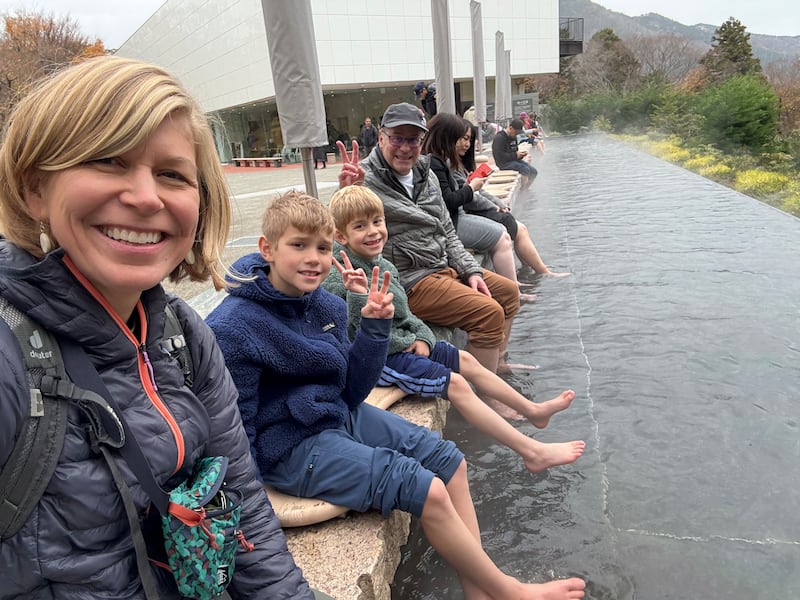
 Left to right: Sara Dykstra, Ben Cohn, Ari Cohn and Steve Cohn enjoy the outside foot baths at the Hakone Open Air Museum in Hakone, Japan. “We averaged 15-18,000 steps per day,” said Sara. (Photo by Sara Dykstra)
When Sara Dykstra pondered a milestone birthday on the horizon, she came up with a big ask.
“For my 50th birthday, I want to go on a big trip with the kids,” she said.
Her husband, Steve Cohn, saw that one coming. But there was a twist.
“And I don’t want to be the one to plan it,” she added.
Sara and Steve had a dream of traveling for a full year. But that wasn’t in the cards this year, so the couple settled on a family visit to Japan.
Japan is a great destination. But because Steve had lived there a year, he had a leg up on planning out the details.
Together, the couple developed a few ground rules to accommodate the kids. That included a strict “carry on only” rule, since they were taking trains all over Japan.
Sara purchased the family’s two-week train passes directly from Japan Rail.
“The advantage was that we could get pre-assigned seats in advance,” she said.
One digital companion that worked well in Japan was Google Maps.
“Google Maps was great,” said Sara. “We could even look up exactly which platform we needed for each train.”
The other rule was to stay at least two nights in each stop.
“Nobody wants to pack and unpack every day, especially with kids,” said Sara.
“Steve and I traveled quite a bit before the kids came along,” said Sara. “So one of the coolest things on a trip like this is to see it through their eyes, including the language and the cultural exposure. It’s very fulfilling as a parent.”
Sara, Steve and the kids flew Hawaiian Airlines across the Pacific from Seattle, arriving just before dinner. Since they were traveling by train, most of the hotels they booked were close to the station.
On arrival in Tokyo, the family caught the train in to Tokyo’s main train station. The Hotel Monte Hermana was just two blocks from the station. One interesting amenity at many hotels: Pajamas are provided in the rooms!
By the time they got to the train station, it was dinner time. As the family walked off the train, they stepped in to a giant underground food court.
It was the first of several foodie adventures, called “Tokyo Station Ramen.”
“It’s funny,” said Sara. “My kids are pretty adventurous eaters. I’m the one who’s picky since I’m a vegetarian.”
Eating their way through Japan became a theme for the family’s tour. “My kids love sushi and ramen,” said Sara. “The food was all delicious.”
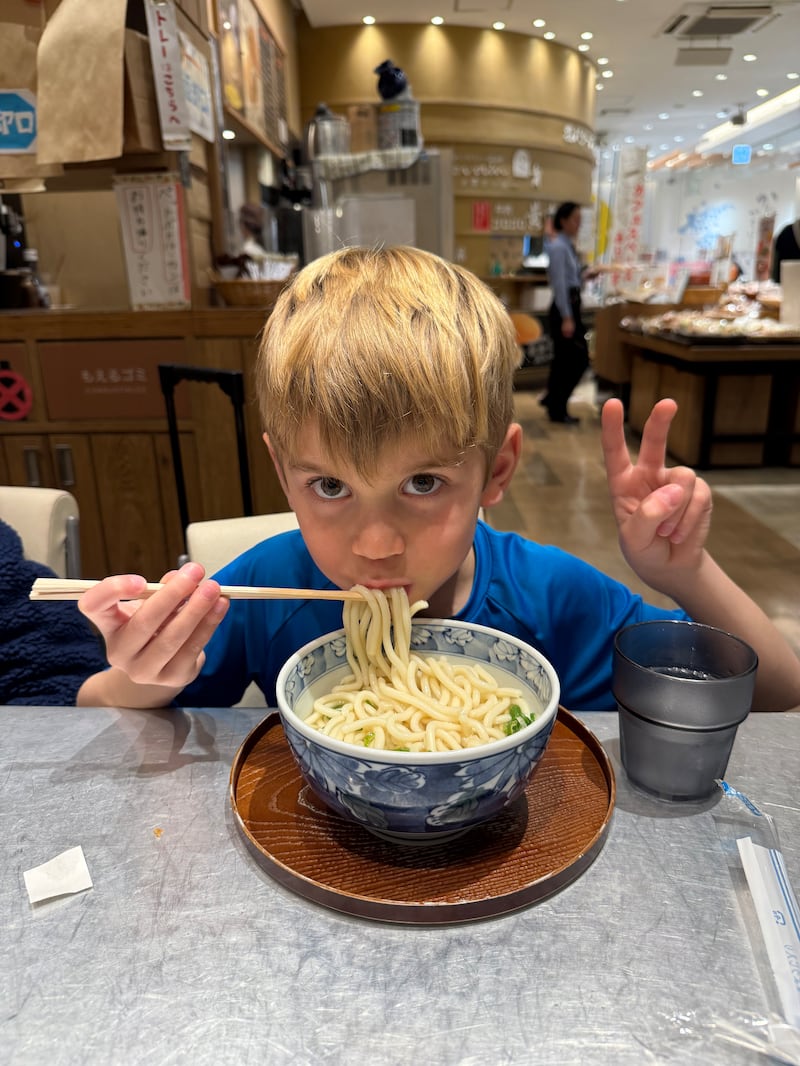 Ari Cohn enjoys a bowl of udon during a family vacation to Japan. (Photo by Sara Dykstra)
Beginning the next morning, the family got outfitted for the day’s activities.
“We’d get some breakfast, pack our water bottles, grab an extra layer and go for adventures,” said Sara.
The extra layers were important because they traveled in November, to take advantage of the short school week around Thanksgiving. So the weather was crisp and cool.
Since Sara works for the Anchorage School District, she pondered the wisdom of pulling the kids out of school for a trip.
“But the experience they got made up for what they lost in school,” she said.
The kids are in first and fourth grade this year.
After a couple of days in Tokyo, the family boarded the train and headed to Kyoto, where they spent four nights.
One quirky feature of the two-week rail pass was the tiny paper receipts provided at the train station.
“I became the keeper of the passes,” said Sara. Before boarding a train, she carefully unzipped the plastic bag and handed out the passes. Once on board, she collected them and zipped them up for safekeeping.
“Kyoto was amazing,” she said. “Our hotel, the Hiyori Stay, had a kitchen, bunk beds and a Western-style breakfast.”
Throughout their journey, the family opted for larger family-style hotel rooms so there was a little more room to move. In Kyoto, the room was about $300 per night.
“The dollar is strong in Japan,” said Sara. “Dinner for the four of us cost between $60 and $70.”
“We walked around all day and ate our way through the country,” said Sara. “The food was all delicious — even at the 7-Eleven store. But even after five days of eating all the time — we all felt very healthy!”
Sara and Steve tried not to overdo the museum component in Japan. Still, there was a samurai museum in Kyoto and quite a few temples to explore.
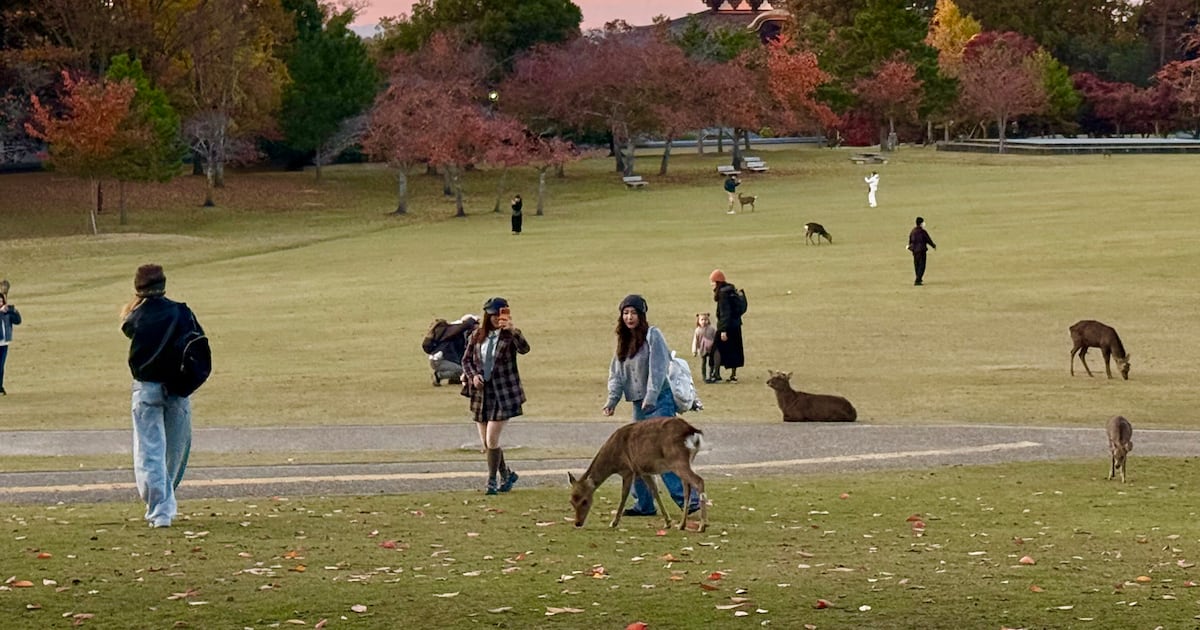
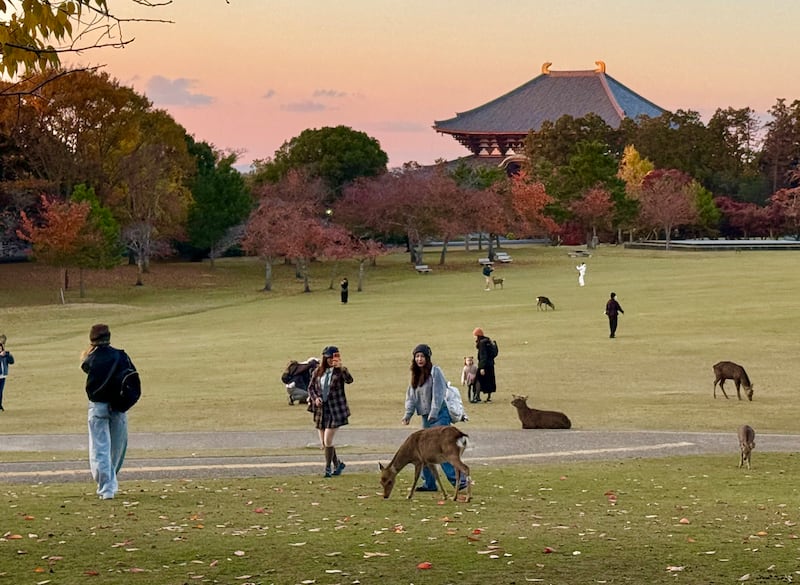 Free roaming deer in Nara Park in Nara, Japan. Nara once was the capital of Japan in the 8th century C.E. A city of extraordinary cultural significance in Japan, it is a UNESCO World Heritage Site. There are more than 1,200 deer that roam the city. Visitors can purchase special rice crackers for the deer. (Photo courtesy Sara Dykstra)
One of the side trips from Kyoto was a journey to Nara, which once was the capital of Japan during the 8th century C.E. Nara is a cultural center for Japan and especially for the region around Kyoto. There are eight major historic temples and shrines in the city. The city is a UNESCO World Heritage Site.
One of the most interesting features in Nara is the abundance of free-roaming deer. Feeding the deer special rice crackers is a popular activity. The deer will actually bow before you to beg for the crackers.
Steve lived in Yamaguchi for a year teaching English. Yamaguchi is close to the southern tip of Honshu, Japan’s largest island, which includes Tokyo, Kyoto and Osaka. It’s close to Hiroshima.
Yamaguchi is not on the Western tourist track at all. For their three-night stay, the family booked a traditional ryokan.
“There were about 30 rooms,” said Sara. “All of them had names. The whole place was built on a hot spring, with a beautiful Japanese garden. It was at least 100 years old.”
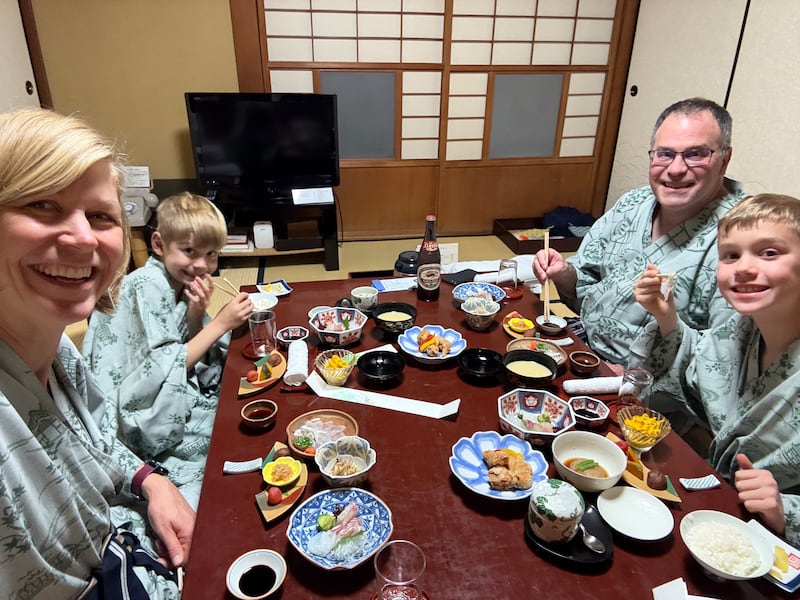 Left to right: Sara Dykstra, Ari Cohn, Steve Cohn and Ben Cohn eating dinner in their ryokan in Yamaguchi, Japan. It was served in the traditional style, in their room with a low table. (Photo by Sara Dykstra)
Sara noted they were the only Western guests at the ryokan. Due to the hot spring, there were community baths for the guests: one for men and one for women.
Breakfast and dinner were included in the daily rate. “They served the meals in our room, on tatami mats,” said Sara. “It was on a low table, with beautiful dishes.”
The daily rate was about $450.
It was a six-hour train ride back north to Hakone, where the family continued their successful strategy of walking-and-eating across the country.
“All of us averaged 15-18,000 steps per day,” said Sara. “The kids were great ages for this trip. Steve and I felt like this was a real vacation, as opposed to simply parenting in a different place.”
The last stop in Japan was in Kamakura, near Yokohama. It’s known as “Surf City” in Japan. “We went swimming in the ocean,” said Sara. “The kids didn’t want to leave.”
As the family boarded their Hawaiian Airlines flight back to Seattle, Sara rated the holiday at 100%. “We had a solid itinerary, but it wasn’t overly structured,” she said. “Mostly, we just kind of explored.”
AloJapan.com