
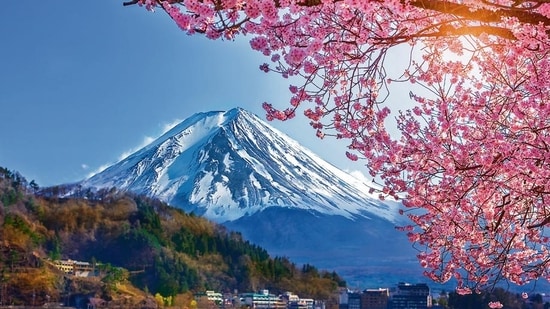
One of Japan’s most famous spring traditions has fallen victim to its own popularity. Officials in Fujiyoshida announced on Tuesday that the annual cherry blossom festival will be cancelled this year to protect local residents from the “crisis” of overtourism.
 Local officials reported instances of tourists entering private homes to use bathrooms, trespassing in gardens, and leaving litter behind (Photo: Adobe Stock)
The festival, famous for its breathtaking view of a five-story pagoda framed by pink blossoms and Mount Fuji, usually attracts over 200,000 visitors. However, the city officials say the surge in international travellers has made life unbearable for those who live there.
The decision comes as Japan faces a record-breaking wave of visitors, with 42.7 million tourists flocking to the country in 2025.
While the weak yen has made Japan a “bucket list” bargain, the strain on local infrastructure has reached a breaking point. Mayor Shigeru Horiuchi stated that the “quiet lives” of citizens are under threat, citing a long list of disruptive behaviors from visitors. Local officials reported instances of tourists entering private homes to use bathrooms, trespassing in gardens, and leaving litter behind.
Public safety has also become a major concern for the community. Residents have reported chronic traffic jams that paralyze the city, and parents have expressed fear for children whose walks to school are frequently blocked by crowds of tourists fighting for the perfect photo.
“To protect the dignity and living environment of our citizens, we have decided to bring the curtain down on the 10-year-old festival,” Mayor Horiuchi said in a statement.
Even though the official festival is cancelled, the city faces a difficult reality because they cannot easily stop people from arriving. The park remains a public space, and officials worry that “photo-hungry” tourists will still swarm the area when the trees bloom later this spring
AloJapan.com