
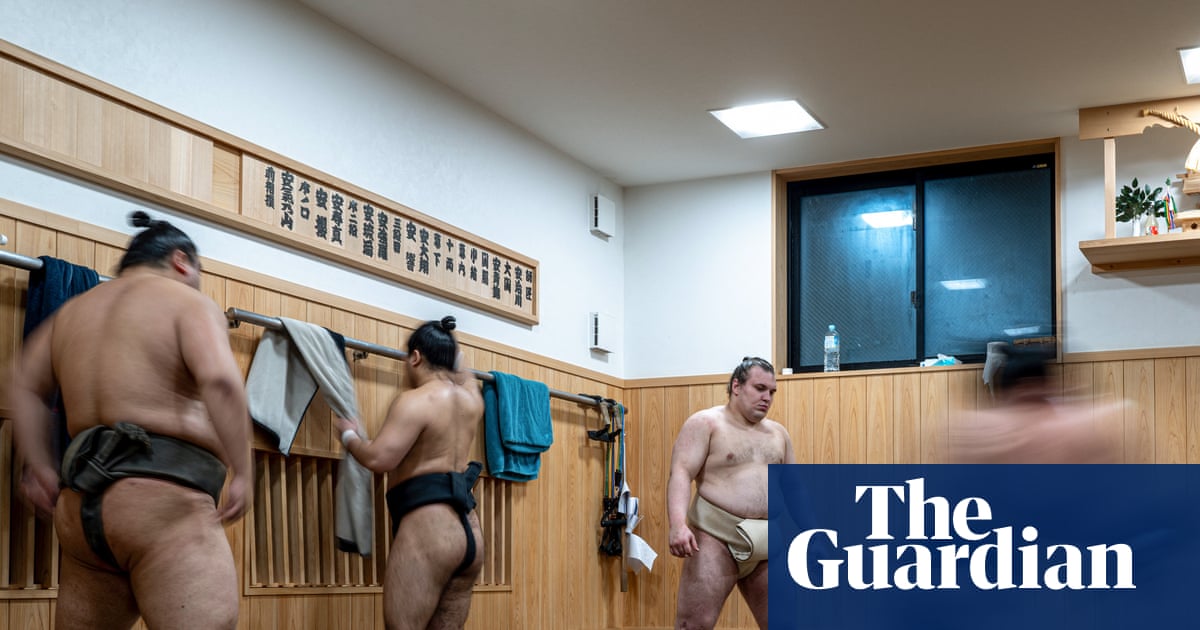
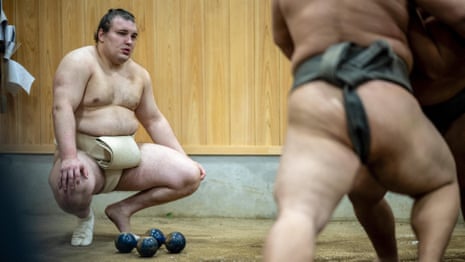
The swish of feet on clay and sand has a soothing, rhythmic feel, as wrestlers at a sumo stable in Tokyo propel themselves across the ring, their bodies low, eyes fixed on an imaginary foe. But by the time their morning training ends an hour later, all but one of the rikishi are bathed in sweat, gulping lungfuls of air, their strength waning with every shove.
Just one wrestler has spent all but the final minutes of the session at the side of the dohyo ring, guiding his stablemates with words delivered with economy and purpose. After the group bow to a miniature Shinto shrine on the back wall, they gather around their mentor in a communal expression of gratitude.
Four years ago, he went by the name Danylo Yavhusishyn, a teenage refugee from the war in Ukraine who arrived in Japan unable to speak a word of the language, and uncertain of how his separation from his family would work out.
Aonishiki’s sumo name means ‘blue brocade’ in honour of the Ukrainian flag. Photograph: Kim Kyung-Hoon/Reuters
Then this month, Yavhusishyn – now known by his fighting name Aonishiki – won his second tournament in a row, and is on course to become the first European to become a yokozuna grand champion – the pinnacle of the ancient Japanese sport.
“It’s not good to be too fixated on [promotion] … But I wake up every day wanting to get stronger, to climb another rank higher,” he told international media, including the Guardian, after a morning training session at the Ajigawa stable in the capital’s eastern suburbs this week.
“Wanting to become stronger and to attain a higher rank is my motivation. The simple fact is that you can’t progress without a struggle.”
Aonishiki, whose sumo name means “blue brocade” in honour of the Ukrainian flag, reached the sport’s second-highest rank of ozeki in record time last year, having made his professional debut only in July 2023. His feat is all the more remarkable given his weight – at 140kg (309lb) he is not particularly heavy by sumo standards.
Aonishiki was preparing for university in Ukraine when Russia invaded in February 2022. Photograph: Philip Fong/AFP/Getty Images
It is his strength, skill and determination that should earn the 21-year-old from Vinnytsia, in central Ukraine, promotion to yokozuna – a feat achieved by just 75 men in the sport’s history – if he wins next month’s tournament in Osaka.
‘I want more people around the world to take an interest’
Aonishiki was preparing to begin his university studies in Ukraine when Russia invaded in February 2022, forcing him to abandon his plans. A career in sumo seemed a natural choice for the teenager, who had taken up judo and freestyle wrestling as a boy, becoming national sumo champion in 2021.
In 2019, he finished third at the junior world sumo championships in Osaka, where he befriended the Japanese wrestler Arata Yamanaka, then captain of a university sumo team in western Japan. After Russia invaded, Aonishiki, who had fled to Germany with his parents, reached out to Yamanaka, whose family agreed to host him.
 Ukrainian-born Aonishiki in touching distance of sumo’s top rank – video
It took Aonishiki just nine tournaments to reach the top tier of sumo – an accomplishment that tied him with two other wrestlers for the fastest ascent through all six divisions since 1958, when the sport adopted its current format of six 15-day grand tournaments, or basho, a year.
Years after sumo was embroiled in match-fixing and bullying scandals – and disquiet among purists at the dominance of Mongolian rikishi – Aonishiki is part of a crop of wrestlers driving a golden age for the sport, whose roots go back centuries.
Aonishiki defeats Hoshoryu during the Grand Sumo Tournament in Fukuoka in November 2025. Photograph: JIJI PRESS/AFP/Getty Images
“People ask me for tickets all the time … I’m excited that sumo is getting a lot of attention, and we as wrestlers have a responsibility to respond,” he says. “I want more people around the world to take an interest in sumo, so we still have work to do.”
‘London was a lot of fun’
Stables are opening their doors to overseas visitors amid Japan’s tourism boom, and tickets for tournaments sell out immediately. The success of last year’s exhibition at the Royal Albert Hall – the first sumo tour to Britain for 34 years – confirmed the sport’s growing global appeal. A similar event will be held in Paris in June.
“London was a lot of fun, and it was different from when we do sumo in Japan,” says Aonishiki, his frame wrapped in a blue-and-white yukata robe. “The fans’ reaction was different, and you could feel the excitement, so it’s something I would definitely like to do again.
“There’s nothing like sumo – it’s not always the strongest or biggest person who wins, so it doesn’t discriminate in that sense. I’ve heard that sumo is becoming popular overseas, and as a wrestler I’d be delighted if more people got into it.”
Aonishiki celebrates his promotion to the rank of ozeki in Kurume, Fukuoka prefecture, in November 2025. Photograph: 進尚幸/AP
Aonishiki is more loquacious than many of his peers, although he is reluctant to discuss the war in Ukraine.
But his home country, and the friends he left behind – are never far from his mind. He speaks to his parents every day and is aware that his success has made headlines in Ukraine. “My friends and my old sumo coach and everyone else, they’re all watching sumo more than I expected,” he says. “When I win a title or even when I just win a match, they get in touch straight away and it gives me more motivation to work hard.”
When he isn’t training and “sleeping a lot”, he visits onsen hot springs and – unsurprisingly perhaps – eats out a lot, with sushi and Korean barbecue among his favourites. “I do miss food from Ukraine, he says. “A lot of Ukrainian dishes contain potatoes, so I like it when we have nikujaga [a Japanese meat and potato stew].”
The exhausted junior stablemate resting in the background as Aonishiki speaks would no doubt have agreed with his response when asked what he enjoyed most about morning training. “The moment it ends,” he says.
AloJapan.com