
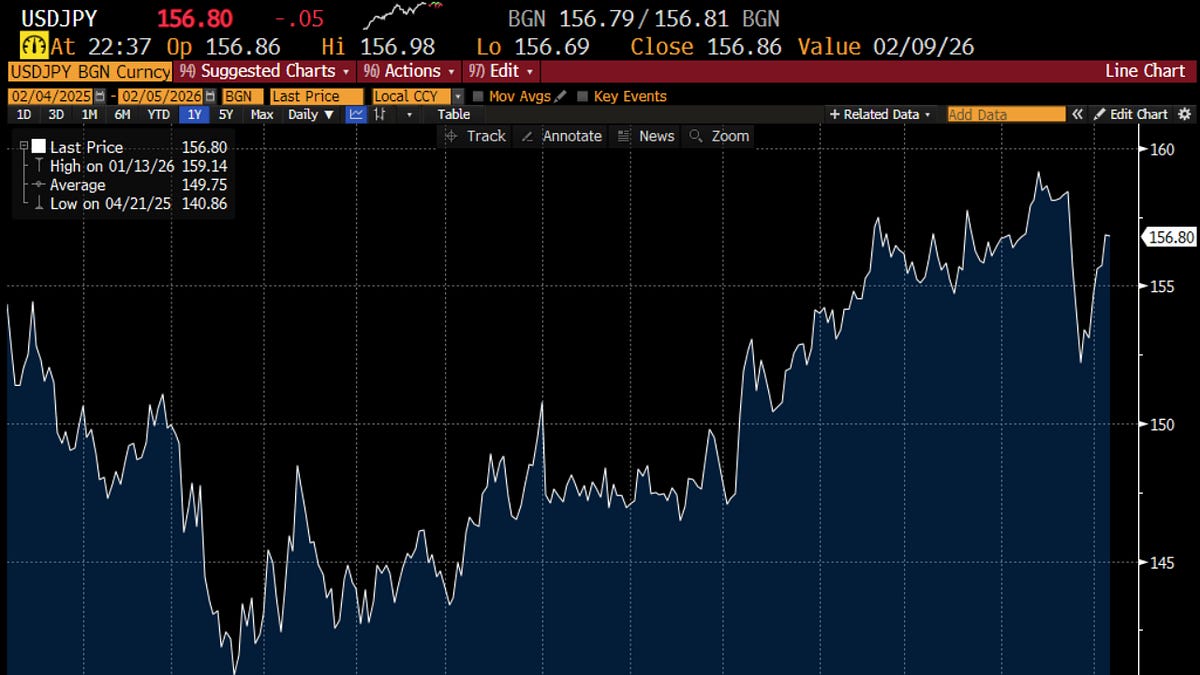
Ten days ago – at the height of all the chatter around Japanese FX intervention – I wrote a post saying this can’t and won’t work. I made two points. First, intervention works best when it’s a total surprise and positioning is extremely stretched. Second, intervention can only work to sustainably strengthen the Yen if it’s acting in concert with monetary policy, i.e. if the Bank of Japan steps back from de facto caps on long-term government bond yields and allows them to rise. Neither condition is met for Japan and – as $/JPY marches back up towards 160.00 – it’s becoming clear that FX intervention just isn’t a workable or successful strategy for Japan.

The NY Fed on January 23 did a highly unusual “rate check,” which in FX markets is seen as an immediate precursor to actual FX intervention. As the chart above shows, $/JPY fell sharply in the days that followed, going from above 158.00 on January 22 to a low near 152.00 on January 27. However, the Yen has returned to its weakening path since then and $/JPY is almost back to 157.00, which is essentially where it was before this “intervention.” It’s fair to say that this most recent episode underscores once again – not that more evidence was needed – that Japanese FX intervention just doesn’t work.
As I’ve noted many times, Japan is caught between preventing a fiscal crisis, which necessitates caps on long-term government bond yields, and a falling Yen, since yield caps just transfer fiscal stress from the bond market to the currency. Risk premia that ought to get priced in the bond market instead put depreciation pressure on the Yen. Japan’s policy makers need to stop battling symptoms like Yen depreciation or yield spikes and focus instead on confronting the underlying problem, which is the public debt overhang. The government has lots of financial assets, which is why net debt is so much lower than gross debt (130 versus 240 percent, respectively). If some of these assets were sold to pay down gross debt, this would do a lot to get Japan out of its current quandary. Sadly, it seems like more Yen depreciation and higher yields are needed to get policy makers to understand this. Japan remains in denial.
AloJapan.com