
by Sakib Iftekhar
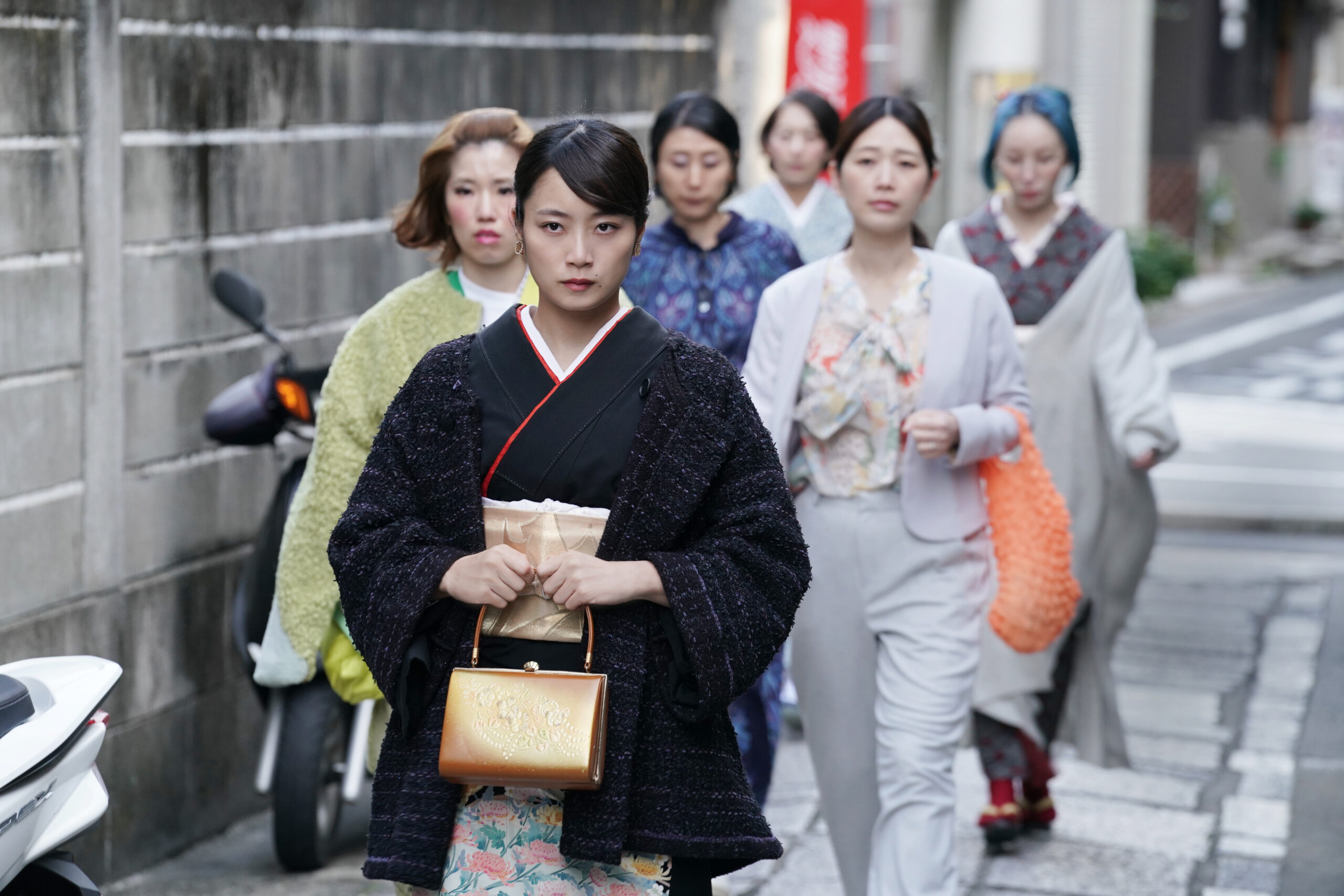
Kyoto is often presented in Japanese cinema as a place of continuity, where tradition appears stable and time moves at a slower pace. “Strangers in Kyoto”, rather than treating the city as a refuge, presents Kyoto as a tightly regulated social space shaped by hierarchy, politeness and a set of unspoken rules that govern everyday interactions.
The film follows Shibusawa Madoka, a manga writer from Tokyo who relocates to Kyoto after marrying Mario, the heir to a family-run folding-fan business that has existed for fourteen generations. As Madoka adjusts to her new life, she begins a manga project documenting long-established Kyoto businesses. Working alongside her manga artist friend and collaborator, Anzai Riko, she interviews shop owners and okami who maintain these traditional spaces.
At first, Madoka is received warmly. Her parents-in-law introduce her to acquaintances, and her project is met with polite encouragement. However, as her interviews continue, subtle resistance begins to emerge. Madoka approaches people directly, asking clear questions and expressing admiration openly. In Kyoto, where communication relies heavily on implication and restraint, such directness disrupts social balance. Refusal is rarely expressed outright, and politeness often conceals reluctance. Madoka does not recognise these signals, and her enthusiasm gradually comes to be seen as intrusive.
The narrative develops quietly, without dramatic confrontation. Conversations remain courteous, routines repeat and tension accumulates beneath the surface. Madoka’s attachment to Kyoto deepens through her domestic life, particularly the house she shares with her husband’s family. What initially functions as a place of residence slowly becomes something she feels responsible for protecting. When she learns that her mother-in-law is considering selling the house, her reaction is immediate and unsettling. The issue is not legal ownership, but the realization that her sense of responsibility exceeds her actual position within the family and the city.
Personal strain intensifies this shift. After discovering her husband’s infidelity with her long-time collaborator, Madoka does not withdraw. Instead, she becomes more focused on her work and increasingly convinced that she is preserving something valuable. A brief encounter with a professor from Kyoto Arts University reinforces this direction. Recognising her manga, he encourages her to express her observations more directly, without holding back. The encounter does not resolve her situation, but it strengthens her determination.
Masanori Tominaga directs with restraint and precision, allowing scenes to unfold without emphasis or explanation. The pace remains steady throughout, and silence often carries as much weight as dialogue. Rather than framing the story as a direct conflict between tradition and modernity, Tominaga focuses on how social systems sustain themselves through courtesy, distance and exclusion.
The performances align with this controlled approach. Emotional shifts are conveyed through posture, timing and restraint rather than overt expression, allowing tension to emerge gradually without melodrama.
The cinematography by Yukiko Nishikawa presents Kyoto as lived-in rather than picturesque, favoring interiors and everyday spaces over postcard imagery. The editing by Kamikura Kenji maintains a consistent rhythm that supports the gradual build-up of tension. The music by Shogo Hama is used sparingly, contributing to mise-en-scène without directing emotional response.
Manga plays an important role in the narrative, functioning as Madoka’s primary means of expression. Where spoken communication is shaped by restraint and social expectation, manga allows her to articulate ideas more directly. This contrast highlights the limitations placed on expression within Kyoto’s social structure.
“Strangers in Kyoto” ultimately presents a quiet psychological drama about the limits of belonging. It examines how admiration can turn into overreach, and how sincere intentions can conflict with deeply embedded social systems. Without judging its protagonist, the film observes how devotion, when left unchecked, can begin to resemble control.
Sakib Iftekhar is a Melbourne-based film producer and distributor working across South and Southeast Asian cinema. Through Screenxcope, he has produced and released films in Australia and New Zealand, and contributes as a reviewer and festival programmer in Australia and North America, with a focus on positioning regional cinema within a wider cultural and international landscape.
AloJapan.com