
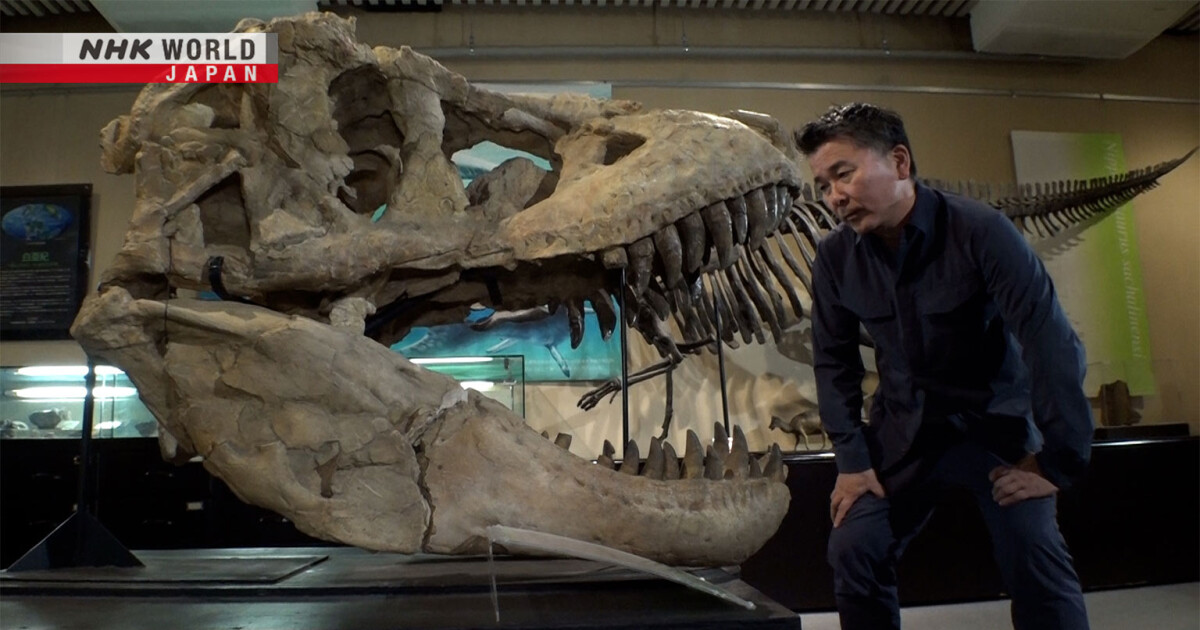
00:08
Our guest today is Kobayashi Yoshitsugu, a paleontologist and professor at Hokkaido University.
00:18
He’s traveled the world, excavating over 10,000 dinosaur fossils along the way.
00:28
Could be a huge find!
00:31
In 2025, his research group published a groundbreaking paper that stunned the paleontology world.
00:45
They showed that tyrannosaurs grew to enormous size after undertaking an intercontinental migration,
00:52
shedding light on a previously unknown evolutionary process.
00:59
We ask Kobayashi about the meaning of his work, and the joy of being at the forefront of dinosaur research.
01:11
The thrill is in the discovery. What is the fossil trying to tell you?
01:18
In my mind I ask the bones, ‘What were you?’
01:24
Gradually you come to understand how they evolved and their lifestyle.
01:35
The Tyrannosaurus rex measured up to 13 meters in length and nine tons in weight.
01:41
It had a thick skull, and powerful hind legs…
01:48
And an estimated bite force of 3,600 kilograms.
01:55
This apex carnivore is thought to have chewed its prey down to the bone.
02:06
The T-rex thrived in North America until 66 million years ago.
02:11
But where did it come from?
02:17
Faraway in Mongolia, scientists had found dinosaur fossils in a geological layer 90 million years old.
02:26
Something about them spoke to Kobayashi.
02:30
They were thought to belong to Alectrosaurus.
02:34
We analyzed their place in the evolutionary tree – basically, their family history.
02:41
And although they were similar to Alectrosaurus, we found that they were something different.
02:50
The fossils, which had been discovered around 50 years ago, were thought to belong to Alectrosaurus,
02:57
but new analysis revealed they actually belonged to an entirely new species of tyrannosaur.
03:05
A medium-sized one, measuring three to four meters in length and weighing under 500 kilograms.
03:12
Many of its features, including its slim body and skull, resembled a juvenile T-rex.
03:23
The fossils represented a transitional form, showing the evolution in the size of tyrannosaurs.
03:33
Kobayashi’s research group named the species “Khankhuuluu mongoliensis,” meaning “Dragon Prince of Mongolia.”
03:44
Khankhuuluu is a slimmer tyrannosaurus that’s along the evolutionary path to its larger form.
03:52
Here’s the evolutionary tree of so-called tyrannosauroids.
03:56
Khankhuuluu is an intermediate form.
04:02
It marked a transition into larger and larger species, culminating in the T-rex.
04:09
The discovery allowed Kobayashi and his colleagues to unravel the evolutionary history of tyrannosaur varieties over time.
04:19
Large tyrannosaurs originated in Asia, migrated to North America, and diversified.
04:25
A variety of species emerged, and a particularly large tyrannosaurus traveled back to Asia.
04:31
It’s called Tarbosaurus.
04:35
Our theory is that what we know as T-rex evolved from tyrannosaurs that then traveled from Asia, back to North America.
04:47
Today, Kobayashi is a world-renowned paleontologist, but he spent much of his youth lacking direction.
04:57
He enrolled at a Japanese university, but was quickly swept along by those around him and went to study abroad in the US.
05:07
I spoke little English and had no interest in the culture.
05:10
So I treated it like an extended sightseeing trip.
05:17
He returned to Japan after one year, unsure as ever about what path he wanted to take.
05:25
I did what people said I should do.
05:27
But when I peeled away those layers like an onion, there was no core.
05:33
No goal or ambition at the center.
05:38
I thought, this isn’t good.
05:41
I did some self-reflection and happened to come across a book on dinosaurs.
05:47
And I felt a sense of excitement come from within me.
05:51
I thought, “This might be fun. I’ll give it a shot!”
05:57
Kobayashi went back to the US and enrolled at the University of Wyoming, which was known for its paleontology research.
06:07
I was determined to live each and every day without making excuses to myself,
06:12
so that even if I were to die tomorrow, I’d have no regrets.
06:18
So after I enrolled, I went all in on my studies with the attitude of absorbing everything I could.
06:28
In 1995, Kobayashi graduated from his department at the top of his class.
06:36
He then became the first Japanese to earn a PhD in Vertebrate Paleontology from Southern Methodist University.
06:46
He began traveling the world, excavating and studying dinosaur fossils.
06:54
Starting in 2006, he took on the challenge of digging out the full skeleton of a Deinocheirus.
07:03
Back in 1965, a pair of 2.4-meter-long limbs had been unearthed in Mongolia.
07:12
The dinosaur was given the name “Deinocheirus,” meaning “terrible hand.”
07:17
But the rest of its appearance remained a mystery.
07:24
Scientists worldwide have been trying to unravel its identity for over 40 years.
07:30
A bona fide mystery dinosaur.
07:34
An international research group including Kobayashi went looking for the other pieces.
07:45
If this is the skull…
07:52
In 2010, the team finally succeeded in excavating a full Deinocheirus skeleton.
08:03
The creature was around 11 meters long.
08:07
The discovery of a nearly-complete specimen offered a wealth of insights into its life and habits.
08:21
It had a body type totally different from any dinosaur we’d seen before.
08:27
As a paleontologist, it was a once-in-a-lifetime kind of discovery.
08:37
Kobayashi also had success back in Japan.
08:41
– The brown part…
– Ah! A bone!
08:46
All right! We did it!
08:52
In Hokkaido, he helped to excavate Japan’s first nearly-complete dinosaur skeleton
08:57
and published a 2019 paper identifying it as a new species.
09:04
Kobayashi spends four months out of the year in the field, at sites in North America, Mongolia, and more.
09:16
He’s uncovered over 10,000 fossils to date.
09:24
What’s more, he’s been involved in naming over 10 new species.
09:32
What makes him remarkable is his extraordinary knack for locating dinosaur fossils.
09:43
It’s an ability that’s earned him the nickname “Falcon’s Eye.”
09:48
…reason that Yoshi is very well known internationally is because he has such a sharp eye, a falcon’s eye,
09:56
that allows him to find things where other people don’t find them.
10:01
And Yoshi is definitely one of the best people for finding new things.
10:06
I go where others don’t.
10:09
Most people don’t like steep slopes.
10:12
But I walk terrain that others avoid, so naturally I end up making discoveries.
10:20
Colleagues say to me, “We thought we were in new territory, then we saw your footprints!”
10:26
“Walkman” is another of my nicknames.
10:30
I always assume there’s something to be found.
10:33
And the longer I spend not finding anything, the closer I get to a discovery.
10:40
I don’t get disappointed because it makes it more likely the next step will bring success.
10:47
So I never get tired of walking.
10:51
Kobayashi explores perilous, hard-to-access locations.
10:55
That’s why they’re more likely to yield fossils that no one else has been able to reach.
11:05
One time in Alaska, he encountered seven grizzly bears in a single day.
11:14
In Mongolia’s Gobi Desert, a sudden thunderstorm caused a torrent of water a hundred meters wide.
11:23
As thunder approached, Kobayashi found himself stranded.
11:29
I had to cross to get back to camp.
11:31
But then… this huge boulder rolled past, and I knew I was in trouble.
11:39
The water eventually receded, and he barely managed to make it back.
11:46
At the time, I thought I’d never visit again.
11:51
But on the plane home, I thought, “Maybe next year.”
11:58
Fieldwork is my priority. It’s not just about finding fossils.
12:03
I try to think about how dinosaurs lived.
12:08
I get a first-hand experience of the harsh environments in which they existed.
12:13
It’s very stimulating.
12:16
I see fieldwork as the essence of research.
12:22
Long before humans, dinosaurs ruled every continent on the planet, thriving for millions of years.
12:34
Then 66 million years ago, they met their end in an extinction event that radically changed the global climate.
12:46
Their fate is by no means irrelevant to us humans living on Earth today.
12:54
Kobayashi says understanding the dinosaurs is also about contemplating humanity’s future.
13:03
Our planet has endured five extinction events.
13:07
And some scientists say… we’re currently on the verge of a sixth.
13:15
Living things are disappearing from the face of the Earth at an alarming speed.
13:22
And it’s all because of us. Human beings.
13:27
We’re putting a huge burden on our planet.
13:32
Amid all of these mass extinctions, humanity has to figure out how to carve out a future for itself.
13:39
And the past is the perfect teacher.
13:42
The most recent extinction event was that of the dinosaurs.
13:49
But humans are different.
13:51
We have the ability to think and convey ideas.
13:56
Dinosaurs teach us that if we want the human race to survive on this planet as long as possible, we have to be kinder to nature.
14:07
Do you have any words to live by?
14:17
This is a phrase that means “Seize the day.”
14:22
Adults often tell kids to follow their dream, but that can be quite cruel.
14:27
Because you don’t choose your dream, your dream chooses you.
14:32
So how can you encourage that to happen?
14:36
Well, by trying different things, looking deep within, and cherishing the moment.
14:44
Something could spark your interest and lead to a dream. So seize the day.
AloJapan.com