TOKYO—Miranda Castleberry made a beeline to a 7-Eleven after arriving in Japan in December to try an iced coffee with vanilla ice cream on top, a treat she’d seen other tourists post about on social media.
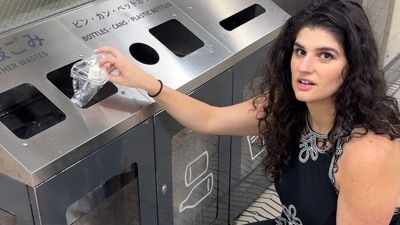 Kat Day learned to carry a bag for her trash.
When she finished the drink, she couldn’t find anywhere to throw out the plastic cup. Castleberry had just discovered another viral Japanese phenomenon: The near-total lack of public garbage bins.
She ended up buying a navy fleece jacket from Uniqlo that had roomy pockets, which became her main garbage receptacle for the rest of her three-week trip.
“I would shove all of my trash into these pockets,” said the 32-year-old engineer in Atlanta. “I’d never been a human trash can before.”
For decades, Japan has enjoyed a reputation as one of the cleanest places in the world, all while having almost no public trash cans. But an influx of foreign visitors—a record 42.7 million last year—is disrupting the garbage equilibrium. In some tourist-heavy areas, littering is on the rise, leading some local officials to rethink waste management.
The lack of bins is the most commonly cited problem for tourists, ahead of language barriers or crowds, according to a recent survey by Japan’s tourism agency. It’s made them a sight worth memorializing for some.
Leslie Saxton, 44, noticed the absence on her first day in Tokyo last fall when looking to get rid of empty chip bags on the walk to her Airbnb from a nearby 7-Eleven. “At home, we would’ve passed 20 trash cans. There, not a single one,” said the air-traffic controller in Riverside, Calif.
When her husband, Jerome Saxton, finally spotted garbage bins outside a Nike store on their fourth day, he took a video as if spotting an endangered species in the wild.
“It was totally a culture shock,” said the 46-year-old artist.
Trash cans disappeared in many parts of Japan in 1995 after a doomsday cult spread toxic gas in the Tokyo subway. They have largely stayed off the streets owing to fears that bins could be used in terrorist attacks, not to mention the cost of maintenance and strict rules about installing things in public spaces.
Japanese people typically carry their garbage with them until they return home. Tourists were expected to conform to the local trash culture. But as more and more visitors came, that proved untenable.
The few bins that do exist fill up quickly and overflow. Some tourists have resorted to hiding trash in hedges or leaving plastic bottles or cups on ledges.
At first, cities and districts tried to fix the situation by raising awareness. Politely worded signs in Japanese and English ask people to take their trash home.
“It’s not working,” Noboru Yoshida, a professor of systems engineering at Wakayama University, said of Japan’s current trash management.
In Tokyo’s Shibuya ward, home to hot spots including Shibuya Crossing and Harajuku, authorities are now rolling out a new regulation requiring convenience stores and cafes to have trash cans, or face a potential fine equivalent to roughly $325.
Nara Park, famous for its free-roaming wild deer, installed trash cans last year for the first time in four decades. The bins, which use solar power and sensors to compress the trash inside when full, say “Save the Deer” in English in large, green block letters.
Other cities and districts have also added smart trash bins, and Japan’s government has offered subsidies to install them. Kawagoe, a city on the outskirts of Tokyo, turned to a low-tech initiative: It began distributing waterproof trash bags to tourists.
Some Japanese are taking matters into their own hands. A group of students from Seikei University in Tokyo began walking around Shibuya last year carrying garbage cans on their backs like book bags. What started as a volunteer initiative is turning into a business selling ads on the bins.
“Tons of people dump their trash in our bins,” said co-founder Junsei Kido, 20, who wants to bring the business to other cities like Kyoto, as well as festivals and concerts.
Sometimes the students dress in all-black costumes with helmets, but it’s not for protection. Kido says they’ve never been on the receiving end of weird or gross trash—or even pranked. The need to get rid of the garbage is too great. And forget about trash-talking. “We really only hear people look at us saying, ‘That looks so cool’ or ‘I want to try that too.’”
On TikTok and Instagram, travelers offer tips, such as bringing a plastic bag to carry trash or heading to convenience stores or big train stations, which normally have bins. Some film themselves dropping to their knees or with their mouths agape in front of a rare trash can.
“It’s been meme-ified,” said Kat Day, a 31-year-old nurse from Atlanta who has been to Japan four times.
Day carries a small backpack or purse for the plastic bottles, wrappers and napkins that she accumulates.
Ryo Nishikawa, a professor of tourism at Rikkyo University in Tokyo, said that while foreign tourists may find the lack of trash cans surprising, other places like the U.S. suffer from a dearth of public restrooms, which are abundant and almost always free in Japan.
“Just to use the restroom, you have to go into a cafe somewhere to buy coffee,” he said. “The trash can issue is probably something I could tolerate much more easily.”
For Castleberry, the engineer from Atlanta, her visit to Japan reinforced how messy it is back home. “Americans will just throw trash anywhere,” she said.
“I don’t think that they should change who they are,” she said of Japan’s trash management. “It’s the cleanest country I’ve ever been to.”
Write to Hannah Miao at hannah.miao@wsj.com and Junko Fukutome at junko.fukutome@wsj.com

AloJapan.com