
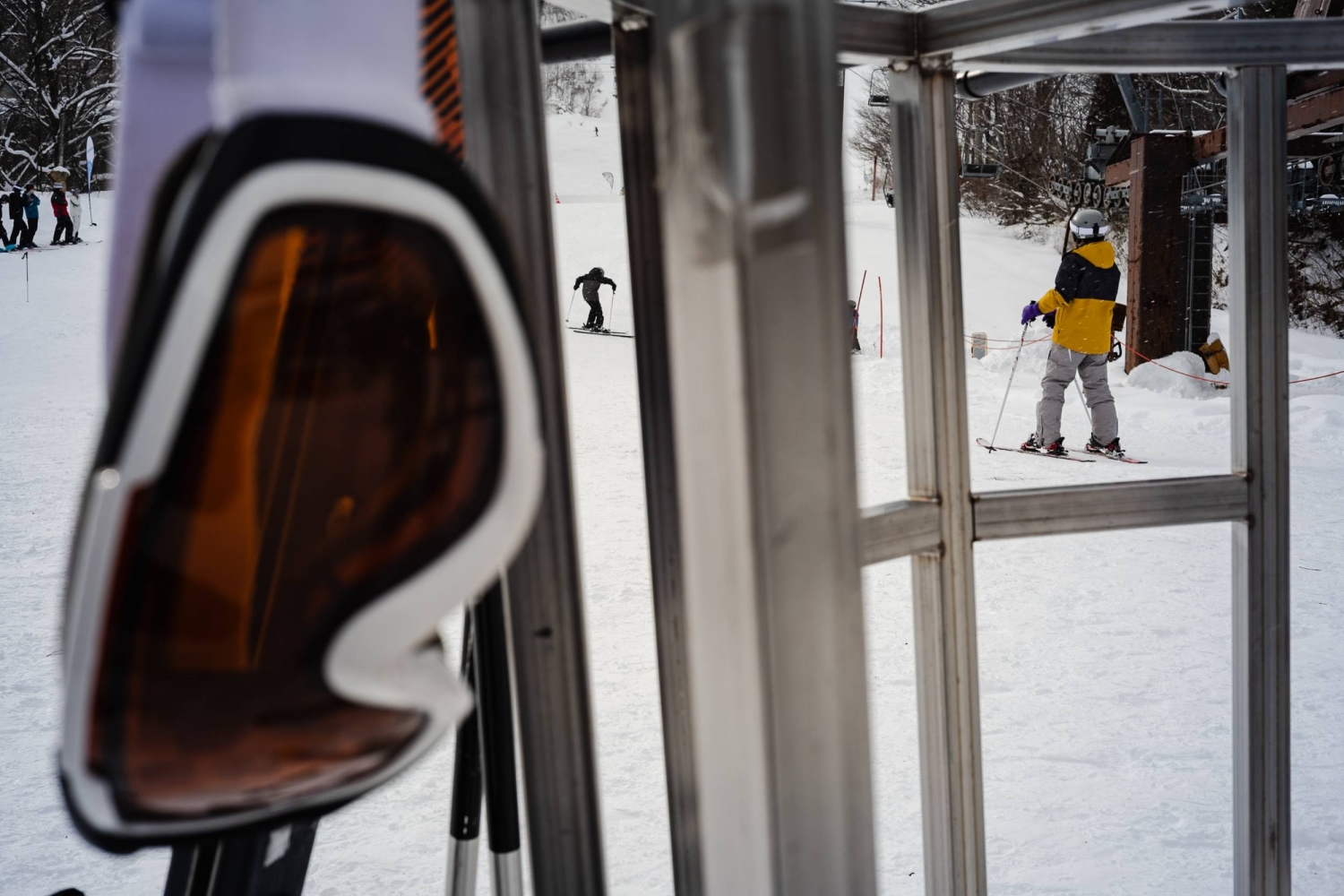
Hakuba, Nagano Pref. –
In Hakuba at this time of year, ski lift lights illuminate the night sky. Restaurant kitchens run late into the evening, and English conversations spill onto the streets. It’s tourist season at this well-known winter resort, and visitors are back in droves, bringing money and activity.
Their return has also brought an uncomfortable question: In a mountain village of fewer than 10,000 people built on seasonal visitors, how much change can Hakuba absorb before it stops feeling like home?
In the three years since Japan lifted its COVID-19 restrictions and reopened to the world, visitor numbers in Hakuba have surged, reaching 2.9 million in 2025 — more than double the levels recorded in 2021.
That influx has brought sweeping changes to village life, along with a growing sense of unease among residents. Prices for food, housing and transportation have climbed, while concerns have mounted over drunken tourists causing nighttime disturbances.
Hakuba is hardly alone. Across Japan, regional communities are leaning ever more heavily on tourism, even as it strains daily life and widens the divide between residents and visitors.
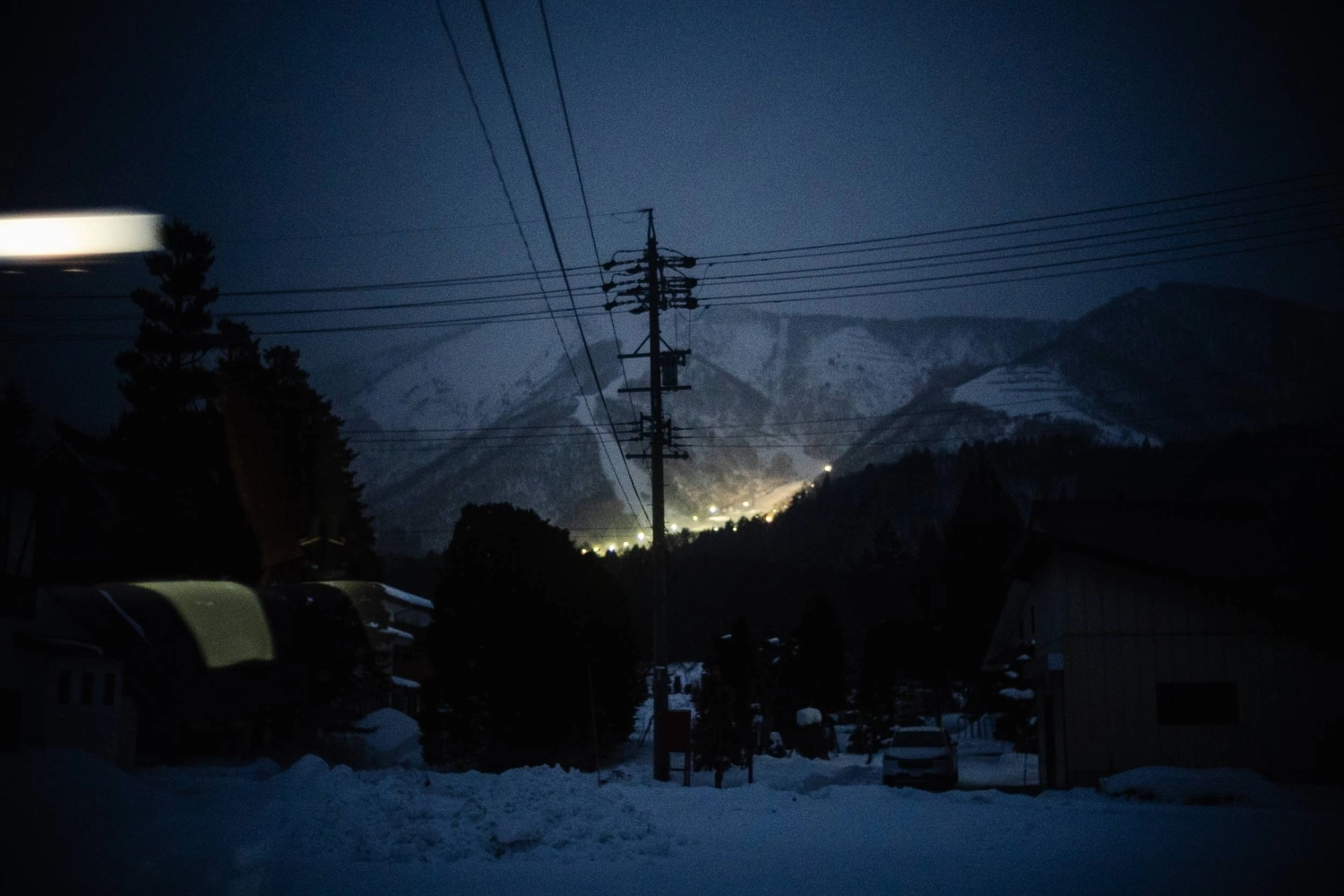
Lights from the ski fields illuminate the night sky in Hakuba, while the sounds of foreign languages spill onto the streets well into the evening.
| JOHAN BROOKS
Japan welcomed a record 42.7 million arrivals last year, and the government is eyeing a target of 60 million by 2030. In Hakuba, officials and business owners say the challenge is managing the pace of tourism without letting it overwhelm the community it is meant to sustain.
For Hakuba Mayor Toshiro Maruyama, the question is not whether tourism will change Hakuba but if it will benefit it.
“Everyone knows that tourism is important,” he says. “We must ensure that it will lead to the well-being of the community.”
A long history
Of the 2.9 million visitors Hakuba welcomed in 2025, 1.18 million came to ski in the village’s five ski areas. To handle this volume, the village hosts about 1,500 international resort workers from November through March. While visitor numbers have not returned to the 3.8 million recorded during the boom of the early 1990s, the seasonal flow of tourists and workers keeps the village lively each winter.
This kind of bustle is nothing new. Hakuba has a long history of hospitality and is the birthplace of minshuku, small, family-run inns. During the Meiji Era (1868-1912), villagers welcomed visiting researchers and surveyors, serving as mountain guides and opening their homes to them. Over time, this practice evolved into the minshuku system known today.
As a skiing destination, Hakuba’s busiest time actually came in the 1980s and 1990s when eager Japanese skiers flocked to the area.
| JOHAN BROOKS
Skiing became part of Hakuba’s identity about 110 years ago, not long after Austrian Maj. Gen. Theodor von Lerch introduced the sport to Japan, first in the Myoko highlands in Niigata Prefecture.
“People from Myoko brought skiing to Hakuba soon after that,” says Yojiro Fukushima, director of the Tourism Commission of Hakuba Village. “It changed winter life here. Before that, people hardly went outside during the harsh winter season.”
As a ski destination, Hakuba has experienced cycles of boom and bust since the 1952 opening of the now-defunct Nishiyama ski field. Its popularity peaked during the 1980s bubble economy, when mostly Japanese ski enthusiasts flocked to the area.
When the bubble burst in the early 1990s, many in Hakuba and elsewhere in Nagano Prefecture remained optimistic about their businesses, Fukushima says, in large part because the prefecture was preparing for a major economic boost: the 1998 Winter Olympics.
The boom eventually ended, and many pension-style guesthouses that had sprouted up since the 1970s went out of business. Some operators vanished overnight, Fukushima says, leaving large debts behind.
Opening to the world
Dave Enright is the founder and CEO of Evergreen Outdoor Center, a Hakuba-based tour provider and ski school. A native of British Columbia, Canada, he was among the first to bring skiers here from overseas roughly 20 years ago.
“Hakuba is an amazing, beautiful town,” Enright says, sitting down at his school’s Tsugaike base in the neighboring village of Otari after a long day guiding backcountry skiers. “I’ve been to many places around the world, and everyone always told me, ‘Canada has the great outdoors. Why would you stay in Japan?'”
He points to the area’s 3,000-meter peaks, fresh mountain water and lush forests as proof of its appeal, along with the generous snowfall each year — known internationally as “Japow,” a portmanteau of “Japan” and “powder” — and four distinct seasons.

Canadian Dave Enright, founder and CEO of Hakuba-based Evergreen Outdoor Center, was among the first to promote the village to skiers overseas roughly two decades ago.
| JOHAN BROOKS
“I think there are more than four seasons,” he adds. “You even have different seasons within the winter.”
Enright says part of Hakuba’s appeal lies in its longer history of exchange and movement. The surrounding valley, which includes Otari and Omachi, once formed part of the Salt Road, a historic route dating back to at least the 17th century that linked the Sea of Japan coast in Niigata Prefecture to Matsumoto in central Nagano Prefecture.
Having witnessed Hakuba’s dramatic decline after the Olympics, Enright says he felt compelled to do something to boost the economy of a place he had come to love.
“For a good five years, the economy here just kept getting worse,” he recalls, adding that he saw fewer and fewer skiers each year.
In the early 2000s, Enright began promoting Hakuba to international skiers with two Australians who had also settled in the valley, as well as Fukushima, who was then working at a local hotel.
“We started going to ski shows around the world — Sydney, Melbourne, Finland, Canada and Russia,” Enright says. “I was going to the U.K., trying to pull in overseas customers to come to Japan.”
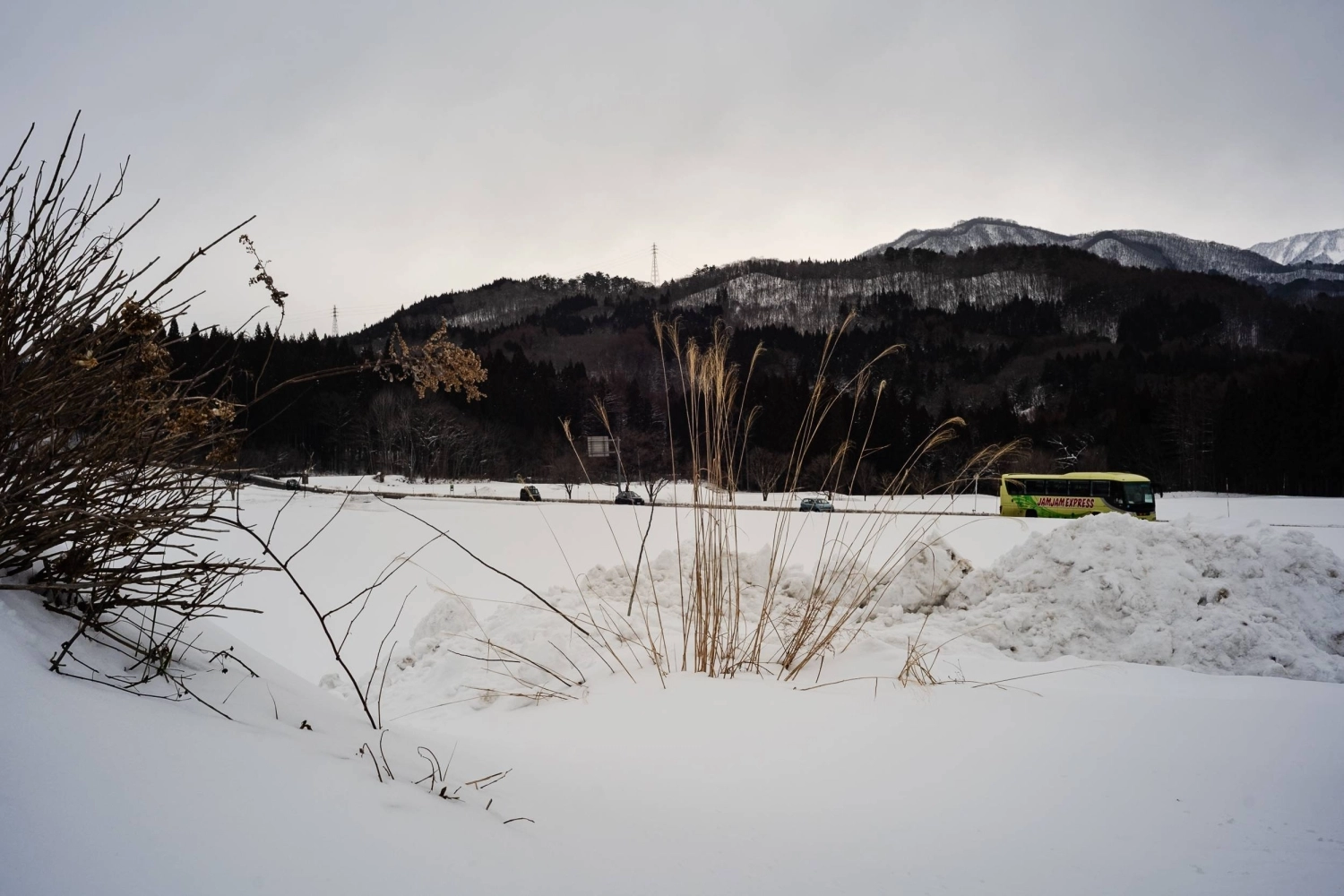
While the roads now ferry tourists from one lodge to another, the area was once part of the Salt Road, dating back to at least the 17th century.
| JOHAN BROOKS
Hakuba proved especially popular among Australians, who were drawn by the valley’s powder snow and the convenience of a similar time zone.
Today, Australians make up by far the largest group of international visitors, both among those served by Evergreen and in Hakuba more broadly. They account for nearly 200,000 of the roughly 450,000 international visitors the village welcomed last year, followed by 36,000 from Taiwan, 26,600 from Hong Kong and 23,400 each from Thailand and the United States.
Over the years, Hakuba has grown into an international ski destination, weathering the 2002-03 SARS outbreak, the 2008 global financial crisis and the 2011 Great East Japan Earthquake.
Then came COVID-19 in 2020.
As Japan closed its borders, inbound tourism ground to a halt, though many businesses managed to survive with government subsidies and summer tourism, according to Fukushima.
For a resort whose revival had been built largely on foreign visitors, the border closures of the early 2020s laid bare how dependent Hakuba — and Japan more broadly — had become on inbound tourism.
A recovery that came too fast
When Japan finally reopened its borders, the return of foreign tourists was abrupt and overwhelming, catching much of the country off guard.
“Japan was isolated for so long, having COVID with no foreigners, and then all of a sudden — boom — it’s open. There are so many foreigners,” Enright says. “I think it was a real shock to the system.”
He says the country was unprepared for the speed and scale of the rebound. “There needed to be preparation, thinking about capacity, load, vision, demographics, infrastructure, safety, transportation, food, religion — all sorts of things.”
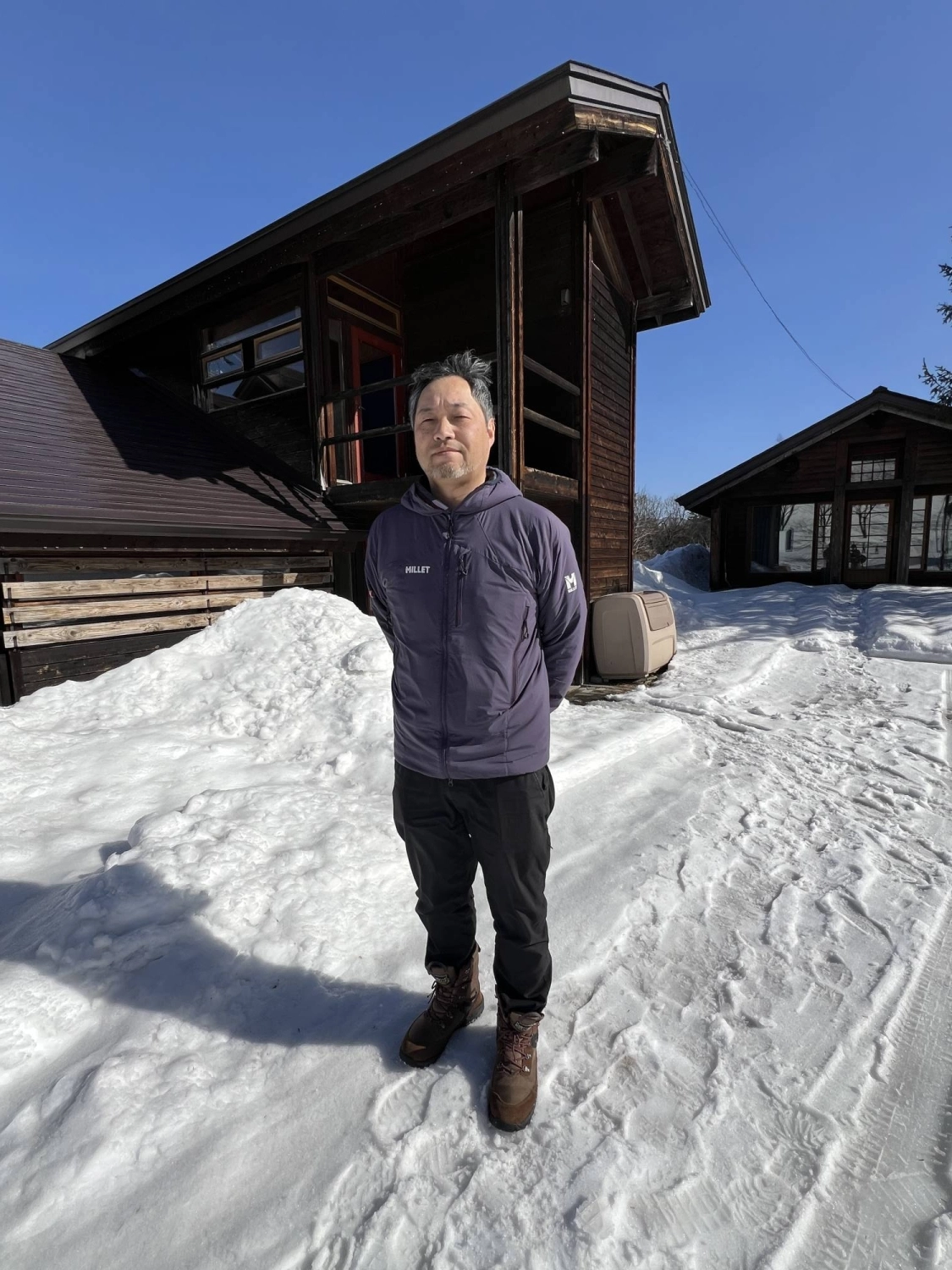
Yojiro Fukushima, director of the Tourism Commission of Hakuba Village, would like to see some visitors eventually choose Hakuba as a place to settle down in more permanently.
| TOMOKO OTAKE
The rapid rebound has created friction in many areas, including public transport. Shuttle buses, which most foreign visitors rely on, are shared with residents and now overcrowded — a complaint heard in other tourist magnets such as Kyoto.
Residents also say there aren’t enough taxis and that fares are rising sharply. Meanwhile, traditional minshuku offering one-night, two-meal stays — long a point of pride for the area’s inns — have declined, as tourists increasingly favor whole-building rentals and private cottages. The shift has contributed to a shortage of restaurants serving dinners, giving rise to a phenomenon known as yūshoku nanmin, or dinner refugees.
The weak yen and widening gap in purchasing power between inbound tourists and local customers have also left many residents feeling that everything in Hakuba has become overpriced.
Last year, the village’s Wadano district — where hotels, cottages and restaurants catering to foreign visitors are clustered — saw roadside land values jump by 32.4% from the year before, the largest year-over-year increase in Japan.
Similar pressures are playing out in some resorts nationwide, though the pattern is far from uniform. Matt Guy, a tourism consultant and 10-year Japan resident based in the snow resort town of Myoko, Niigata Prefecture, says the rise of luxury tourism is reshaping local communities.
After learning that his Japanese neighbors, young and old, could no longer afford to ski, Guy launched a petition last year calling on the government to offer 20% discounts on ski lift tickets to verified residents of Myoko.
Overseas investors often renovate properties and upgrade facilities to appeal to international visitors — a move that makes perfect business sense but can squeeze out Japanese customers whose income levels have remained largely stagnant for decades.
“A lot of things have been sold off already,” Guy says. “If a property is sold for $10,000 in Myoko to a foreign buyer, that property will never be $10,000 again. It’s going to be $300,000 from here on. And the market’s going to be different. It’s going to change hands.”
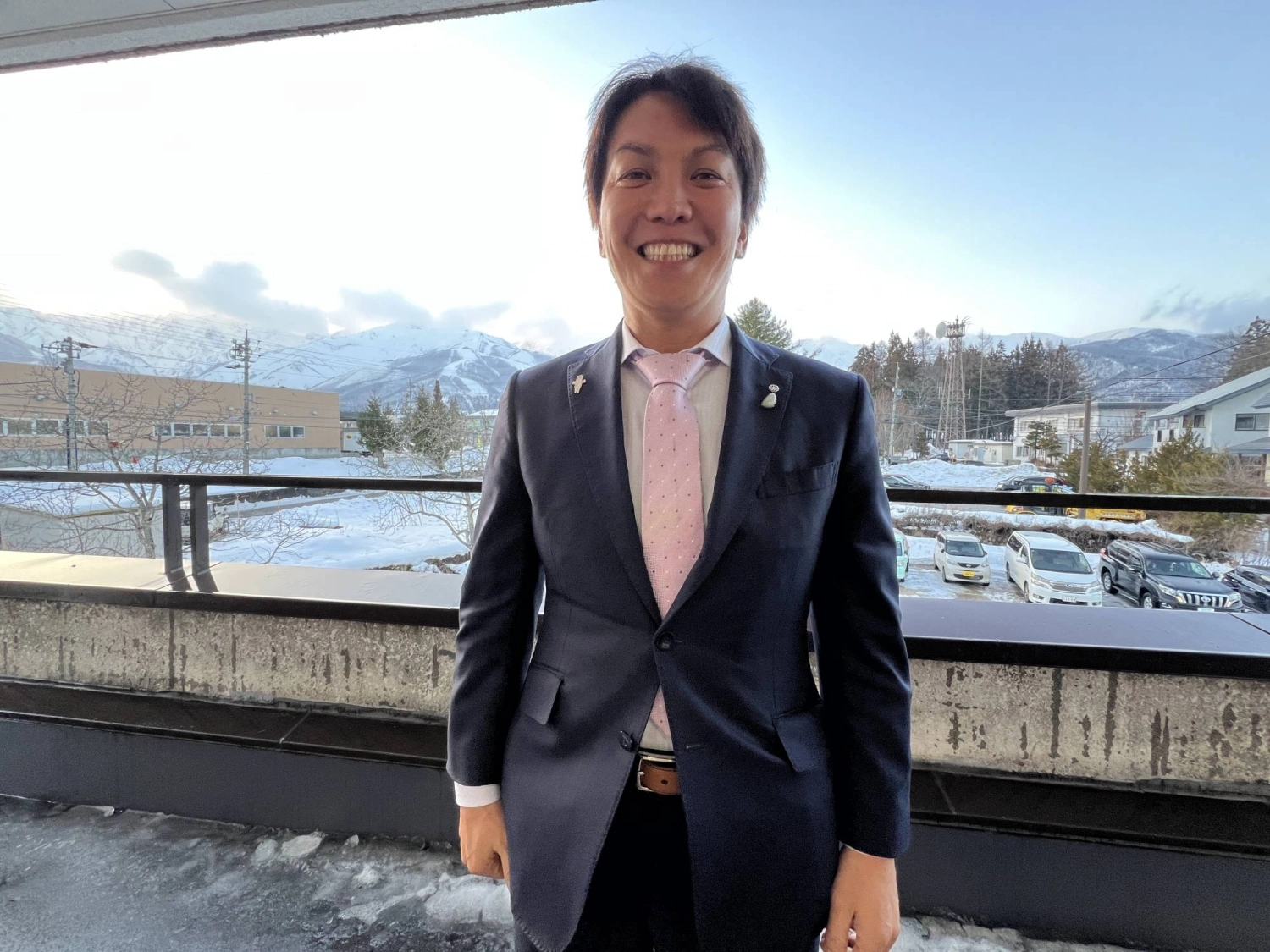
While an ordinance has been enacted to try and curb unruly behavior from overseas tourists in particular, Hakuba Mayor Toshiro Maruyama stresses the need to be welcoming to all guests.
| TOMOKO OTAKE
Across Hakuba, English signs crowd shopfronts, and many staff now use English first. At one winter-only washoku restaurant, staff struggled to communicate in Japanese, serving a bowl of udon that would be considered overly salty and rather pricey by local standards at ¥1,500. Mayor Maruyama, the third-generation owner of the award-winning Shirouma-so inn who took office in 2022, acknowledges the pressures on the town and says he has taken steps to manage them.
In line with measures in other tourist destinations, Hakuba will introduce its own accommodation tax in June, charging ¥100 to ¥1,800 per person per night depending on room rates. The village says it plans to use the revenue to improve public transportation, manage tourism-related waste and expand multilingual disaster information.
In December, the village assembly also passed a revised “manner ordinance” aimed at curbing disruptive behavior, banning acts such as graffiti and sticker vandalism, loud noises near residences, nighttime fireworks and drinking or skiing and snowboarding on the streets. While a similar ordinance existed before, the revised version allows authorities to impose fines of up to ¥50,000. The penalty clause will take effect in July.
“I find the ordinance pioneering in the sense that it reflects what can actually happen in Hakuba,” Maruyama says, adding that he favored giving it a soft-sounding name.
“Some assembly members argued it should be called a ‘nuisance behavior prevention ordinance.’ But Hakuba has a village charter that states residents should love the village, cherish the land and its people, and warmly welcome visitors. In my mind, visitors are not assumed to be a nuisance or a burden to be endured. For that reason, I didn’t want to give the ordinance a title that framed it that way.”
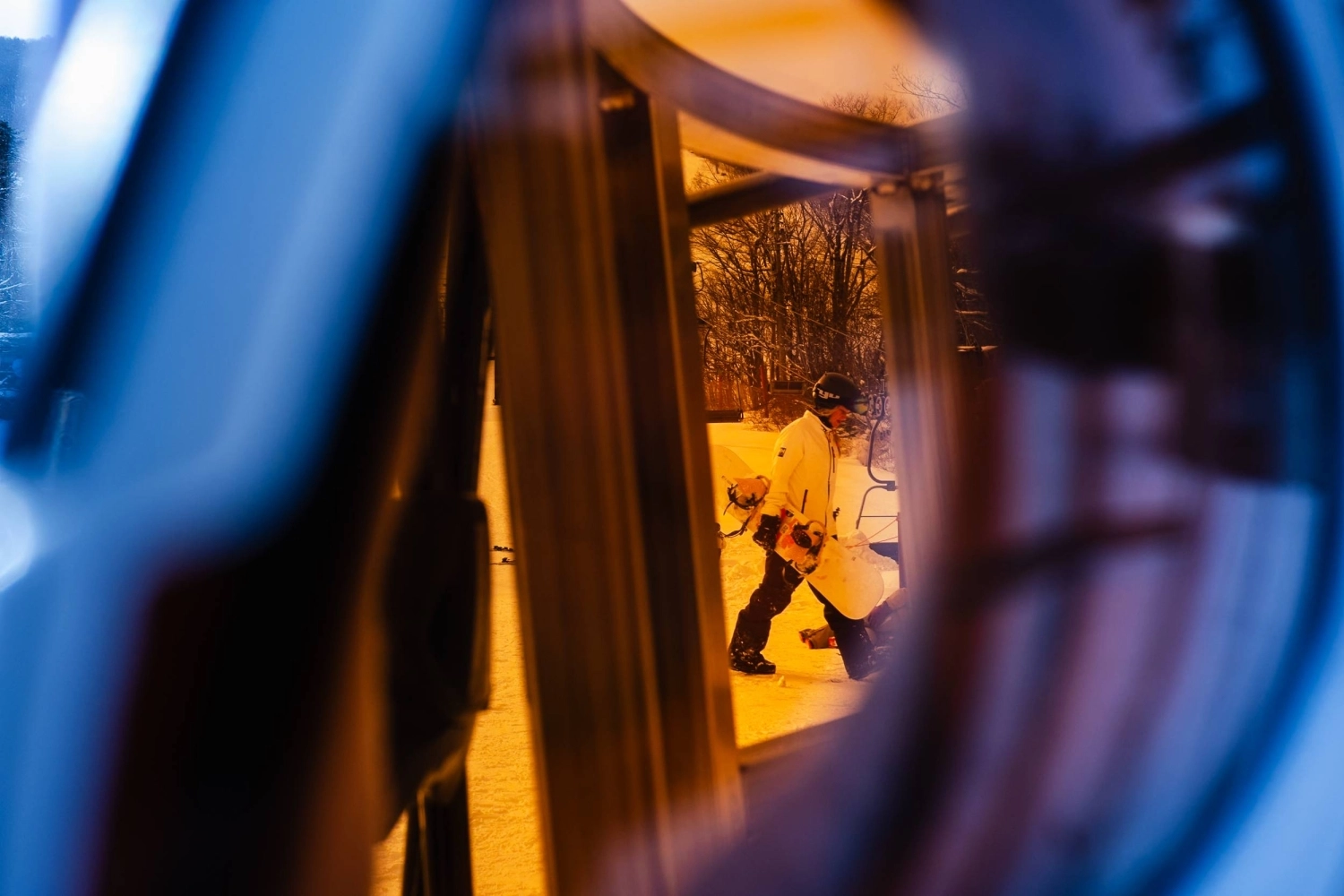
From Hakuba to Hokkaido, Japan’s ski resorts are popular with international tourists looking for some good snow in the winter months.
| JOHAN BROOKS
Hidefumi Hasui, a restaurant owner in the Wadano district, welcomed the move.
“Some people opposed it, saying the penalty would discourage tourism,” he says. “But this is really about what to do when people won’t listen to requests.”
Hasui, who lived in New York and is fluent in English, has played an active role in the community, serving as head of Wadano’s neighborhood association and communicating directly with non-Japanese business owners.
Many community leaders in Hakuba, by contrast, do not speak English and struggle to communicate with newly arrived foreign business operators when asking them to follow local rules on matters such as garbage disposal and cleanup.
Is Hakuba overrun by tourism? Fukushima, a Hakuba native who remembers the ski boom of the 1980s and 1990s, doesn’t think so. A single ski field back then could see 1 million visitors per season, compared with about 1.1 million today across all five ski fields. Yet he notes that tourism in Hakuba remains heavily concentrated in winter. For the village to develop sustainably, he says, it needs a steadier flow of visitors throughout the year.
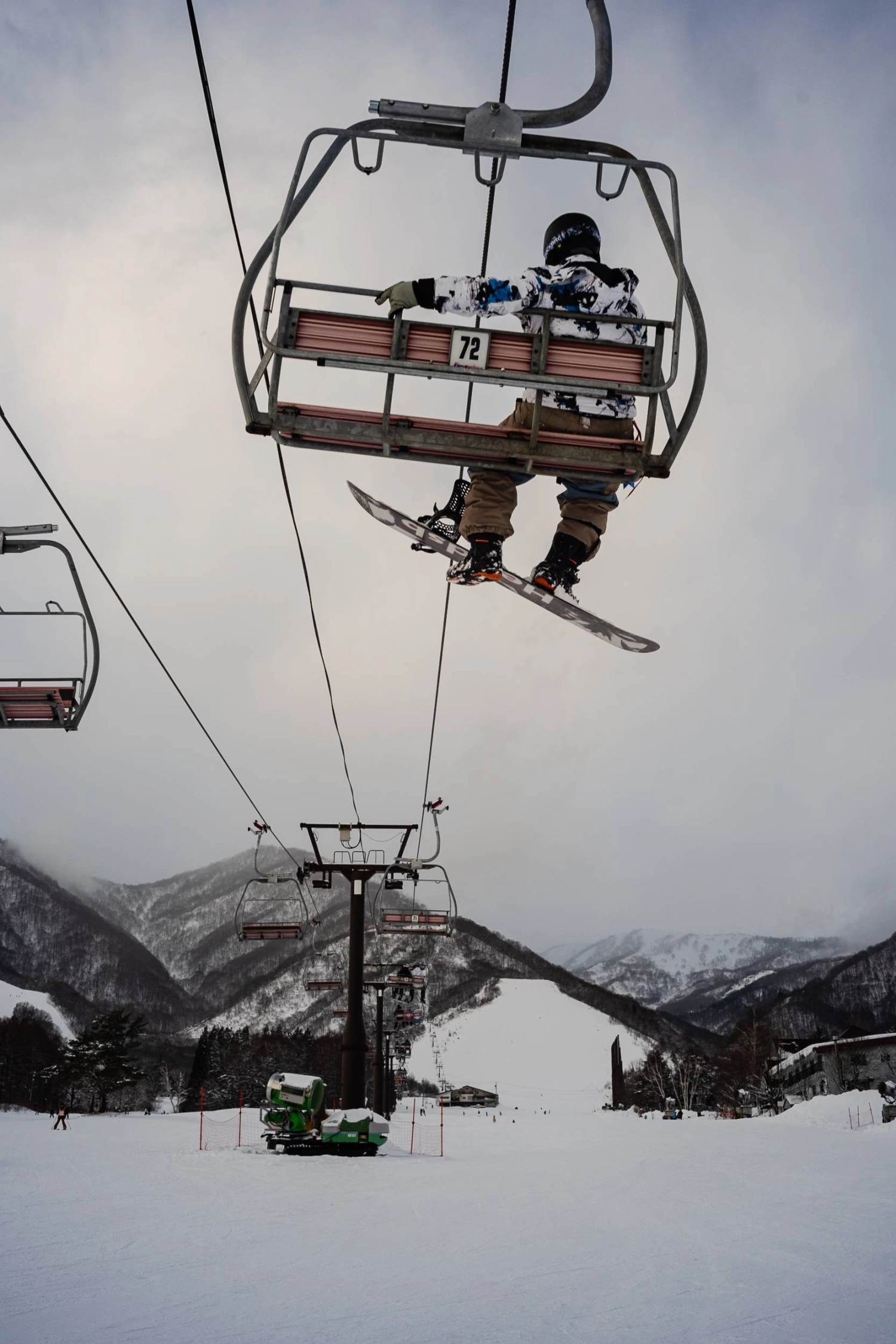
Pandemics, earthquakes, financial downturns — Hakuba has weathered many crises since it became a major tourist destination.
| JOHAN BROOKS
For Fukushima, housing shortages driven by new hotel and condominium developments are the biggest challenge, making it harder for visitors — regardless of nationality — to settle as residents. Hakuba, where more than 10% of residents are non-Japanese, is also grappling with population decline, like many rural communities in Japan.
“In tourism strategy, it’s important to cultivate repeat visitors,” Fukushima says. “Ultimately, repeat visitors could become residents. Right now, though, we can’t offer that goal. That’s not good.”
Who tourism is really for
Some local businesses are trying to shape Hakuba’s tourism future. On Jan. 16, B&D Hakuba Iwatake opened next to the Iwatake ski field, combining a two-story hotel with six rooms of varying sizes and a Western-style deli and restaurant.
The hotel, formerly a ski lodge, had been closed for a few years due to family health issues. Its restaurant is open to both guests and the public, a move intended to ease the “dinner refugee” problem.
Under an arrangement with Hakuba-based resort operator Zukutochie, the owner will lease — but not sell — the property, allowing him to remain on site.
Yutaka Wada, co-president of Zukutochie, is a longtime advocate of green tourism in Hakuba. A former farm ministry bureaucrat, he has renovated restaurants and lodges for modern consumers and opened a cafe. Wada founded Zukutochie with Hakuba native Satoru Ohta three years ago with the aim of revitalizing the valley’s tourism.
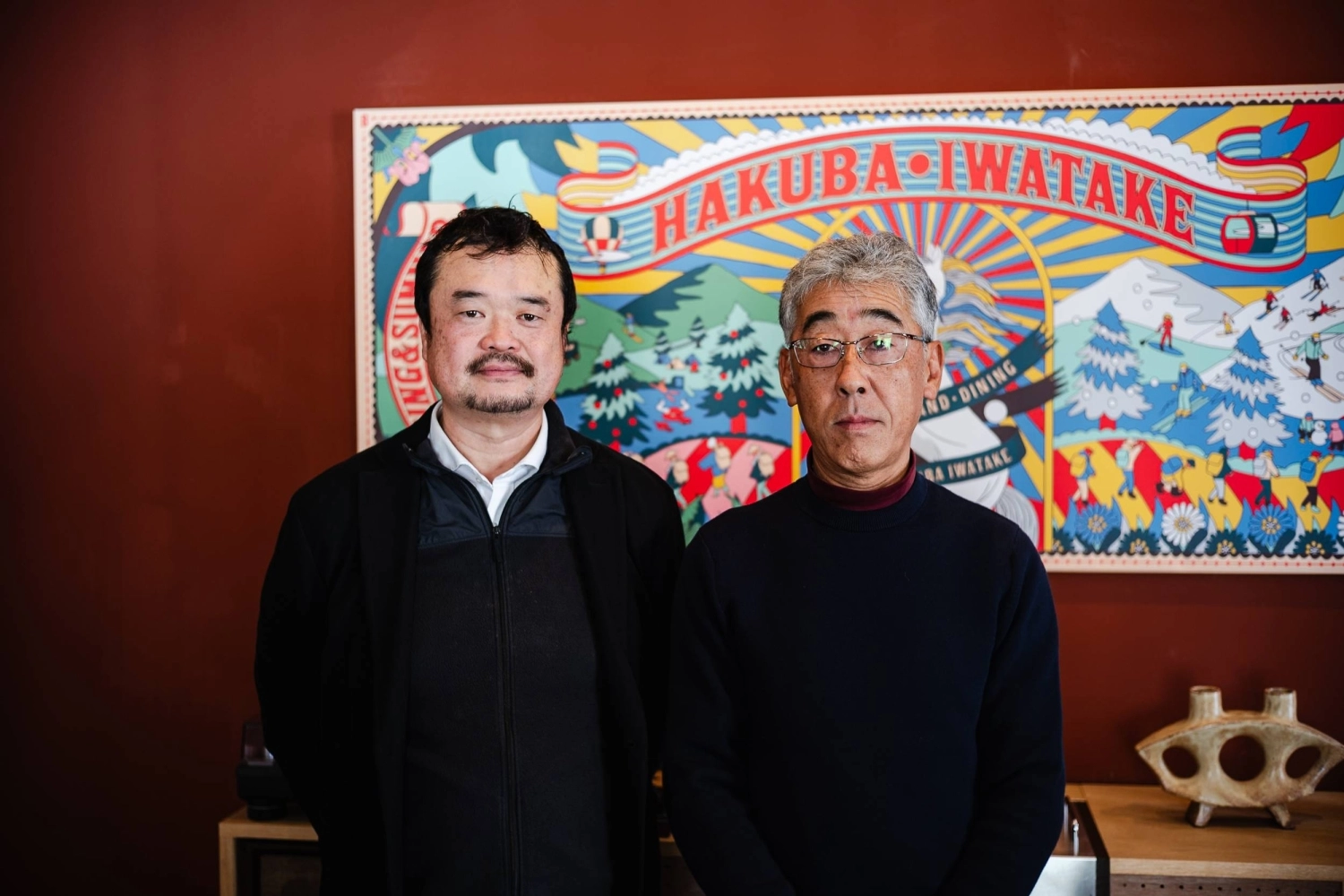
Yutaka Wada (left), the co-president of Hakuba-based resort operator Zukutochie, and Noriyuki Ito, the owner of a ski lodge recently renovated and reopened as B&D Hakuba Iwatake, are among local operators seeking to shape a more sustainable future for tourism in the village.
| JOHAN BROOKS
Many of Hakuba’s ski lifts and family-run inns are aging and in need of reinvestment, but their original owners are growing older and often struggle to maintain their properties. When they sell, rising land prices frequently force them to leave town.
Wada notes that while many overseas tourists come to Hakuba, they tend to stay at newer and fancier hotels and cottages catering specifically to them. As a result, he says, minshuku have not benefited from the boom. Many aging minshuku owners, with no one to take over their businesses, end up selling their properties to outside operators.
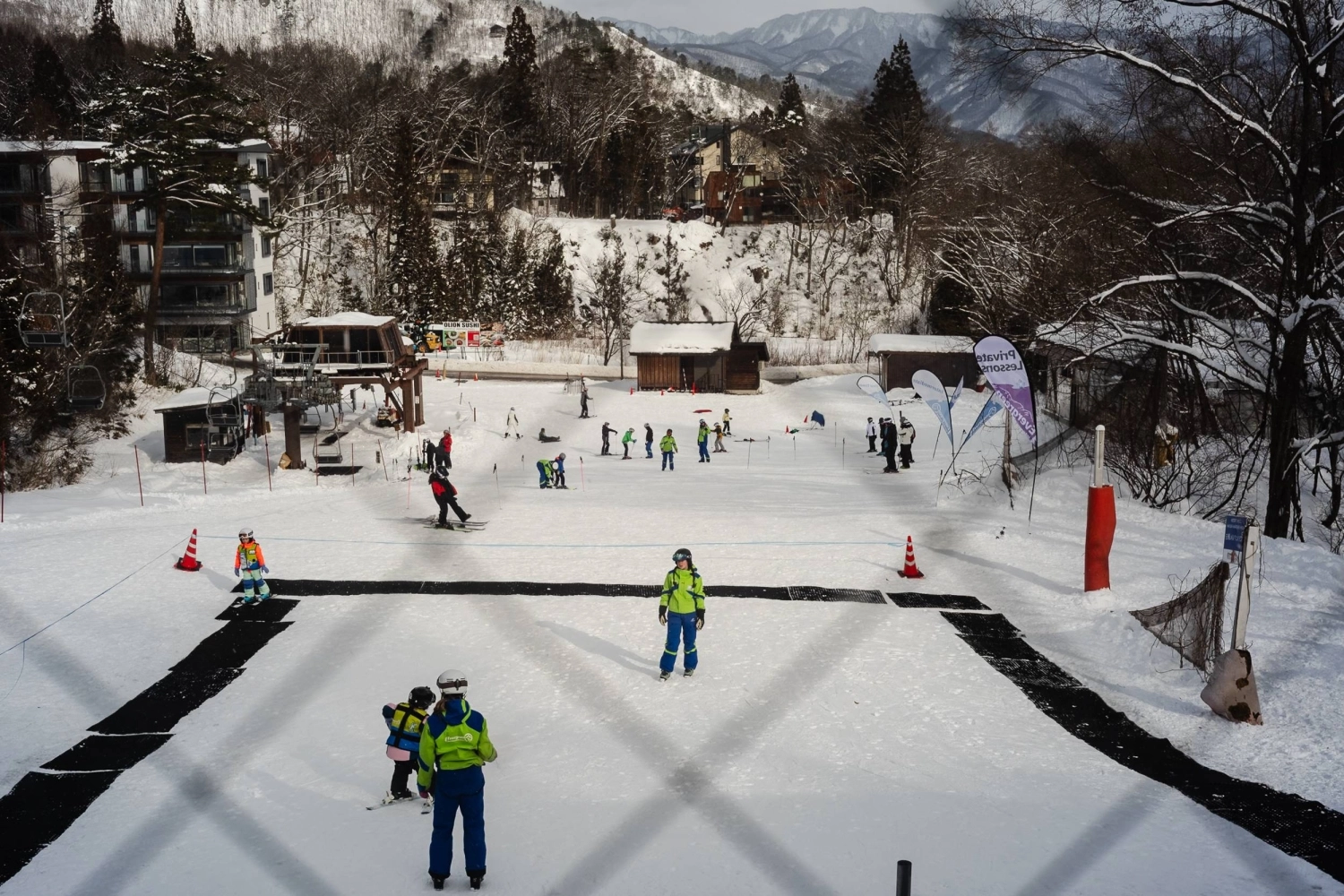
Hakuba has become especially popular with Australians in search of a type of snow known as “Japow,” a portmanteau of “Japanese powder.”
| JOHAN BROOKS
For Wada, local involvement is key.
“The real question is whether the profits generated in Hakuba will continue to be reinvested in Hakuba,” he says. “On that front, we as local operators are more likely to meet that expectation.”
He says that businesses from outside the valley may invest elsewhere — for example, Myoko or even Singapore or Malaysia — making it difficult to keep locally generated profits in the community.
“I think it would be difficult if the investors were exclusively foreign,” he says.
Ultimately, it’s up to Hakuba’s residents to find the right balance between welcoming visitors and preserving a sense of home. It is a question many tourism towns in Japan are asking now, one whose answer will define their future.
AloJapan.com