
Japan Data
Society
Education
Feb 2, 2026
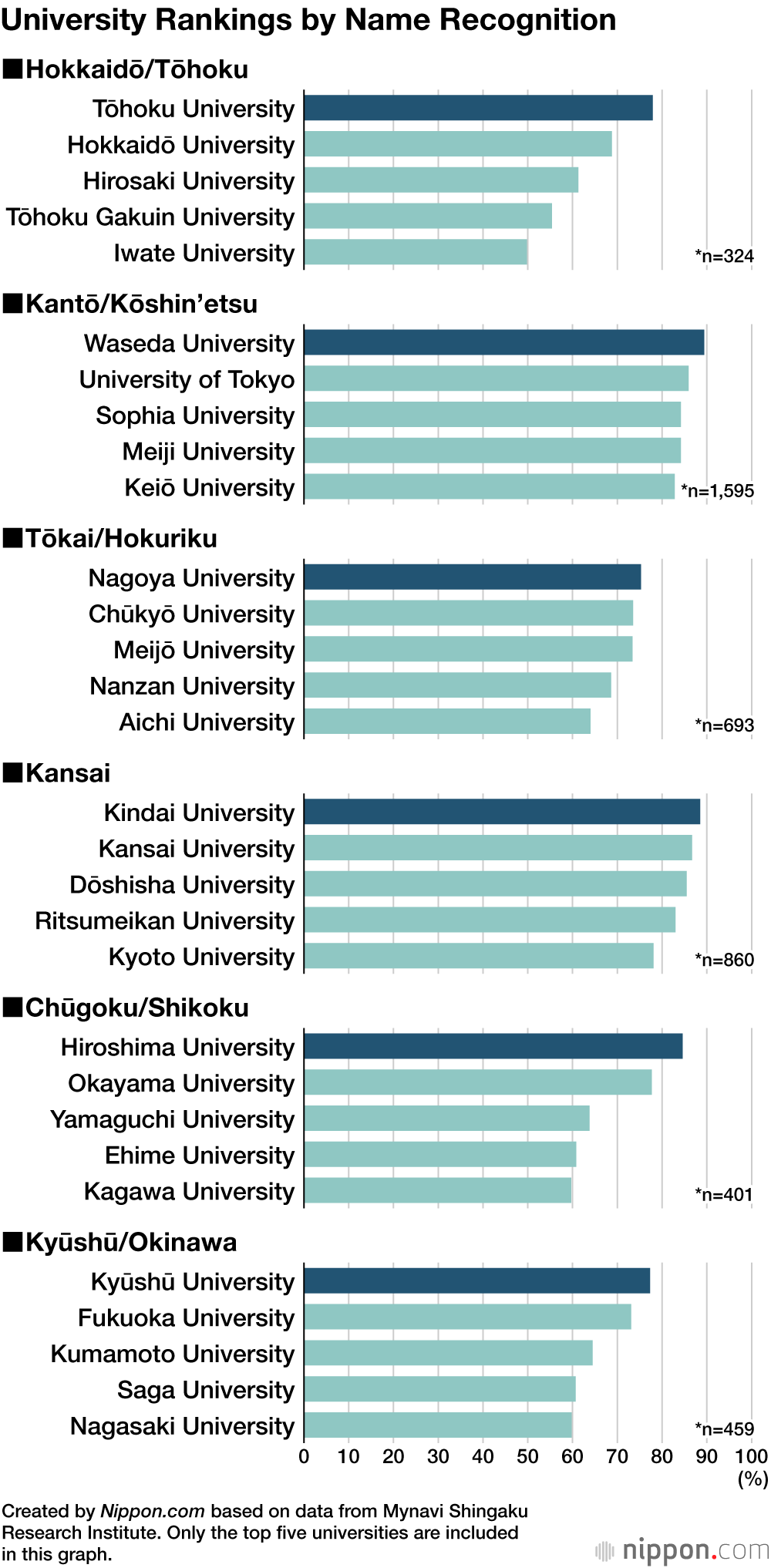
A survey of Japanese high school students found that Waseda University was the best-known university in the wider Tokyo area, while Kindai University was top for Kansai.
Top Name Recognition
An annual survey of third-year high school students, held in the 2025 academic year, found that Waseda University had the greatest name recognition in the Kantō-Kōshin’etsu region, centered on Tokyo, rising from its second-place position the previous year. Meanwhile, in the Kansai region, Kindai University maintained its top spot for the fourth straight year.
The online survey was conducted by Mynavi Shingaku Research Institute between July and November 2025, targeting 127,815 third-year high school students who are scheduled to graduate in March 2026. A total of 6,520 valid responses were received. The name-recognition rankings according to region were compiled on the basis of the 4,332 students who intended to pursue higher education.
The survey covered 821 universities across Japan. Waseda University has been able to attract the attention of prospective students by using social media and video content to convey its campus atmosphere and student life. Kindai University, for its part, has become more popular through its social-media strategy and a unique public-relations effort, resulting in the university having one of the largest base of followers for its official social-media accounts.
Elsewhere in the country, national universities stood out as the most recognized institutions, with Tōhoku University at the top of the Hokkaidō and Tōhoku region, Nagoya University leading the Chūgoku and Shikoku region, and Kyūshū University ranked first in the Kyūshū and Okinawa region. This contrasts with the Kantō-Kōshinetsu region, where private universities ranked highly.
When asked what factors boosted the image of their preferred universities, “a wide range of academic content” was mentioned most frequently, by 67.6% of those surveyed, followed by “name value in the job market” and “solid support for students,” at 67.1% and 61.3%, respectively, thus reflecting a pragmatic trend among students.
Data Sources
(Translated from Japanese. Banner photo © Pixta.)
university
AloJapan.com