
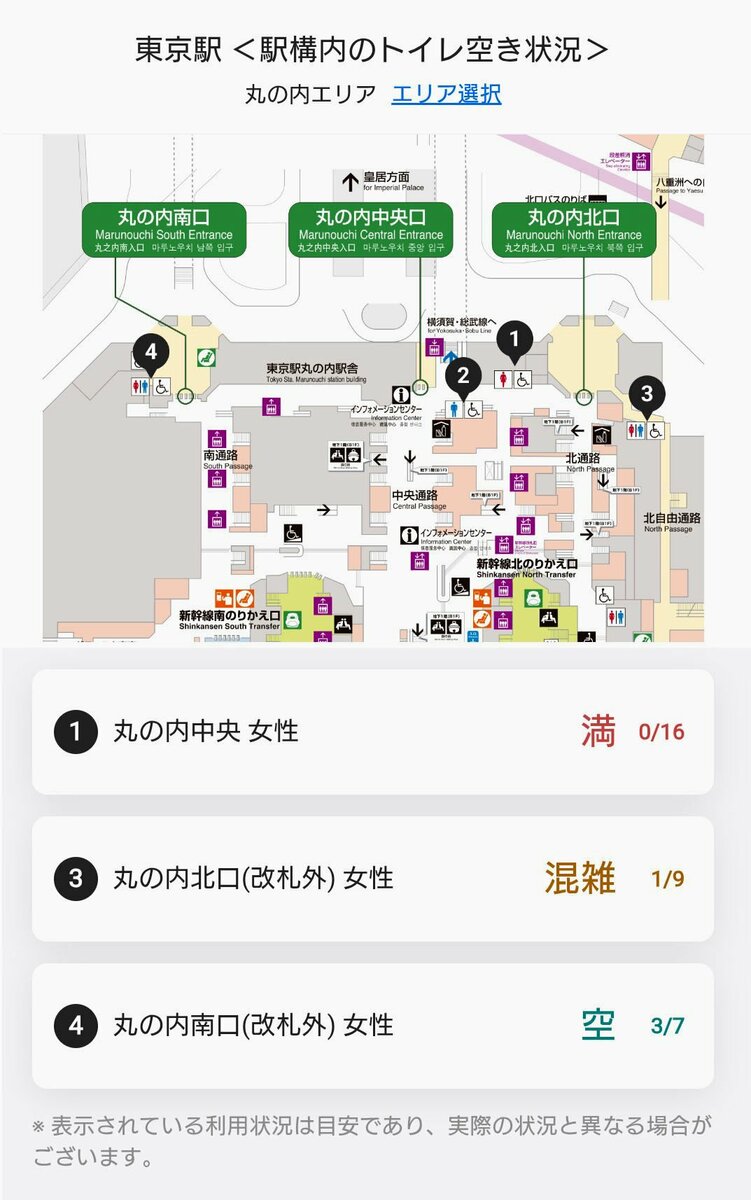
TOKYO – Japan Railways group has been rolling out measures to ease congestion at women’s toilets at stations, including increasing the number of facilities and introducing services to help users find less crowded restrooms.
Women’s toilet capacity at stations remains at only about 60 percent of that for men, according to the Ministry of Land, Infrastructure, Transport and Tourism.
East Japan Railway Co. launched a service in December that allows users to check congestion levels at women’s toilets at Tokyo Station. The number of vacant stalls is displayed on monitors in front of restrooms or on the operator’s website, with indicators reading “empty,” “congested” or “full.”
JR East has identified 13 stations in the Tokyo metropolitan area, including Tokyo Station, where women’s restroom capacity is particularly strained, with company President Yoichi Kise calling it an “operational challenge.”
The company is encouraging dispersed use because building new facilities takes time, but it remains unclear how much this will ease congestion at stations such as Tokyo, where huge numbers of people pass through, and restroom availability is constantly changing.
Meanwhile, Central Japan Railway Co. increased the number of women’s toilet stalls at Shin-Osaka Station from 16 to 26 by last March. It also installed more women-only toilets in cars on the Tokaido and Sanyo Shinkansen lines.
Similar services showing restroom congestion levels were introduced earlier at Kyushu Railway Co.’s Hakata Station in southwestern Japan, JR Central’s Shin-Osaka Station and West Japan Railway Co.’s Hiroshima Station.
In November, the transport ministry held the first meeting of its council to address congestion at women’s toilets at public facilities. Data presented at the meeting showed that women’s toilet capacity at railway stations is only about 63 percent of that for men, reflecting the use of both urinals and stalls in men’s restrooms.
The figure was 66 percent at airports, 71 percent at bus terminals and 89 percent at movie theaters, according to the data, while facilities such as commercial complexes, theaters and halls tend to offer higher capacity for women.
Regarding the cause of congestion, an analysis by the ministry indicated that many facilities were built when only a small share of women worked outside the home, leaving women’s toilet capacity insufficient. The analysis also suggested that the spread of Western-style toilets, which offer more comfort than Japanese-style ones, has led to longer occupancy times.
AloJapan.com