
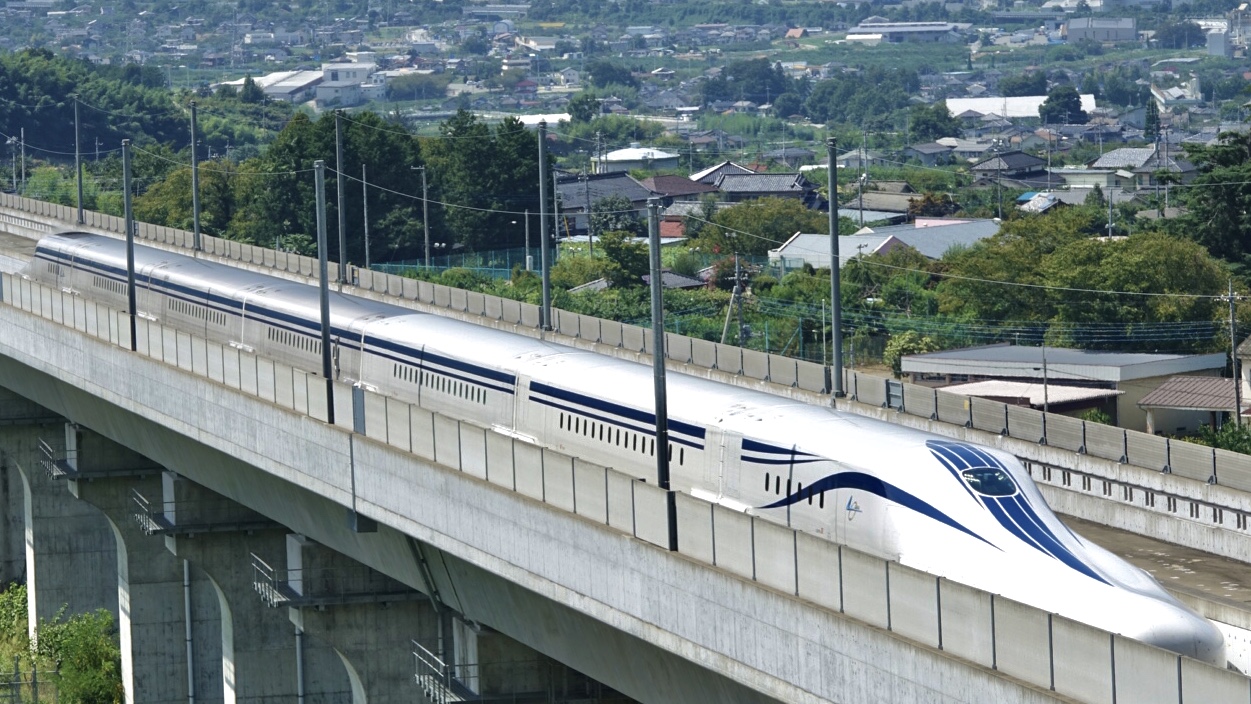
The L0 Series maglev train should be inaugurated around 2035 and should be able to travel at a maximum speed of 603.5 kilometres per hour. Even though a similar train would significantly reduce travel times within Europe, such an arrival should not be expected anytime soon.
Japan has a long-standing history with high-speed trains. The country’s first bullet train was introduced over 60 years ago – in 1964 to be precise – and connections have been expanding ever since. The Shinkansen, as the Japanese bullet trains are called, have since become a national symbol and at the moment, over 2,897 kilometres of specialist track connect most major cities within Japan, travelling at speeds of up to 322 kilometres per hour.
@saaadro Tokyo to Osaka in 1 hr gonna be nice #tokyo #japan #osaka #kyoto #travel #bullettrain ♬ original sound – S
But why stop there? At the time of writing, the Central Japan Railway Company (JR Central) is working on the L0 Series’ Chuo Shinkansen line between Tokyo and Nagoya, which should be extended to Osaka. Once completed, it would be home to the world’s fastest train, reaching maximum speeds of 603.5 kilometres per hour.
At the moment, people can travel between Tokyo and Nagoya using different trains, which makes the journey take a minimum of one hour and 26 minutes. Once the L0 Series’ Chuo Shinkansen line is completed, this would go down to a mere 40 minutes.
That astonishing speed would be reached using so-called maglev trains and tracks. Maglev stands for ‘magnetic levitation’, a technique using both magnets and electricity. The trains are lifted above the rails using magnets, thus taking away as much friction as possible, and then pushed forward by an electric motor. The same technology is already being used for China’s Shanghai Maglev, currently known as the world’s fastest train, reaching speeds of up to 460.2 kilometres per hour.
@browsingwithbruno This train represents the growth of my account. #fy #fyp #train #japan #traintok #fast #speed #fun #information ♬ original sound – Browsing with Bruno
However, before the new fastest train in the world can become a reality, major works need to be carried out. The tracks in particular demand an excruciating amount of care, amongst other things, to make them earthquake-proof. Local objections and soft grounds have caused major delays, so while the completion of the project was initially scheduled for 2027, a new inauguration date has been set for 2034 or 2035. At the moment of writing, costs for the project have reached some €59.9 billion.
What about Europe?
If the same L0 Series’ Chuo Shinkansen technology were introduced in Europe, travel times across the continent could drop significantly. The fastest trains are currently being operated by the French TGV and the Italian AGV Italo, reaching a maximum speed of 354 kilometres per hour.
However, as the Japanese project shows, maglev train connections would require major infrastructure works, including all-new tracks and numerous tunnels, asking for big investments. Moreover, as the European train network currently partly relies on its beautiful landscapes along the way for its attractiveness, chances are small that the maglev trains will reach Europe anytime soon.
AloJapan.com