
KYOTO–A research team from Kyoto University and other institutions has discovered a drug that selectively kills and eliminates only senescent cells, which are involved in the aging process.
The drug was found effective when it was administered to mice with idiopathic pulmonary fibrosis (IPF), an intractable disease without a known cause, the scientists said.
The researchers said they hope to have the drug tested clinically for humans in the years to come. The research results were published Dec. 15 in Signal Transduction and Targeted Therapy, a scientific journal.
TARGETING REMOVAL OF SENESCENT CELLS
Living creatures lose resilience gradually as they age. A class of deteriorated cells known as senescent cells, which die hard, survive and accumulate in their organism.
It is believed that the buildup of senescent cells in the body causes chronic inflammation and the progression of aging.
Studies are under way around the world for artificially removing the senescent cells from the organism by causing their cell death.
The scientists on the study team set their sights on a chemical compound that was developed as an anticancer agent but is not used because of its high toxicity.
The researchers found, however, that the optical isomer of that compound, which has the same constitutional formula and has a mirror image structure, causes cell death selectively to senescent cells alone.
They discovered that administering the drug to aged mice eliminated senescent cells in their livers, lungs, kidneys and muscles.
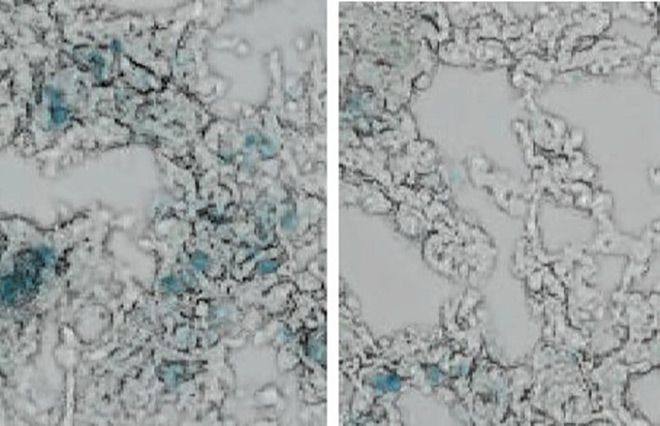
They also induced a state of IPF in mice and administered the drug to them, whereupon they found a decrease in senescent cells and alleviation of lung fibrosis.
IPF is a government-designated intractable disease that typically occurs in middle-aged and elderly men.
“Senotherapy, or the removal of senescent cells from the organism, is attracting global attention and is under study, but it has yet to reach the stage of practical use,” said Hiroshi Kondoh, a Kyoto University associate professor of geriatrics, who led the study team. “We will continue with our research toward practical implementation of the drug we found in the latest study.”
AloJapan.com