
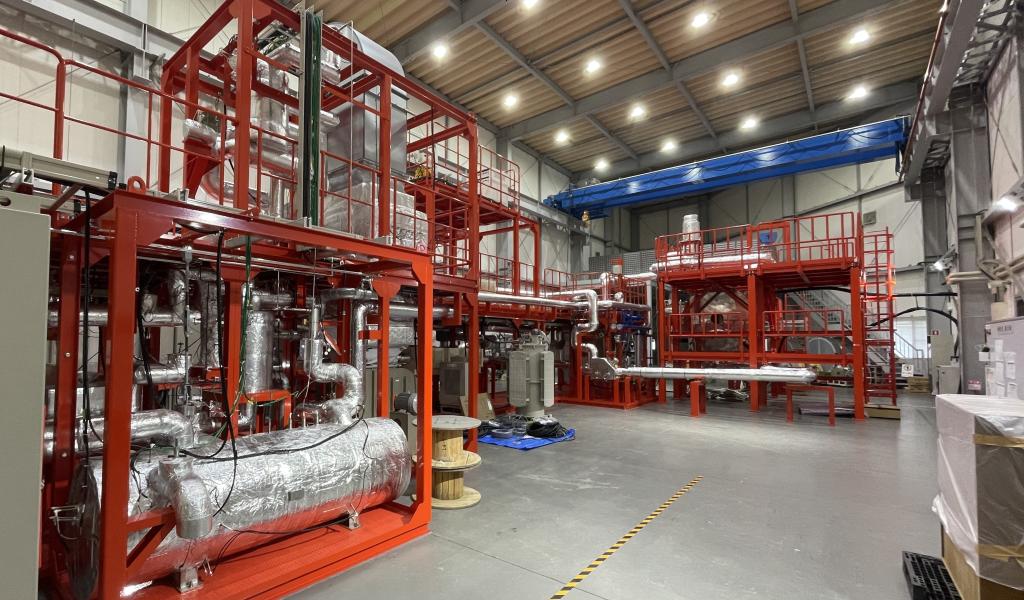
Anchoring the strategic partnership announced today by the U.S. Department of Energy (DOE) and Kyoto Fusioneering (KF), Oak Ridge National Laboratory (ORNL) and KF have established a new public-private partnership that leverages each institution’s expertise in fusion technology to accelerate the deployment of commercial fusion power. ORNL and KF will develop cutting-edge experimental infrastructure to test and validate next-generation tritium breeding blanket systems, a critical technology for producing the fuel needed to sustain fusion power generation.
The agreement includes working towards the creation of UNITY-3, a world-leading breeding blanket test facility capable of testing blanket concepts in prototypic fusion nuclear conditions. The facility will be sited at ORNL. These R&D activities will advance mutual commercial and research goals of both organizations, as well as drive down risk for fusion pilot plant (FPP) programs.
“Fusion energy represents a transformational opportunity for our energy future,” said Dr. Darío Gil, DOE Under Secretary for Science. “This partnership reflects DOE’s commitment to working with trusted allies and the private sector to build critical infrastructure, strengthen American competitiveness, and deliver real, measurable progress toward making fusion energy a reality.”
UNITY-3 will complement KF and its partners’ existing Unique Integrated Testing Facility™ (UNITY) Program, which includes the UNITY-1 blanket and thermal cycle test facility operating in Kyoto, Japan, and the UNITY-2 deuterium-tritium fuel cycle facility under construction in Chalk River, Canada.
Through the partnership, ORNL and KF will close critical gaps identified in the DOE Office of Science’s Fusion Science & Technology Roadmap and advance the technology readiness levels of tritium breeding blanket and fuel cycle systems. This collaboration will also develop key infrastructure, accelerate discovery through industry-informed collaborative research, and grow the U.S. fusion sector through strategic public-private partnerships as part of DOE’s Tritium Blanket Development Platform under the Fusion Nuclear Science mission.
As the largest multi-program science and technology laboratory in the DOE complex, ORNL is at the forefront of supercomputing, neutron science, materials research and advanced manufacturing, all of which can support the design, validation and fabrication of advanced blanket systems for future fusion energy devices.
“Moving breeding blanket technology from theory to real-world application is crucial in realizing a path to fusion energy,” said Troy Carter, director of ORNL’s Fusion Energy Division. “By combining ORNL’s deep expertise in fusion systems, materials and blanket research with Kyoto Fusioneering’s unique technology and engineering expertise, and integrated test platforms, this partnership can strengthen the public-private fusion ecosystem and support the commercialization of fusion energy.”
KF is a privately funded fusion technology group of companies with headquarters in Japan and subsidiaries in the U.S., the United Kingdom, the European Union, and Canada. KF is focused on developing high-performance advanced technologies and integrated systems for commercial fusion power systems, including electron cyclotron resonance heating and alternative plasma heating, tritium fuel processing, and breeding blanket technology for fuel production and power generation.
“Partnering with ORNL allows us to tackle one of fusion’s hardest remaining cross-cutting challenges: validating breeding blanket performance in a nuclear environment. This collaboration operationalizes the DOE’s ‘Build-Innovate-Grow’ strategy, combining ORNL’s deep scientific lineage in fusion nuclear science and engineering with KF’s fusion technology and engineering expertise,” said Bibake Uppal, Vice-President and Head of KF’s U.S. subsidiary, Kyoto Fusioneering America. “Leaning on our respective strengths through this public-private partnership, we will rapidly build essential infrastructure to close critical technology gaps and directly de-risk and accelerate the path to a fusion pilot plant.”
ORNL and KF have ongoing collaborations through DOE’s Innovation Network for Fusion Energy (INFUSE) program, which involves evaluating the effect of lead-lithium mixtures for fusion blankets, and DOE’s Fusion Innovation Research Engine (FIRE) Collaborative program, where KF’s UNITY-1 facility will contribute to the ORNL-led Blanket Collaborative on Test Facilities project by investigating liquid metal blanket concepts.
In addition to establishing the UNITY-3 facility, ORNL and KF will co-develop a plan for public-private technology commercialization and explore opportunities for technical expertise and personnel exchanges between the organizations.
DOE-KF announcement linked here .
UT-Battelle manages ORNL for DOE’s Office of Science, the single largest supporter of basic research in the physical sciences in the United States. The Office of Science is working to address some of the most pressing challenges of our time. For more information, please visit energy.gov/science .
AloJapan.com