
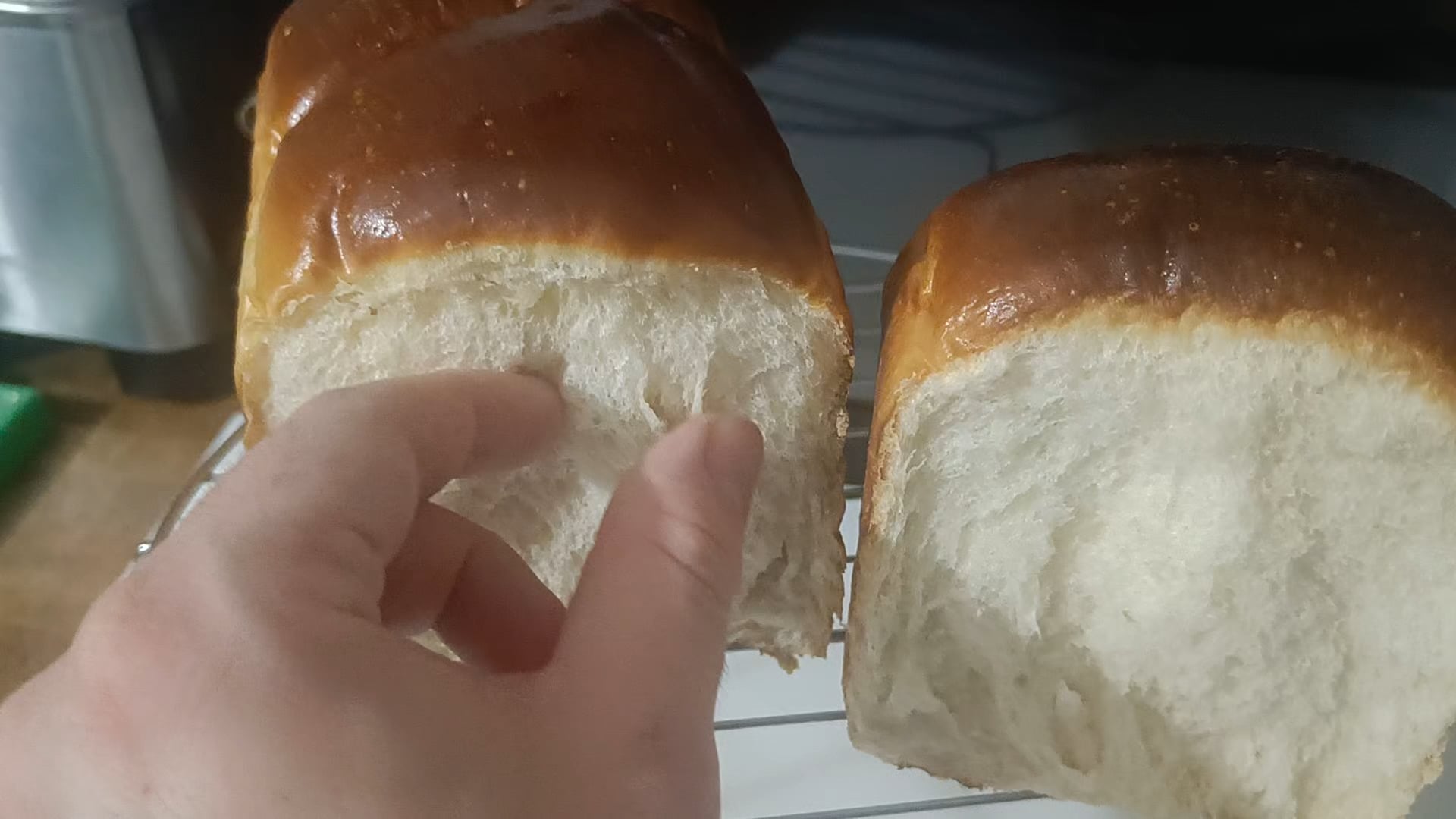

And after making an unexpected bread the other day ( https://www.reddit.com/r/Breadit/comments/1qmgamg/i_made_shokupan_with_the_wrong_hydration_the/ ), I tried again because I still wanted Japanese bread.
I'd say it couldn't have been better, and since I can't post videos or photos, I'll post them below:
https://i.imgur.com/WQBrsLd.jpeg
https://i.imgur.com/7oR7IuD.jpeg
For the procedure, I used the usual video https://www.youtube.com/watch?v=tc3coiL36Cg, (I know this one is korean but I think the recipe is the same for japanese milk bread too) but this time I thought I'd try to summarize, also because I used slightly different proportions:
310 (25)g Manitoba flour,
110g milk (100+), 35g water, (this is where my mistake from last time comes from; the 100g of milk is in parentheses, I wrote 220g milk (100+)… actually, 220g was the total grams of milk in the recipe… so I used 320 the other time, way too much)
6-7g salt,
7g fresh yeast (half if you use dry yeast),
33g sugar,
27g egg (about half, the other half will be needed along with a drizzle of cream for brushing, so don't throw it away/consume it),
27g butter
First, take 100g milk and 35g water, place them in a nonstick pan with 25g flour, stirring to remove any lumps while cold, then heat over low heat, stirring constantly until a sticky dough forms. Note: a nonstick pan is recommended, as it tends to stick with a regular pan, but it's not mandatory. Note: If you're in a hurry, you can skip this entire step, but it adds softness, fluffiness, and flavor (by developing amylase during the resting phase), so I recommend doing it. If you skip it, add all the ingredients to the next dough.
Let it cool overnight in the refrigerator (if you skip the resting time, you'll still have to let it cool; it won't develop as much amylase, but it will have similar characteristics in terms of liquid absorption, resulting in softness and fluffiness).
This is called tangzhong or yudane, or scalding the flour (or starches, depending on what you use). You can also do this by bringing a liquid to a boil and mixing it with the flour in a container, but the risk is that part of the flour will come into contact with a liquid that's too cold and won't gelatinize, whereas if you put it in a pan, everything will gelatinize.
For the main dough, place all the ingredients in the bowl of a stand mixer (except the butter) and develop the gluten very well (without butter, a veil won't necessarily form, but the dough should still be one that doesn't tear easily). Once this is done, add the butter and knead until a veil forms. Note: It's possible to make the dough without a stand mixer as a no knead, but expect it to take much longer… it's not an easy dough.
Let it rest for 5 minutes towards the end before forming a ball of dough to rise.
If you're in a hurry, add up to 20g of fresh brewer's yeast (10g of dry yeast); otherwise, it will take several hours to rise (you can speed up the process by placing the dough in a bowl and then the bowl in warm water, obviously without wetting the dough).
Once it has doubled in size, divide it into 3 equal portions (weigh with a scale).
Make balls.
Let it rest for 15 minutes.
Roll out the balls with a rolling pin (if you roll out the exposed side, it shouldn't stick). Pop any bubbles with your hands and turn the dough over. Once you have a strip of dough, fold the two edges so that they overlap. You'll end up with a 3-layer dough, a strip the other way around.
Roll up from the now longer side and seal the bottom to form a tube.
Place the tube in the buttered pan.
Once all three are done, let it rise until it has tripled in size. Note: in the summer, using 15-20g of fresh yeast will take no more than half an hour. If you use 7g of fresh yeast now, in the winter, it could take several hours.
Brush the remaining half egg mixed with a little cream over the bumps (if you have any leftovers, you can make a mini omelette; don't use too much).
Bake at 180°C fan off. After 20 minutes, place a thermometer in the center and bake until the core is 92°C.
by LiefLayer
AloJapan.com