
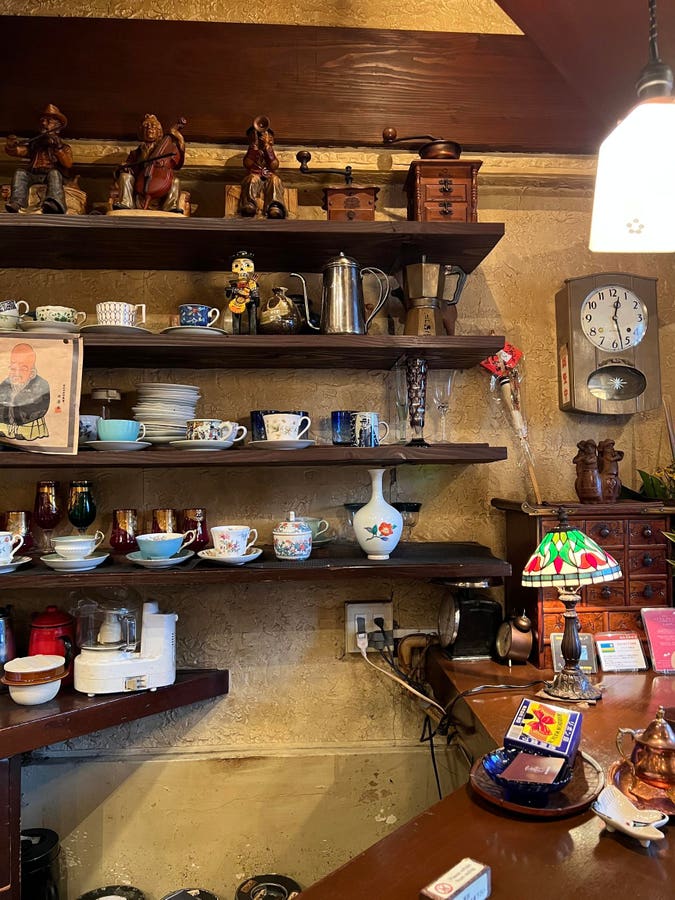
Shelves lined with mismatched porcelain cups inside Tajimaya Coffee House in Shinjuku.
Alex Catarinella
Endlessly sprawling Tokyo has so much to offer that things can quickly tip from exhilarating to overwhelming. When the need for a soul-soothing moment to myself inevitably arises, I make my way to the nearest old-school kissaten. These beyond-retro coffee shops and tea rooms feel less like businesses and more like Showa-era (1926–1989) time capsules. My favorites are known as junkissa, or “pure cafes” (not to be confused with the jazz kissa, vinyl-focused listening bars). Beyond serving unfussy and affordable coffee, my go-to junkissa share a few things in common: they’ve been open for at least fifty years, are often cash-only, rarely offer English menus and are always decorated like dusty antique shops frozen in time.
I really know I’m in an authentic, locals-only spot when my eyes are watering from intense cigarette smoke and the waiters look as if they have been there since opening day. When it comes to kissaten fare, you can’t go wrong ordering the classics: omurice (an omelet stuffed with ketchup-fried rice), spaghetti Napolitan (ketchup-based pasta), tamago sando (an egg salad sandwich) and colorful ice cream floats. If you consider yourself even mildly Japan-obsessed, you’ve likely seen the bright green, melon-flavored soda float topped with vanilla ice cream and a cherry all over your social feeds lately. That visibility makes sense, considering my preferred spots for dissociation and smoking are suddenly having a comeback.
According to a recent piece in The Japan Times, the resurgence is fueled by a nostalgia boom and Gen Z Tokyoites embracing a more offline life, with high-concept newcomers like contemporary artist Takashi Murakami’s prismatic Coffee Zingaro inside Nakano Broadway and 27 Kissa in Kabukicho, which moonlights as a nightclub featuring pole dancers and drag performances. With more than 155,000 kissaten nationwide at their peak in the early 1980s before glossy chains and trend-driven cafes took over, the revival feels like a welcome plot twist. Still, the Showa-era soul lives most vividly in the idiosyncratic holdouts that never felt the need to change.
For proof, just head to Shinjuku, where some of the megalopolis’ most memorable institutions are hidden away within its frenetic streets, making it easy to spend an entire day supporting longtime local businesses and disappearing into the smoky charm of old Tokyo.
Coffee Seibu
Coffee Seibu
Alex Catarinella
According to the internet, everyone wants it to be 2016 again. I get it, because that was the year I had my first kissaten experience. I trusted the hip receptionist at the budget hotel in Shinjuku, where I was staying, who sent me straight to Coffee Seibu after I asked where I could find a smoker-friendly, non-touristy coffee shop. Walking into Coffee Seibu felt like stepping back in time to 1964, when it first swung open its doors. The warmly lit space was a photographer’s dream, atmospherically bedecked with low-slung crimson velvet booths and a stained-glass ceiling, with clouds of cigarette smoke cascading over cups of coffee and plates of omurice.
A sundae at Coffee Seibu.
Alex Catarinella
While Coffee Seibu’s dessert menu offers everything from coffee jelly to sundaes, the architectural fruit parfaits are the undisputed showstoppers. These highly Instagrammable creations—layered with scoops of ice cream, fresh fruit and whipped cream, then crowned with whole cones and Pocky sticks—are what younger crowds flock here for later in the day. I always arrived early for the delightfully simple, inexpensive breakfast set: a few slices of toast with butter and jam packets, some decorative lettuce, a dollop of potato salad and a hot or iced coffee. I came so often that an older, ever-present server, who brightened every morning with his contagious genki (lively energy) and seemed never to have taken a day off since 1964, started remembering my order.
Climbing the narrow, scuffed-up staircase and into a serene, jazz-filled smoker’s paradise became my giddy morning ritual every time I was in town. So when I learned in 2023 that Coffee Seibu would be relocating to Kabukicho, Shinjuku’s wild nightlife and red-light district, my heart nearly stopped. Thankfully, its Showa-era soul survived the move, bringing along the original stained-glass ceiling, those plush red velvet chairs, the indulgent menu and its loyal regulars. And while the new Coffee Seibu no longer allows smoking, I’m forever addicted to the timeless charm of my very first kissaten.
Coffee Times
Alex Catarinella
After Coffee Seibu’s relocation and smoking-free reinvention, I was on the hunt for a Shinjuku replacement that still let me live in a nicotine haze when I finally discovered Coffee Times, discreetly nestled a stone’s throw from Coffee Seibu’s old front door. I’d walked past the entrance for years, but since I can’t read a lick of Japanese, the retro red katakana on the sign made as much sense to me as football scoring. While Coffee Seibu is decadent and photo-ready, Coffee Times is a casual, brick-walled haunt with shadowy lighting and creaky vintage furniture. Think: tightly crammed red velvet seats that feel functional rather than theatrical, potted plants that have seen better days, a rack of morning newspapers and a retro rotary telephone collecting dust.
A breakfast set at Coffee Times.
Alex Catarinella
Opened in 1967, the shop’s name reflects the founder’s original vision: a place where patrons could hole up with the morning paper and a pack of cigarettes. Today, locals continue to treat it as an extension of their daily routine, settling into familiar seats with newspapers spread across tables beside ashtrays. The setting is so specific and so lived-in that I recognized it immediately while watching the final season of Netflix’s Alice in Borderland, followed by an immediate craving for its affordable and absolutely oishii breakfast set: thick buttered toast, a scoop of potato salad and coffee or tea, paired here with a hard-boiled egg you have to peel yourself. The rest of the cash-only menu includes expected kissaten comforts like egg salad sandwiches, sundaes and plates of spaghetti Napolitan, swiftly delivered by staff alongside handwritten paper receipts. For however long you end up hunkering down here, this no-frills refuge makes you completely forget you’re just steps away from the district’s rowdy izakayas, cacophonous arcades and heaving streets.
Coffee Peace
I discovered Coffee Peace several years ago after getting lost yet again within the enormous Shinjuku Station, which, in my defense, happens to be the world’s busiest railway station. At some point in my disorientation, I was spit out near the West Exit onto a sidewalk choked with commuters surging in every direction. I’d learn this was the Nishi-Shinjuku side of the station, a landscape defined by office towers, department stores and airport limousine buses screeching to a halt. In the middle of all that motion, a small, angular blue sign—a retro relic that looks more like a sci-fi prop than a cafe logo—dragged me from the sidewalk chaos like a coffee-loving guardian angel and into Coffee Peace, a laid-back joint that has been open since 1962.
A coffee float at Coffee Peace
Alex Catarinella
Interior-wise, it feels like a divey but clean diner: there are fluorescent ceiling lights, glossy brown paneling and green vinyl booths arranged in orderly rows. The crowd is a mish-mash of salarymen on quick breaks, locals who have clearly been coming here for decades and clusters of Gen Z friends smoking cigarettes while photographing their creamy coffee floats. Hungry? Order like the regulars do and go for a pillowy egg salad sandwich or fluffy pancakes paired with a straightforward cup of hot or iced coffee. Perfectly positioned and aptly named, Coffee Peace offers a rare, smoke-saturated breather from the Nishi-Shinjuku bustle—and, honestly, it’s the only reason I’d ever willingly step foot on this side of the station.
Cafe Arles
Alex Catarinella
If you quickly Google “cat cafe” and end up at Cafe Arles without looking at the details, you’re in for a surprise. There is a major difference between a cat cafe—those uber-modern, kawaii spots dotting Tokyo’s touristy areas—and a cafe that just happens to have cats. Cafe Arles is very much the latter and the cigarette-smoke-filled home to a pair of cats. Tucked away on a quiet street in Shinjuku-sanchome near Shinjuku Gyoen National Garden since 1978, the interior is a wacky, whimsical world of Showa-era clutter that reads more like an eccentric uncle’s living room than a business. Think manga-stuffed bookshelves, antique lamps and an abundance of feline decor, from framed oil cat paintings to the bathroom’s absurdly fluffy cat-shaped toilet paper holder. The room hums with relaxing jazz constantly punctuated by the creaking of antique chairs occupied by a perfect collision of Shinjuku archetypes: jaded salarymen hunched over their cups and a cool-kid set of art and fashion types.
The entrance to Cafe Arles
Alex Catarinella
The kitchen churns out hefty plates of its signature Indian curry omurice, which arrives with a complimentary banana slice and a cup of hot onion broth. If you like your kissatens quirky and cluttered—where, if you’re lucky, a cat or two plops down next to your coffee for an afternoon nap—make this your Shinjuku smoky sanctuary.
Tajimaya Coffee House
Alex Catarinella
The exterior might look like a period-piece movie set, but Tajimaya Coffee House is actually set inside a traditional wooden house with a weathered tiled roof. Perched right at the entrance to the lantern-lined narrow alleys of Omoide Yokochō—better known as “Piss Alley” for its boozy clientele and hole-in-the-wall bars—this quintessential kissaten has offered a cinematic escape from the surrounding high-decibel energy since 1964.
To fully experience Tajimaya Coffee House’s hidden-gem charm, carefully make your way up the creaky wooden staircase and into the low-ceilinged, attic-esque coffee den replete with antique stained-glass Art Deco lamps and pendulum clocks and soundtracked by soothing jazz music and the occasional rattle of nearby trains. Grab a seat at the bar, where baristas grind house-roasted beans and prepare pour-overs with bronze kettles and cloth filters in front of shelves displaying hundreds of hand-painted porcelain cups. Collected from around the world over the past fifty years, the cups are chosen to match each customer’s unique vibe.
Whether treating yourself to dorayaki (red bean pancakes), an ice cream sundae or a slice of cake at a cozy corner table, or sandwiched between chain-smoking strangers with a coffee float at the bar, Tajimaya Coffee House makes it easy for your kissaten dream to come true.
AloJapan.com