
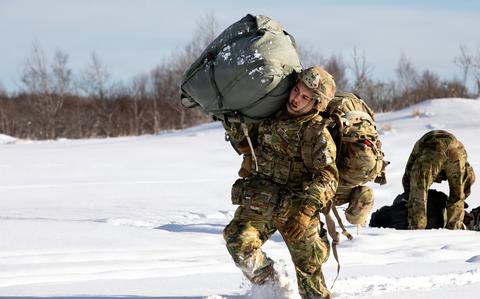
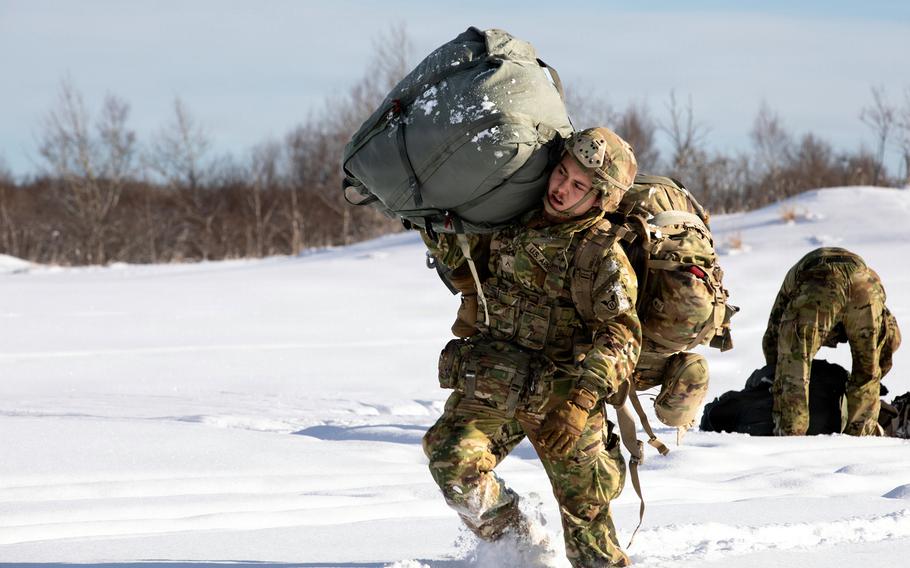
Pvt. Stallone Ealey, a member of 3rd Battalion, 509th Parachute Infantry Regiment, 2nd Infantry Brigade Combat Team, 11th Airborne Division, carries gear during training in Hokkaido, Japan, Jan. 22, 2026. (Michelle Mayancela/U.S. Army)
Reconnaissance Marines had four run-ins with bears during recent parachute training in northern Japan, according to the commander of an Alaska-based U.S. Army battalion.
Members of the 11th Airborne Division’s 3rd Battalion, 509th Parachute Infantry Regiment from Joint Base Elmendorf-Richardson are in Japan this month for a series of parachute drills.
The soldiers jumped into Narashino Training Area in Chiba prefecture and Ojojibara Maneuver Area in Miyagi prefecture, both on Japan’s main island of Honshu, before deploying to the northern island of Hokkaido, said their commander, Lt. Col. Cody Grimm.
The bear encounters occurred at Ojojibara, where reconnaissance Marines from III Marine Expeditionary Force parachuted in ahead of the soldiers’ Jan. 13 jump, Grimm told Stars and Stripes by phone Saturday from Hokkaido.
“The Marines had four bear encounters,” he said. “They had bear spray and they had a team that responded with more bear spray and fireworks.”
A III MEF spokesman, Capt. Colin Kennard, was unable to confirm the bear run-ins when reached by email Tuesday.
Soldiers are accustomed to operating in bear habitats while training in Alaska, Grimm said, noting that black bears pose less concern than brown bears.
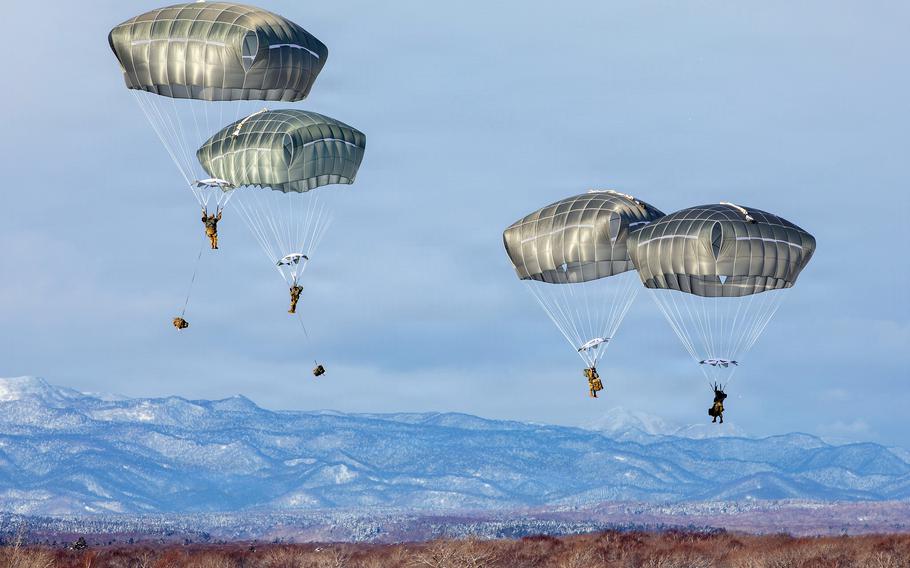
Soldiers assigned to the 3rd Battalion, 509th Parachute Infantry Regiment, 2nd Infantry Brigade Combat Team, 11th Airborne Division parachute over Hokkaido, Japan, Jan. 22, 2026. (Michelle Mayancela/U.S. Army)
“In both cases, we move away from the bear,” he said. “We have a team [in Alaska] that has non-lethal means to get them out of there.”
The training took place amid an increase in bear encounters across Japan. Air Force officials alerted the community at Misawa Air Base in northeastern Japan after a bear was spotted on the installation Jan. 10.
Japan’s Ground Self-Defense Force was mobilized in November to help address bear threats in northern parts of the country. The rare deployment followed a surge in encounters nationwide that left 13 people dead and more than 200 injured so far in the current Japanese fiscal year, which ends March 31, according to the country’s Ministry of Environment.
Experts have attributed the rise in bear encounters to factors including expanding forest areas, declining food sources, shrinking rural populations and fewer hunters.
Japan is home to two species of bears, the Japanese black bear and the larger Ussuri brown bear. Black bears typically stand about 5 feet tall and weigh just over 200 pounds, though adult males can be significantly heavier. Brown bears, found only on Hokkaido, can weigh as much as 880 pounds.
Japan’s bear population stood at about 11,700 in 2020, according to the Ministry of Agriculture, Forestry and Fisheries, more than double the number recorded 30 years earlier.
The 11th Airborne Division trained with Japan’s 1st Airborne Brigade, U.S. Marines and British forces on Honshu, Grimm said.
On Hokkaido, the troops are training alongside Japan’s Northern Army and a platoon of Canadian soldiers during the annual North Wind exercise, which began Jan. 20 and runs through Feb. 3.
Now in its 33rd year, the exercise focuses on cold-weather operations and includes skiing, snowshoeing and medical training, Grimm said.
AloJapan.com