

January 27, 2026 — 5:00am
Save
You have reached your maximum number of saved items.
Remove items from your saved list to add more.
Save this article for later
Add articles to your saved list and come back to them anytime.
Got it
AAA
Tokyo is splitting at the seams, but there’s not a foreigner to be seen in Namiitakaigan, 650 kilometres north of the capital city. That is, until my friend, Amanda, and I step off the dinky Sanriku Railway Rias train.
We’re the only disembarking passengers. There’s no manned ticket office here, just an empty shelter and a picnic table where a delivery man is eating lunch.
“Konnichiwa,” we say. He nods, mounts his motorbike and departs.
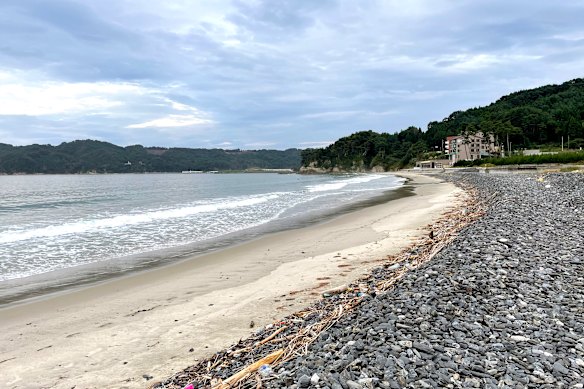 The beach at Namiitakaigan.Amanda Kendle
Behind us stands Mount Kujira; a few hundred metres downhill, wavelets caress a beach said to be great for summer surfing. A cenotaph beside the station records the point the water reached when the 2011 tsunami disrupted the serenity.
There’s no sign of the destruction wrought here. Houses are immaculate and the last of summer’s flowers bloom. But the town appears to be empty. The only other person we see is a woman in the distance pushing a cart.
Sign up for the Traveller Deals newsletter
Get exclusive travel deals delivered straight to your inbox. Sign up now.
It’s liberating to be the sole outsiders in an obscure hamlet in an overtouristed country.
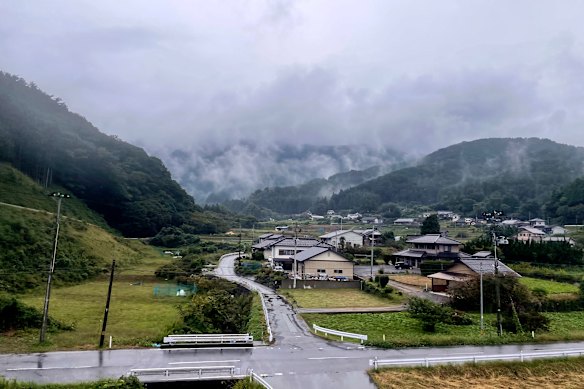 Namiitakaigan is devoid of tourists.Catherine Marshall
It’s a breeze shaking off the crowds. We leave Tokyo in the morning, taking the shinkansen to Hanamaki and changing to a secondary line that twists through mountainous farmland before curving north at Kamaishi towards our bayside destination.
Repeat visitors to Japan (Amanda lived in Osaka and Nara for two years), we bypass the icons and spend our dollars in a part of Tohoku region still vainly awaiting tourists after the tsunami tragedy.
We go where our noses lead us and book accommodation on the hop. Tonight’s lodging is Takamasu Guest House, which sits along the 1025-kilometre Michinoku Coastal Trail. Proprietor Yasuko Nakamura seems pleased to see us. We’re the first foreign guests in a long time.
Our room is an airy space with tatami mats and a sea view. Ablutions are shared with the inn’s handful of lodgers: students attending high school in nearby Otsuchi, a man working on the post-tsunami reconstruction project and a spearfisherman from Aomori, who was mercifully on dry land when the tsunami hit. Nakamura was inland that day, she says through her translation app, and only a section of the inn’s roof was damaged.
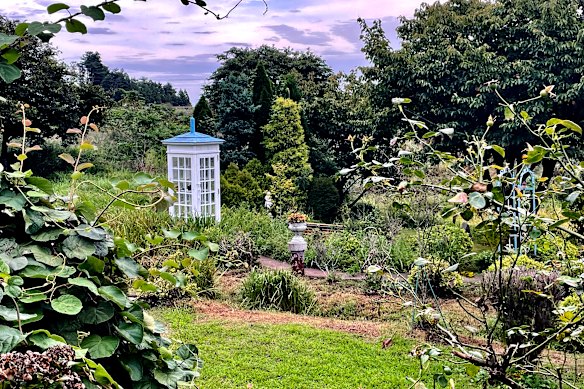 The Bell Gardia Kujira-yama garden contains a phone box with a telephone on which you can ‘speak’ to those who have died.Amanda Kendle
The main attraction in town is Bell Gardia Kujira-yama, a garden flushed with autumnal colour. Years ago, Namiitakaigan resident Itaru Sasaki placed a phone box here in which to “talk” to his late cousin on a disconnected telephone.
Following the tsunami, this “Phone of the Wind” became a pilgrimage site for those who’d lost loved ones in the tragedy and other maladies (it featured in a 2016 episode of the radio program This American Life, and in Laura Imai Messina’s novel, The Phone Box at the Edge of the World).
“It’s my second visit here,” reads an inscription in the visitors’ book, “but it’s going to take a lot more time for my heart to heal.”
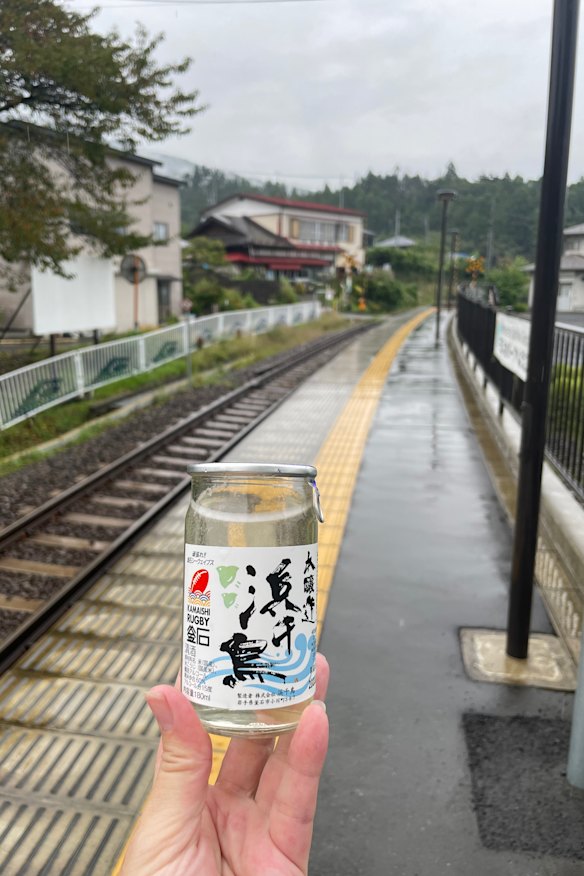 Leaving Namiitakaigan Station with a gift of sake.Catherine Marshall
Wandering back into town, we meet the woman pushing the cart. She’s come from Morioka to sell doughnuts door to door. We’re willing customers. It’s hours since we cleared out the bento boxes we bought on a Tokyo station platform. But there’s a feast awaiting us at the inn: Nakamura buzzes from kitchen to dining room bearing hotpots bubbling with miso broth and kneaded fish, kaiseki bowls brimming with wakame, platters of grilled saba (mackerel) and bottles of sake.
“The sake is famous from Kamaishi,” she says through her app.
Sharing no common language, we engage in gesticulatory conversation with our dining companions – the students, the spearfisherman, the construction worker. We think the spearfisherman has gifted our host a fresh fish – could it be the mackerel on our plate?
In the morning, Nakamura farewells us with jars of sake. From here, we’ll take the train to Rikuzentakata, where the Iwate Tsunami Memorial Museum stands, and onwards to Futaba in Fukushima, ground zero of the tsunami-precipitated nuclear meltdown and site of The Great East Japan Earthquake and Nuclear Disaster Memorial Museum.
Related Article
Devoid of tourists, the 300-kilometre rail journey will introduce us afresh to a new, unfiltered country.
DETAILS
Stay
Rooms, including dinner and breakfast, at Takamasu Guest House from $70 a person. See takamasuminshuku.com
Train
Japan Rail’s JR East Pass covers travel from Tokyo to Kamaishi. The Sanriku Railway Rias Line runs from Kamaishi to Namiitakaigan and tickets are available on the platform. See jrpass.com.
Visit
Entry to Bell Gardia Kujira-yama is free. See bell-gardia.jp
More
See japan.travel
The writer travelled at her own expense.
Save
You have reached your maximum number of saved items.
Remove items from your saved list to add more.
 Catherine Marshall has worked as a journalist for more than three decades and has received awards for her travel writing and reportage in Australia and abroad. She specialises in emerging destinations, conservation and immersive travel.Connect via X.Traveller GuidesFrom our partners
AloJapan.com