
KOSHIGAYA, Saitama Prefecture–Yuta Koinuma converted to Islam, married a woman from the world largest Muslim country and has searched for work related to the religion.
His current life is quite a turnaround from when he viewed Islam as “scary” and associated with “terrorism.”
Yuta, 36, and his wife, Yumiko, 30, who live in Kawaguchi, Saitama Prefecture, want to shatter such stereotypes and help Japanese people better understand Islam.
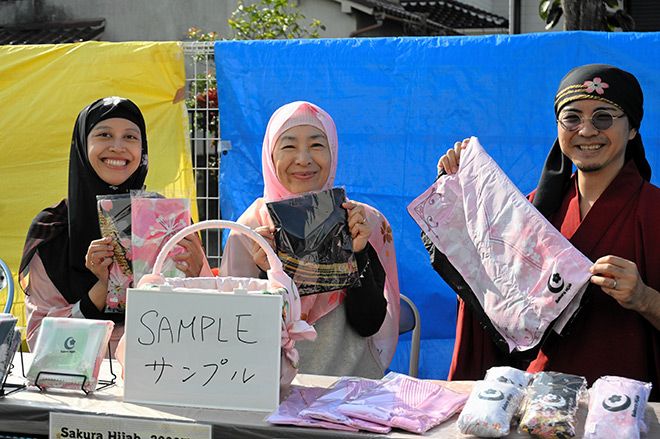
One of their methods is designing and selling hijabs, the traditional headwear of Muslim women, in pink, white, cream and other colors of Japan’s beloved cherry blossoms.
They want the hijabs to give both the wearer and onlookers a sense of “approachability.”
“I hope the combination of Japan and Islam will help people learn about Islam–even if only slightly—and encourage interactions,” he said.
An Indonesian company produces the hijabs and ships the finished products to Japan. The couple chooses a light fabric for the headwear.
“There are at least 100 types of fabrics with different weaving patterns and thread thicknesses in Indonesia,” Yuta said. “They are more suitable for hijabs than those available in Japan and can be produced at an affordable price.”
Their hijabs are sold at events held at halal-certified restaurants and mosques in and outside Saitama Prefecture, as well as online.
Children’s hijabs are also offered because Yumiko wants to encourage Muslim kids living in Japan with cute designs. They are made of a highly stretchable and breathable material.
“I hope children feel more comfortable in wearing hijabs and enjoy them as a fashion item,” Yumiko said.
Yumiko, who was born in Indonesia, came to Japan as an elementary school pupil and grew up in a Muslim household.
Yuta’s negative view of Muslims changed about seven years ago while he was traveling across the world as a backpacker.
After he was scammed and ran into other problems abroad, Muslims helped him out and even let him stay at their homes.
He became fascinated by the hospitality of Islamic culture and the recitation of the Koran he heard in a taxi.
After returning to Japan, he searched for Muslim-related work and converted to Islam. He gave halal certification to products conforming to Islamic precepts while doing other jobs.
This lifestyle eventually led to the sakura-themed hijabs.
“In Islam, female hair is believed to be something beautiful, and women are protected by wearing hijabs,” Yuta said.
AloJapan.com