
You’ve danced in the dark, bass-filled halls of Berlin’s Berghain. You’ve survived a full moon party in Koh Phangan. Maybe you’ve even gone to one of those transformative ayahuasca ceremonies held deep in the Amazon. But what happens when the luster fades from the world’s most well-known wild adventures? It might be time to seek out trips that feel illegal but aren’t.
The good news: You have more options when it comes to taking on the unknown than ever before. From Bangkok to Lima, you can find tours and trips that let you experience a thrill without putting you in actual danger.
The bad news: You won’t find many of these adventures stateside. Also, you need a steel backbone.
Welcome to the world of trips that feel illegal but aren’t. First up: a little jaunt to one of the world’s most militarized zones, the DMZ.
MORE: This U.S. Airport Was Just Named the World’s Most Beautiful
Best geopolitical trip: Visit the DMZ near Seoul, South Korea
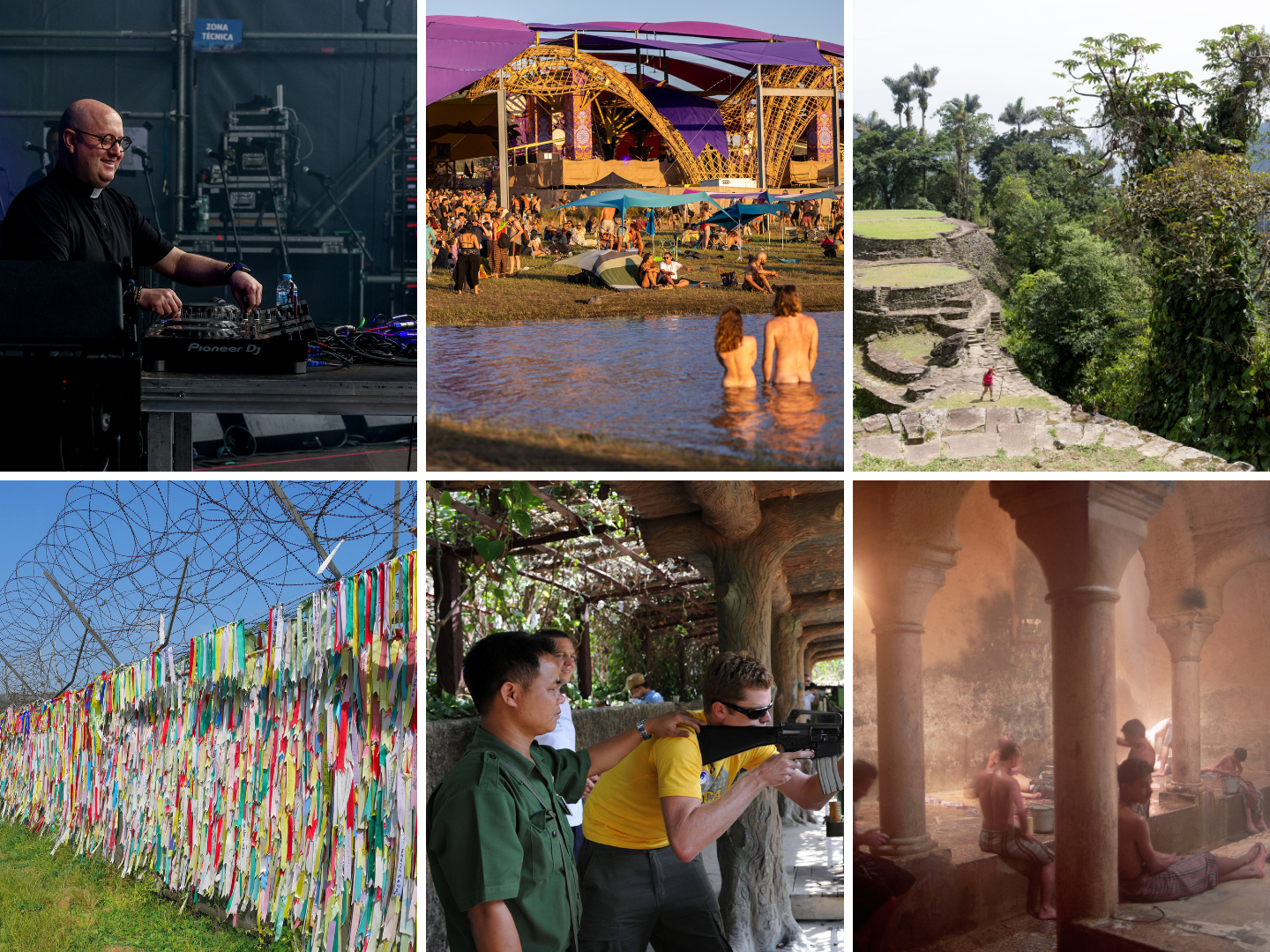
 PAJU, SOUTH KOREA – SEPTEMBER 26, 2017: Colorful prayer ribbons at Imjingak Park near DMZ or demilitarized zone. South Koreans tie these ribbons with messages for their family members in the North. (Photo CREDIT: Getty Images)
The Korean Demilitarized Zone is a narrow 2.5-mile buffer zone between North and South Korea that was established in 1953. Its formation was part of the Korean Armistice Agreement that ended the Korean War.
Since then, it’s become one of the most heavily militarized zones in the world—and operations are still ongoing. In 2019, the US deployed SEAL Team Six to complete a water crossing of the DMZ to implant a covert listening device, which was covered by The New York Times in detail.
Despite ongoing operations, the DMZ is open to visitors. And it’s only around fifty miles from Seoul, too, meaning you can easily book a day trip-style tour of the DMZ with select, authorized groups during your visit to South Korea. In addition to visiting the Demilitarized Zone, some tours also visit the Dora Observatory, where you can look across the DMZ at North Korea, and Dorasan Station, a train station that could, one day, link the countries once again.
Tours from Seoul that take you to the DMZ
Best raver-friendly trip: Attend Boom Fest in Aguas de Moura, Portugal
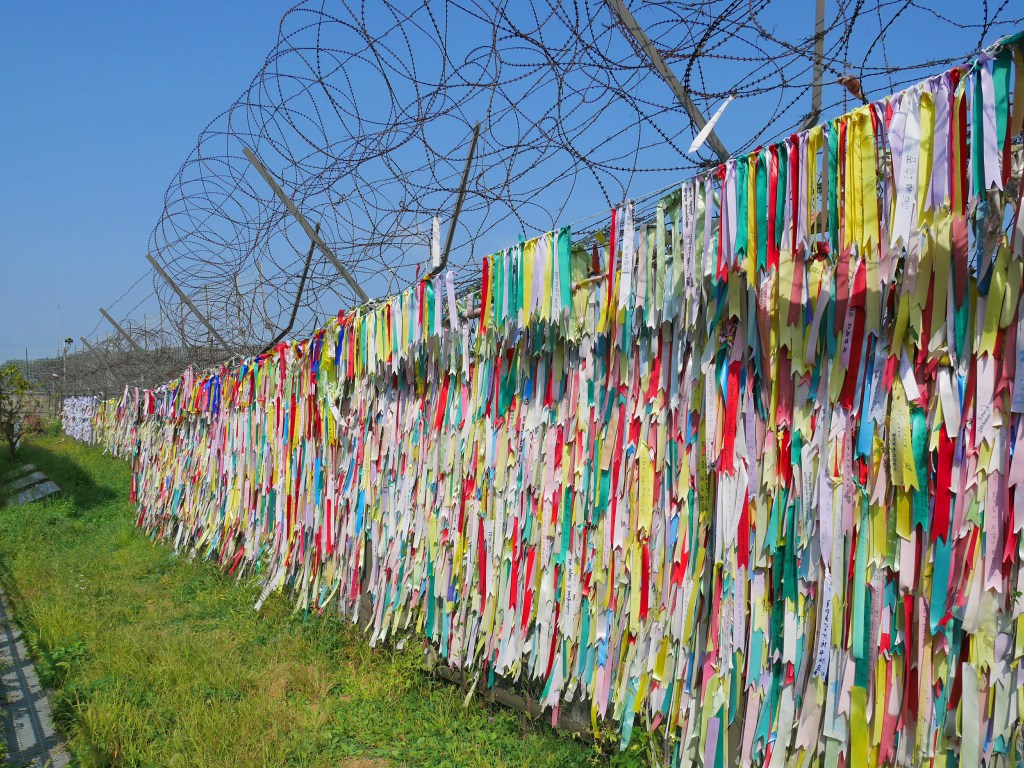
 PORTO, PORTUGAL – 2025/07/18: People seen on the opening of the main stage during Boom Festival at Idanha-a-Nova. Boom Festival is a renowned biennial transformational event held in Idanha-a-Nova, Portugal. (Photo CREDIT: Getty Images)
You’ve heard of Burning Man—but what about Portugal’s Boom Fest? Founded in 1997 as a casual Goa psytrance beach party, Boom Fest is now considered one of the world’s most important alternative culture gatherings.
It’s held on the same site in rural Portugal (Aguas de Moura) that has a large, natural lake and summer temperatures that climb well over 100 degrees Fahrenheit. In addition to psytrance music, the indie festival (as in, no big-name sponsors) focuses on intercultural exchange. In 2018, staff counted attendees from 147 of 195 countries around the world.
Aside from all-night dance sessions at stages called Alchemy Circle and Nataraj Dance, the festival hosts workshops and interactive classes during the day. When I attended in 2022, I learned about permaculture and disarmament pacts from expert speakers.
Aside from the scheduled programming, expect many side quests. My favorite moment was getting into a battle of wits with a wiry gnome of a man in the tea tent at some odd hour of the night. We exchanged word puzzles and allegories. I’m pretty sure we were also fully sober during the interaction—so, feel welcome at Boom even if your hardcore raver days are bygone.
The festival welcomes around 50,000 visitors when it’s held every other year, which is around 20,000 fewer than Burning Man. Show up early to get a good camping and/or parking spot. I recommend renting a camper van that you can use as a home base—the walk is pretty far from the main stages, but you’ll be happy you have some peace and quiet.
Reserve your ticket to Boom Fest 2027, then rent a car to drive to Aguas de Moura from Porto or Lisbon
MORE: 8 Very Real Places You Can Visit That Look Like Another Planet
Best rugged adventure trip: Hike to Colombia’s Ciudad Perdida from Santa Marta
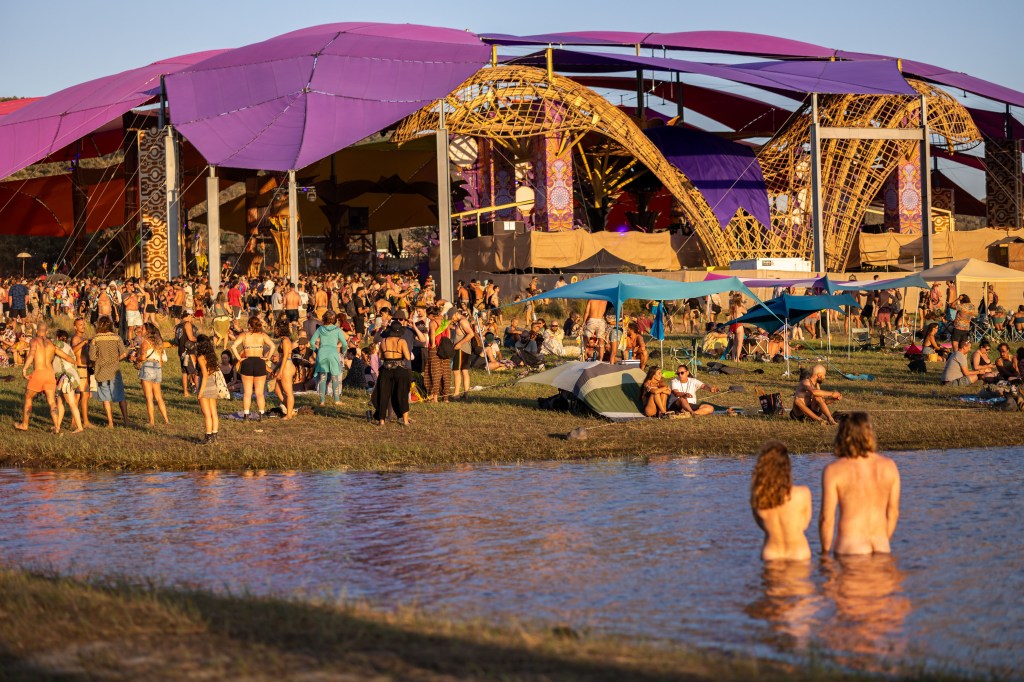
 Ciudad Perdida, Colombia’s Sierra Nevada, August 16, 2015. – The Ciudad Perdida, is a 13th-14th century pre-Colombian city built by the Tayrona Indians and disovered in 1975 by guaqueros (tomb raiders). (Photo CREDIT: Getty Images)
Hidden in Colombia’s Tayrona National Park is one of the world’s most extensive ruin systems. Today, these ruins are the domain of the Kogi people, who help lead multi-day treks from Santa Marta in Colombia’s Caribbean coast to the high Sierra Nevada mountains. In fact, the Kogi are descended from the tribe that originally built what’s now known as Ciudad Perdida.
Ciudad Perdida, Spanish for lost city, consists of over 150 terraces carved into the mountainsides and covered in dense jungle. To get there, you need to trek for four days through the jungle, then climb a winding stone staircase with over 1,200 steps.
Built around 800 CE, Ciudad Perdida was originally inhabited by the Tairona tribe, who fled the area in the 16th century. For hundreds of years, the site lay forgotten by most except for the modern-day Kogi.
Here’s where the story gets a little wild: the Western world didn’t become aware of the ruins until the 1970s, when archaeologists realized unknown artefacts were making their way onto the black market from Colombia. Local and international authorities and academics joined forces to track the objects back to their origin: Ciudad Perdida.
Here’s where it gets a little more interesting: Around the same time that grave robbers were stealing artefacts from Ciudad Perdida, armed conflict between paramilitary groups in the area started. Throughout the 1970s and 80s, armed groups vied for control of the area.
But the word was out that Ciudad Perdida existed. By the late 1990s, Ciudad Perdida became a tourist destination, attracting backpackers with a thirst for jungle frontiers. Back in 2003, one military group kidnapped tourists hiking to Ciudad Perdida before a demobilization treaty was signed in 2006.
Since then, the Colombian Army has patrolled the area to keep it safe, and no further incidents have occurred. Today, the Kogi tribe and Global Heritage Fund help maintain and preserve Ciudad Perdida.
How to visit Ciudad Perdida
Most hands-on trip: Shoot an M60 in Ho Chi Minh City
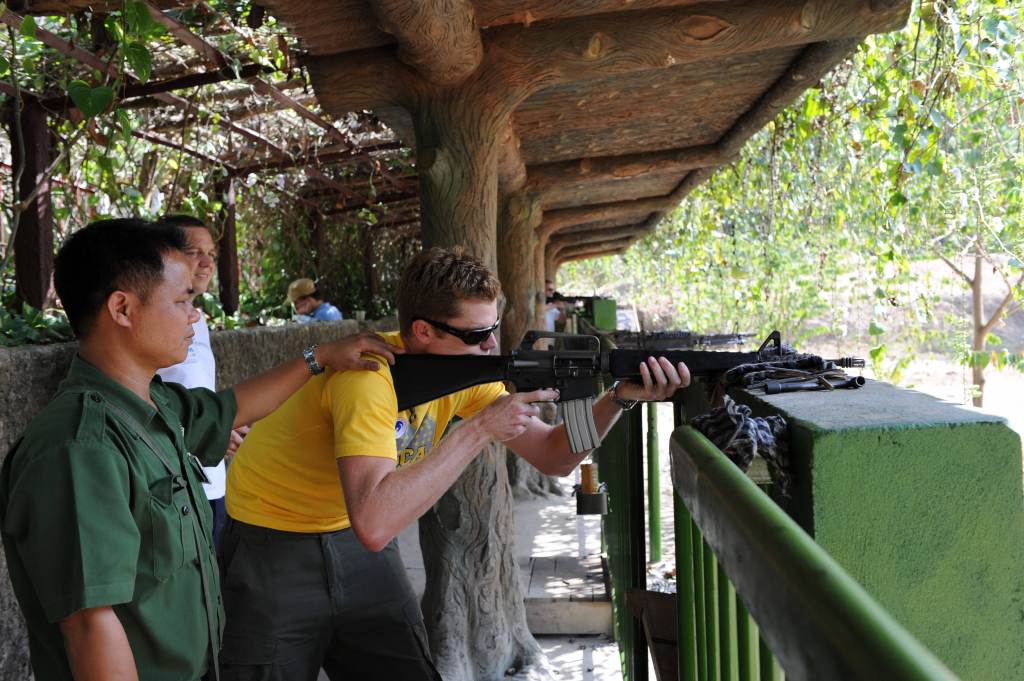 A western tourist practices shooting on US made M-16 at the Cu Chi tunnels 27 January 2008 in Cu Chi district, Ho Chi Minh City. For years, Viet Cong guerrillas lived in a network of tunnels three storeys deep, a labyrinth that spanned over 300 kilometres (186 miles), connecting villages in virtual underground cities in this district north of former Saigon. AFP PHOTO/HOANG DINH Nam (Photo CREDIT: Getty Images)
I’m sure you’ve heard: the U.S. left Vietnam in a bit of a rush when the Viet Cong and People’s Army of Vietnam closed in on Saigon back in 1975. Unsurprisingly, the United States Army left behind more than a few pieces of military equipment. If you’ve visited the Museum of War Remnants (called the Museum of American War Crimes when I visited in 2012) in HCMC, you’ve seen the proof up close.
But only those who visit the Cu Chi Tunnels will have the chance to physically handle the US’s left-behind weaponry. The Cu Chi Tunnels are a series of preserved, expanded, and/or recreated tunnels that showcase how the Viet Cong made death traps and underground labyrinths that helped them survive and, ultimately, defeat American forces. Think: Tower of London meets the jungle.
The Cu Chi Tunnels attraction includes a firing range called the National Defense Sports Shooting Range. There, you can get behind an M60, aka the Machine Gun, and hold on for dear life while the recoil shakes your brain around in your skull. Is it illegal? No, but it feels weird to shoot a weapon that was used in a not-so-distant war that started and ended disastrously.
Where to stay in HCMC and how to book the tour
Best true crime-style trip: Go on an Anti-Mafia Tour in Palermo, Italy
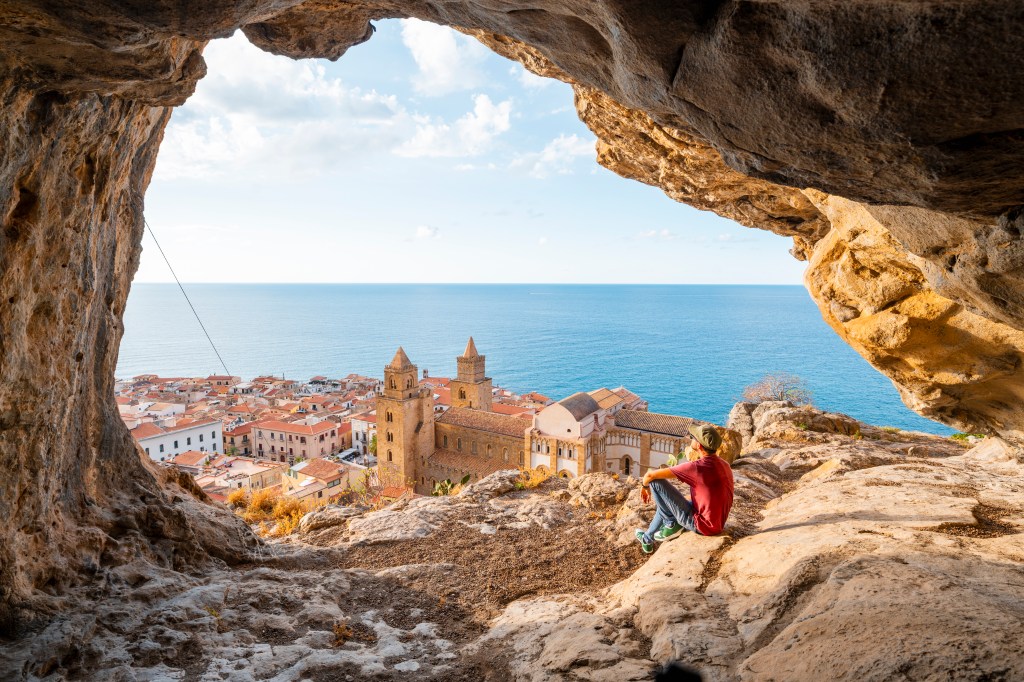 Person in a cave above Cefalù IN PALERMO, ITALY, overlooking the town and sea (PHOTO CREDIT: GETTY IMAGES)
The Mafia, aka Cosa Nostra, is still alive and well in parts of Italy, and it has long had a stronghold in the Sicilian capital of Palermo. One report from Fortune reports that Italy’s Central Bank turns over around 40 billion euros annually.
Despite Cosa Nostra’s presence in the city, you can take a tour that gives the Mafia the finger. Since the early 1990s, a grassroots anti-Mafia organization called Addiopizzo has worked tirelessly to create a Mafia-free future in Palermo.
How, you might ask? By hiding in plain sight.
Addiopizzo, whose name stands for ‘goodbye pizzo’, has worked with the public, businesspeople, and judges to reframe how people think about the Mafia. Pizzo is the small contribution that businesses in Palermo are forced to make to the Mafia—and everyone who buys something at these shops is, unwittingly, also paying the tithe.
For around three decades, Addiopizzo has built a network of businesses that agree not to pay the pizzo. And the organization’s public tours have helped keep its members in the limelight and out of harm’s way. The mafia is unwilling to target public figures like Addiopizzo staff—and especially the tourists the group ferries around the city.
Still, it was a little surreal to take a tour of Palermo as our guide (a member of Addiopizzo) pointed out places where high-profile assassinations took place… all while knowing the Mafia is still active.
Find a place to stay in Palermo & take the tour at your leisure:
Best techno-centric trip: Dance to a Padre Guilherme set in Portugal
 MADRID, SPAIN – APRIL 06: DJ Padre Guilherme performs during the second edition of the Resurrection Festival, at Plaza de Cibeles, on April 6, 2024, in Madrid, Spain. (Photo CREDIT: Getty Images)
Have we found the latest Catholic saint? It’s possible. Meet Father Guilherme, born Guilherme Peixoto in Portugal in 1974. He was ordained as a priest in 1999, then went on to serve as a chaplain for Portugal’s military. He drifted from place to place before, in a bid to cheer up soldiers serving in Afghanistan in 2010, Padre Guilherme decided to try out DJing.
For the next decade, he tinkered with electronic music, blending synth and drum machines with holy hymns like Ave Maria and speeches from Pope Francis.
Fast forward to the COVID-19 pandemic, when Padre Guilherme began releasing weekly streams for his followers. He gained international attention playing an early morning set at Portugal’s World Youth Day Festival in 2023. Shortly after, he went viral as his performances drew in thousands at festivals in Spain, Brazil, Slovakia, and Chile.
The twist? He’s actually good. If you like progressive house and techno, you’ll enjoy Padre Guilherme’s sets. (Give him a listen, starting at the 7-minute mark.) I know it’s not illegal to enjoy Catholicism or priests, but as someone who survived a Catholic upbringing, it wasn’t on my 2025 bingo card to hear a DJ set from a priest and turn up the volume.
If you want to see Padre Guilherme, he’s playing a set in Portugal at RFM Somnii Festival at Praia do Relogio alongside Dual Damage on July 11.
Book tickets/place to stay/his next big show
Most relaxing NAKED trip: Unwind in a sauna, banya, hammam, or onsen
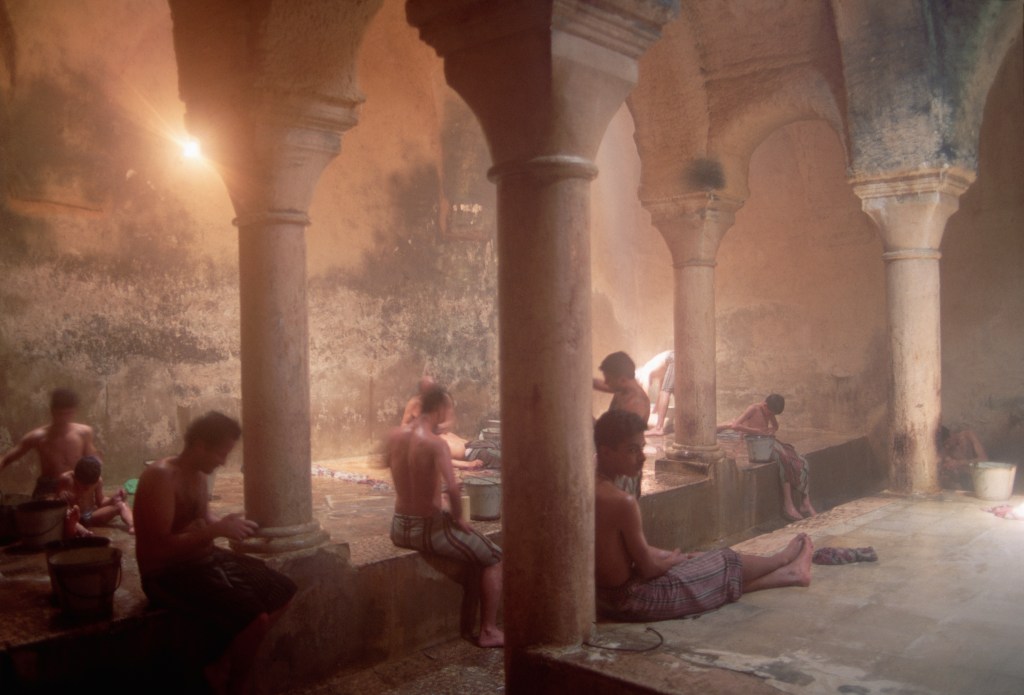 Hamam at-Taba Turkish Bath (PHOTO CREDIT: GETTY IMAGES)
If you’ve traveled extensively, I guarantee you’ve been invited to fully disrobe more than once—at least, in the context of the spa. The spa goes by many names and comes in many forms. If you want to add a dash of transgression to any of your upcoming trips, keep these naked-friendly zones in mind.
Scandinavians and Central Europeans are known for sauna culture. Clothing isn’t allowed in the sauna, and saunas aren’t divided by gender. German has a tradition of Freikörperkultur, literally free body culture, that promotes nudity as healthy and natural.That means you’re going to be ass-naked alongside adults of all ages. On the same bench, even. If you’re lucky, you might even catch an aufguss performance.
Russians and Eastern Europeans have their own version of the sauna, called a banya. The banya is very similar to the sauna, but has a more social element to it. Banyas are divided by gender, or might be men-only or women-only, depending on the day of the week. Banyas use birch or oak sticks to gently beat the back as part of a venik massage, which is said to boost circulation and detox the body.
Islamic regions prefer the hammam, aka the Turkish bath. The hammam combines elements of a traditional bath house, along with spa services like scrubs and, in some cases, ritual cleansing. Areas are divided by gender, where you’re encouraged to go nude. Expect any spa treatments to also occur in the nude and be very hands-on.
Japan, on the other hand, has a distinct onsen culture. Onsens are hot springs instead of saunas, where locals gather to soak and relax—and have been since around 750 CE, according to some research. Onsen baths are divided by gender and are often fully nude.
Tattoos, famously, aren’t allowed at many onsens, although you can rent private baths called kashikiri. What makes onsens special is that they’re often located in gorgeous natural settings because they’re centered around hot springs.
Visit these famous saunas, banyas, hammams, and onsens around the world
AloJapan.com