
Why book?
To come face to face with the majesty of Mount Fuji, one of Japan’s most enduring icons, while surrounded by design that blends the best of Japanese tradition and modernity. You could hike in the surrounding forest, horse-ride in the hills or even climb the sacred peak, but it’s just as easy to spend a few lazy days here, gazing at the different faces of the volcanic cone from the healing waters of your hot spring bath, or sipping a cup of matcha on the Fuji-view terrace.
Set the scene
No view of Mount Fuji is ever guaranteed—clouds can roll in, swaths of mist can form a thick shroud, and rain showers can obscure the steep slopes—but on a clear day, the views from Gora Kadan Fuji are absolutely breathtaking. At once sacred and imposing, Mount Fuji has captured the imaginations of artists for centuries, most famously Katsushika Hokusai’s Thirty-six Views of Mount Fuji series, and is a constant presence in Japanese contemporary culture, its silhouette featuring in everything from brand logos to popular chocolates and the one thousand yen note.
If Mount Fuji is the star of the show here, Gora Kadan Fuji is the auditorium, positioned so that almost every room, hot spring bath and public area has the perfect vantage point of the volcano’s ever-changing form.
The hotel blends elements of traditional Japanese ryokan inns with sleek, modern design, placing a focus on the five elements—earth, water, fire, wind, and space—represented in features like external earthen walls, a decorative pool that reflects Mount Fuji like a mirror, and the cantilevered Fuji viewing platform, offering some of the best views in the entire property. Kimono-clad staff glide through the light-filled lobby, and the rooms welcome with the warmth of natural materials so tactile I found myself constantly touching everything, sliding my feet over the soft weave of tatami floors and feeling the smooth grain of wood with my fingertips.
Mount Fuji’s westerly location means that clear nights offer spectacular sunsets, the sun dipping behind the peak, but sunrise is equally as magical, when the first rays cast their light on the cone. Located at an altitude of around 2,600 feet, the weather here is dramatically cooler than in Tokyo during the summer months. It’s the perfect escape when the city heat begins to feel oppressive, reached by a short 42-minute ride on the ultra-fast Hikari shinkansen from Tokyo to Mishima station, followed by a 35-minute drive.
The backstory
The original Gora Kadan ryokan opened in 1948 in Hakone, one of Japan’s most famous hot spring resorts and a popular trip from Tokyo, centered on the summer villa of the Kan’in-no-Miya branch of the Imperial family. It’s still one of Japan’s most renowned luxury ryokans today, and was one of the first to make a concerted effort to welcome international guests. The new hotel incorporates elements of the Hakone original in the form of service, attention to detail and exceptional cuisine, creating an experience that is completely contemporary, a reflection of the Japanese ability to revere cultural and craft traditions, while making them relevant and of the present moment. Stay at both Gora Kadan outposts, and you’ll experience the beautiful contrast of two complementary experiences.
The rooms
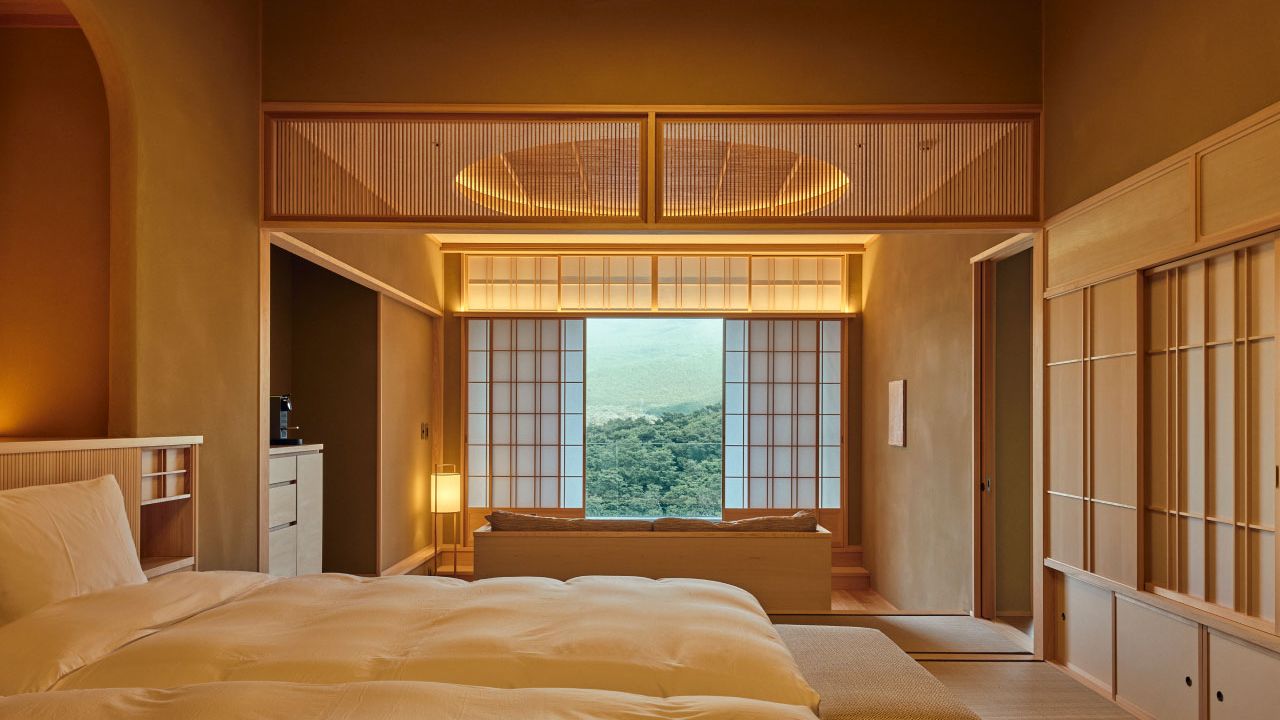
Many hotels claim to create a sense of place for guests, but Gora Kadan Fuji’s 39 suites and three standalone villas really deliver. Every accommodation offers an introduction to Japanese ryokan culture before you even step inside, with each having a kutsunugi ishii, a shoe-removing stone, at their entrance. It’s here where outdoor footwear is removed, symbolizing the transition between the outside world and the inner sanctuary of the suites. Materials like tatami mats, cedar wood, bamboo, paper and granite combine to form a harmonious minimalist aesthetic that simultaneously feels traditional and modern. Delicate details are everywhere, from the finger-holds shaped like cranes and gourds to open sliding doors, to the lacquered boxes containing calligraphy kits with ink and brushes.
Every suite and villa faces Mount Fuji, and most—weather permitting—have clear views of the peak. They also have outdoor space, either balcony, terrace or garden, and, in some cases, al fresco bathtubs for calm contemplation of the surrounding nature. The smallest suites measure a generous 800 square feet, and minimalist Japanese décor, high ceilings and lots of natural light contribute to the overall sense of space.
Pick the right suite and you’ll see Fuji from beneath your fluffy duvet in bed. Others have chairs or sofas positioned Fuji-wards, and some have Fuji-facing bathtubs. The whole arrangement feels as if it has miraculous powers to lower blood pressure and stress levels, and I find myself so deeply relaxed that at times I’m almost in a daze.
My villa, possibly one of the loveliest I’ve ever stayed in, is Villa Suite Hare, pronounced ha-ré. It’s the hotel’s largest, a collection of tatami-floored rooms set around a garden filled with ornamental trees and stones, and an outdoor swimming pool that reflects Mount Fuji in its surface. In the morning, I have breakfast at a low table in one of the living rooms, listening to warblers in the garden as the mountain is framed like an ukiyo-e painting by sliding paper-and-wood fusuma doors. In the evening, I soak in the big round hinoki cypress wood bathtub, opening the glass doors to let the cool night air in. The villa has multiple spaces for quiet meditation, a small, stone outdoor rotenburo bath, a chef’s kitchen for those who want their sushi prepped at home, and a bed so dreamily comfortable it’s almost impossible to drag myself out of it at 4:20 a.m. to see the early summer sunrise (which, on a clear day, is one of the best things you’ll ever do).
Food and drink
Breakfast is a highlight of any stay at Gora Kadan Fuji, even if you’re usually a coffee-on-the-go kind of person. In most suites you can choose to have it served in-room or head to the restaurant with its Fuji-view terrace. The Japanese breakfast is a work of art, including items like grilled fish, pickles, rice, miso soup, natto fermented soy beans and more, served in a multitude of pretty little dishes. If this feels a little too adventurous for your early morning routine, the very good Western breakfast includes eggs, French toast, bakery items, seasonal fruits and juices, albeit with something of a Japanese take. This being a ryokan-style hotel, breakfast times are semi-fixed, and you’ll need to decide what time you want to eat in advance.
It’s the same at Kaiseki Cuisine Kadan, the hotel’s main restaurant, where multi-course dinners are served nightly at 6 p.m. or 7 p.m. Each tasting menu features a succession of exquisite morsels served in equally exquisite tableware, many of which are antique pieces selected to represent the season and complement each dish.
Three of the hotel’s restaurants feature counters for interactive experiences that place the diner at the center of the slicing, dicing and cooking action. At Kappo, chefs shave bonito flakes, grill seasonal fish and simmer dashi broth in front of just seven guests, cheerfully explaining each dish, where it’s from, and how it’s made. When I dine, the maguro katsu is a highlight, as are the cold summer noodles served in a block of ice, and the blackened eggplant, looking like a lump of volcanic lava hot off the grill, seasoned with pink Mongolian salt.
At the eight-seat Sushi Fuji Takumi, from the team at renowned Sushi Sho, fish sourced from nearby Suruga Bay and the waters beyond is turned into delicate seasonal nigiri, served with fresh wasabi from a nearby farm. And at Teppanyaki Fuji Kanda, an outpost of Tokyo’s Michelin three-star Nihon Ryori Kanda, rare-breed beef from Kagoshima sizzles on a hot plate. At all of Gora Kadan Fuji’s restaurants, the majority of ingredients come from Japan’s land and waters, with as many products as possible sourced from the local area.
The spa
The Japanese love of bathing goes far beyond taking a quick shower, involving long hours spent soaking in healing hot spring waters. There are two main communal baths here with indoor and outdoor onsen pools (separate for men and women at certain times of the day, and swapping over so every guest gets to experience both), as well as private baths in all suites. Communal bathing is de rigueur here, as is stripping off, showering, and stepping into the steamy waters. If getting naked with unknowns is a step too far, you can enjoy the same experience in private in your suite. The baths here contain either ground water from Mount Fuji, consisting of snowmelt from the summit filtered through layers of volcanic rock, or naturally alkaline onsen spring waters that emerge from underground at high temperatures.
While it may seem odd to wander around the hotel in what feels like a bathrobe, wearing a yukata, a type of summer kimono, around a ryokan is completely normal, and it’s no different at Gora Kadan Fuji. Remember to close your yukata with the left side on top of the right. Only the deceased are dressed right-over-left, something you really want to avoid emulating.
Aside from the hot spring baths, the bijou Kadan Spa Fuji offers excellent treatments expertly performed. I fall into a deep sleep moments after my head spa begins, a ritual of hair-washing with carbonated hot spring water and stress-releasing massage. The therapist tells me that everyone does, so I don’t feel quite so bad. A deeply relaxing body massage follows, targeting all the areas that really need it, soothing shoulders that feel crunchy from a ten-hour flight. And I also manage to squeeze in a facial using a mask of fermented rice koji, leaving me with skin hydrated, refreshed, and plumped like mochi. The spa also an 18-meter Fuji-view indoor pool and small outdoor infinity pool, as well as a 24-hour gym.
The area
Most people come here to see Mount Fuji, and there are plenty of ways to commune with the volcano. The climbing season is in the middle of summer, and it’s hard to imagine a better place to recover after summiting the peak than at Gora Kadan Fuji. There’s also horse riding and hiking nearby, and the hotel’s own 36-hole golf course offers mountain-view manicured greens dotted with pine trees. The clubhouse is currently being renovated, and will reopen later this year.
Nearby Hakone makes for a lovely excursion, home to centuries-old onsen, cute shopping streets, winding mountain roads, lakes and shrines. It can get extremely busy, but the hotel team can point you in the direction of less-touristed spots, like the 400-year-old Amasake-chaya, a thatched-roof tea house serving sweet amasake, a non-alcoholic sweet rice drink, and the old Tokaido road that linked Tokyo and Kyoto, made of big chunks of stone and lined with ancient cedars.
About an hour’s drive away, the excellent Enoura Observatory by Japanese photographer and architect Hiroshi Sugimoto sprawls over a citrus orchard and bamboo grove with views over Sagami Bay. The complex brings together a number of structures—a stone Noh theatre stage, long galleries that capture the sunrise and sunset on the solstices and equinoxes, stone lanterns from ancient temples—that incorporate traditional Japanese building styles, as well as a couple of Sugimoto’s metallic Mathematica Model sculptures and seascape photography.
The service
Gracious, generous and warm, the service at Gora Kadan Fuji is as much a part of the experience as the views, rooms and food. The hotel strikes the perfect balance of traditional Japanese omotenashi hospitality and reverence for tradition with an approach that is welcoming, inclusive and doesn’t make international visitors feel like they’re about to make a faux pas at every step, something that can be felt at some of Japan’s more traditional ryokans. Each room is take care of by a kadanbito, a staff member who is part-butler, part attendant, although neither word really does justice to the way they take care of each guest throughout their stay, always on hand to help with anything needed in the room, or to make the perfect cup of matcha on the Fuji-view terrace.
Eco effort
All water used at the hotel is natural underground water from Mount Fuji or hot spring water. Heating utilizes pellets made from wood offcuts from local forestry programs that would otherwise be thrown away. Guest amenities are made from bio-plastics or bamboo, and most food is sourced locally from within Japan, reducing waste and supporting local farmers and producers.
Accessibility
There are two wheelchair-accessible guest rooms, both suites with open-air rock baths. Public areas have been designed to be accessible for wheelchair-users, wheelchair-accessible bathrooms are located on the dining and lobby floors, and elevators feature signage in Braille.
Family
Families are made very welcome here, and most rooms feature flexible space and sleeping arrangements to accommodate children of all ages. Kid-sized yukata, obi belts and slippers are provided, which are not only practical but are likely to make for great family photos. Unusually for a Japanese ryokan, one of the three villas, Villa Suite Yuki, is dog-friendly. It even has its own dog bath carved out of a solid rock.
Good to know
At many traditional Japanese ryokans and onsen hot springs, tattoos are frowned upon, and tattooed guests will be refused entry. This goes back to the association of tattoos with criminal elements of Japanese society, and gang affiliations. It’s an association that still hasn’t been shaken off in many parts of the country, and it can impact travelers and tourists today. At Gora Kadan Fuji, guests with smaller tattoos can use the swimming pool and communal baths without any problems, but those with larger tattoos (“larger than an A4 sheet of paper”, according to the hotel team) will be asked to cover them in public bathing areas. It’s not an issue in in-room hot spring and onsen baths.
AloJapan.com