
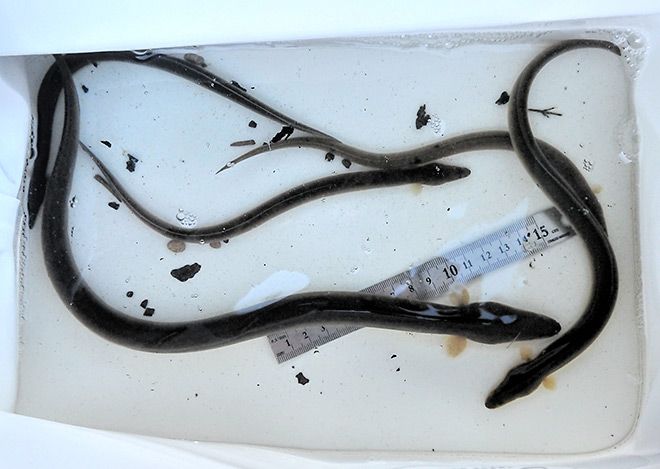
Japan’s endangered freshwater eels were found in over 50 rivers in Hokkaido, far more than previously believed, a survey showed.
The study, conducted by a team from Hokkaido University, the University of Tokyo, and the Japan Agency for Marine-Earth Science and Technology (JAMSTEC), could reshape assumptions about the eels’ range and raise questions about how to protect the species in a warming world.
Anguilla japonica, or “nihon unagi” in Japanese, is both a culinary treasure and a species now considered at high risk of extinction.
Most famously grilled with a sweet soy-based glaze and served as “kabayaki,” the eel has long been a symbol of summer stamina and seasonal indulgence.
This silver-bodied fish was once believed to range primarily from Japan’s main island of Honshu southward.
But the survey confirmed its presence in rivers across southern Hokkaido, Japan’s northernmost main island, expanding the known boundaries of its habitat.
The study found a clear trend: Rivers with higher summer water temperatures tended to support larger eel populations.
The findings were published in PNAS Nexus, a peer-reviewed, open-access journal from the National Academy of Sciences and Oxford University Press.
Japanese eels begin life far to the south, spawning in waters west of the Mariana Islands. After hatching, the larvae drift on ocean currents before transforming into transparent juveniles known as “shirasu unagi,” or “glass eels.”
These young eels enter estuaries and river mouths, swimming upstream to mature in freshwater environments across Japan.
Although Hokkaido has long been considered the northern limit of their range, detailed data on their distribution in rivers there had been lacking.
From June to August 2023, the team, led by Kanta Muramatsu, then a graduate student at Hokkaido University and now a teacher at Nagano Nishi High School, and Osamu Kishida, a professor at the university, conducted a large-scale survey of 105 rivers in southern Hokkaido.
Because eels often conceal themselves in riverbeds, rock crevices and submerged vegetation, the team used electrical currents to temporarily stun the fish for capture and counting.
Their efforts confirmed the presence of 222 eels across 52 of the surveyed rivers.
“While it was already known that eels exist in Hokkaido’s rivers, this survey confirms they inhabit far more rivers than we previously thought,” Kishida said.
The researchers also examined how environmental factors influenced eel distribution. Rivers with warmer summer temperatures, when eels are most active in feeding, tended to host more individuals.
In contrast, rivers fed by cold spring water, which remain cooler in summer, supported fewer eels.
Previous studies suggest that Japanese eels in Hokkaido grow more slowly than their counterparts in Honshu. This slower growth means that overfishing could quickly deplete local populations, especially of larger, mature individuals.
“We now know that many rivers in Hokkaido are home to eels, but their absolute numbers are by no means high,” Kishida cautioned. “To protect this resource, we must move forward with conservation efforts, such as restricting catches and improving habitats in rivers with high populations.”
AloJapan.com