
KYOTO — An “unprecedented” project to move wild deer from the outskirts of Kyoto to Nagoya Castle some 100 kilometers away is gaining momentum. Will the relocation become a reality?
Nagoya Castle, built by Tokugawa Ieyasu (1543-1616) and a symbol of the city of Nagoya, currently hosts two deer in its inner moat, which surrounds the “honmaru” area including the main keep. These female deer, a mother and her offspring, are affectionately known as “Momiji-chan” and “Yamamura-chan.”
According to the Nagoya Castle General Administration Office, records show that deer were also kept at the castle during the Edo period (1603-1867). However, they were wiped out in U.S. bombing raids on Nagoya during World War II. In 1952, three deer were transferred from Higashiyama Zoo & Botanical Gardens in the city, and their population had grown to 56 by the late 1970s.
However, wild dog attacks, disease and other factors took a toll on this number. In 1991, three deer were received from Wakayama Castle Park Zoo in the city of Wakayama. The two current occupants of the moat are believed to be their descendants. However, as both are female, there is no chance of any new deer being born without bringing in male reinforcements.
They are 17 and 14 years old, roughly equivalent to 60 and 40 in human years. The lifespan of captive deer is about 20 years, meaning they have about five years left to live.
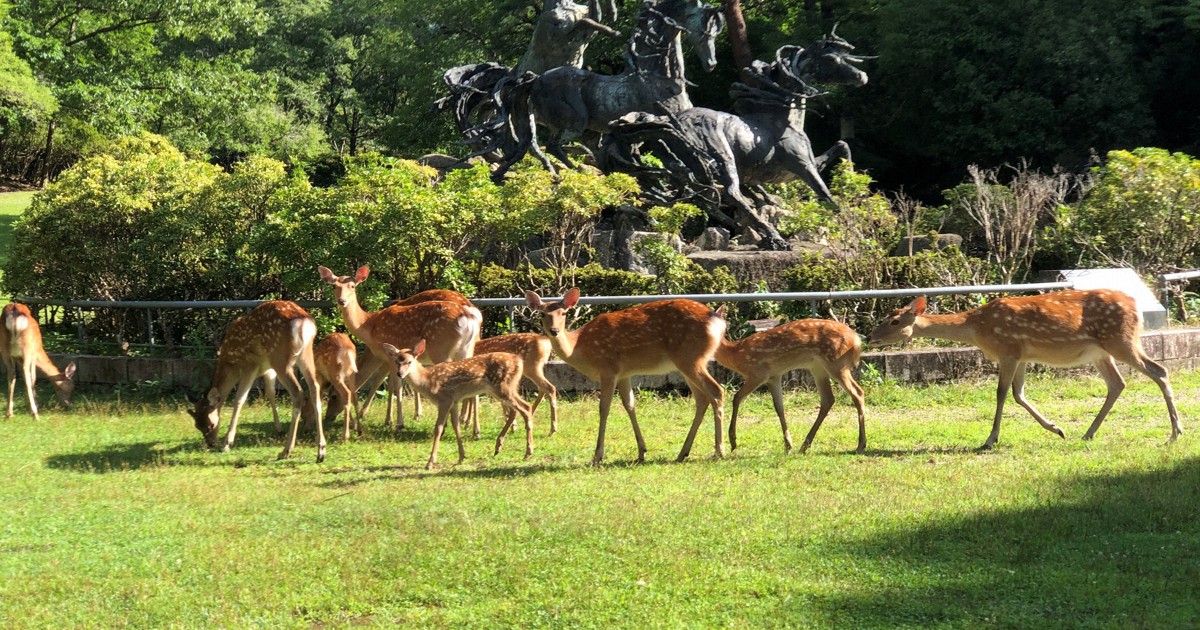
Meanwhile, the city of Kyoto is advancing efforts to control the local wild deer population. In recent years, wild deer have proliferated around areas like a park near the Takaragaike pond, created as an irrigation pond during the Edo period in the city’s Sakyo Ward, and the Mizorogaike pond, a national natural monument in Kita Ward that is home to rare plants believed to be remnants from the Ice Age, such as the buckbean. These areas did not have many deer until about a little over a decade ago. They have caused issues by consuming rare plants and crops, and one has been involved in a collision with a motorcycle.
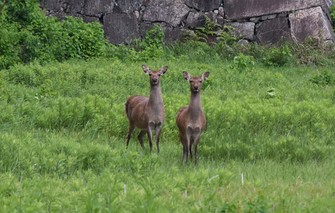
The two deer, a mother and her offspring, are now the only ones roaming freely in the inner moat of Nagoya Castle, down from a peak population of 56, as seen in this photo provided by the Nagoya Castle General Administration Office.
The Kyoto Municipal Government began a project in fiscal 2024 to capture and cull approximately 80 deer thought to inhabit these areas, aiming to complete the cull over two years.
The Nagoya Municipal Government’s interest in Kyoto’s wild deer was sparked by discussions in the city assembly. In June 2025, a Liberal Democratic Party councilor expressed concern about Nagoya Castle’s deer potentially dying out and proposed acquiring more of the animals from outside Aichi Prefecture. Mayor Ichiro Hirosawa stated, “We’d like to avoid a situation where the deer would disappear,” and indicated he would consider acquiring them.
Hearing this, Kyoto citizens urged Hirosawa to house the wild deer being culled in Kyoto at Nagoya Castle. The Nagoya government had considered acquiring deer from leisure facilities in other prefectures but shifted focus to Kyoto’s wild deer. In August 2025, Nagoya city officials visited Kyoto to express their interest in receiving several deer.
In a September Nagoya Municipal Assembly session, when asked by a councilor about helping Kyoto’s deer and taking them in at Nagoya Castle, Mayor Hirosawa stated, “We will make every effort to welcome them as soon as possible, aiming for December.” City officials visited Kyoto again the following month.
Deer relocation challenges
Capturing wild deer, transporting them from Kyoto to Nagoya, and maintaining them is no simple task. Key challenges include determining who will capture the deer and how to transport them, establishing a disease testing system, and temporarily housing the deer to acclimate them to humans and feeding. The hurdles are significant.
In mid-November, Nagoya informed Kyoto of “various challenges” and is working to address them. The Nagoya Castle office told the Mainichi Shimbun, “There are challenges, but we haven’t abandoned the idea. This is an unprecedented challenge.”
A Kyoto official in charge of wild deer culling said, “No specific plan has been presented yet, so I cannot say anything specific, but as long as it does not interfere with Kyoto’s culling project, there should be no problem.”
(Japanese original by Satoshi Kubo, Kyoto Bureau)
AloJapan.com