
On a recent sweltering day in August, men were seen repeatedly walking back and forth along a street in a hotel neighborhood in Tokyo’s Kabukicho red-light district.
They were appraising a number of young women who stood at hotel entrances amid the temperatures hovering near 40 degrees.
News reports have indicated that some inbound visitors and other foreigners come here in search of women available for a price.
However, an Asahi Shimbun reporter had the impression that middle-aged and elderly Japanese men accounted for the majority of the potential johns who were talking to the women.
In 2016, France enacted a law to punish clients of prostitutes, which defines the sex sellers as victims to be protected and penalizes the sex customers.
Those who have paid for sex from individuals in vulnerable settings, such as minors, disabled or pregnant persons, face particularly severe punishments.
What, then, does Japan look like in the eyes of a citizen living under such a legal system?
KABUKICHO TOUR AN EYE-OPENER
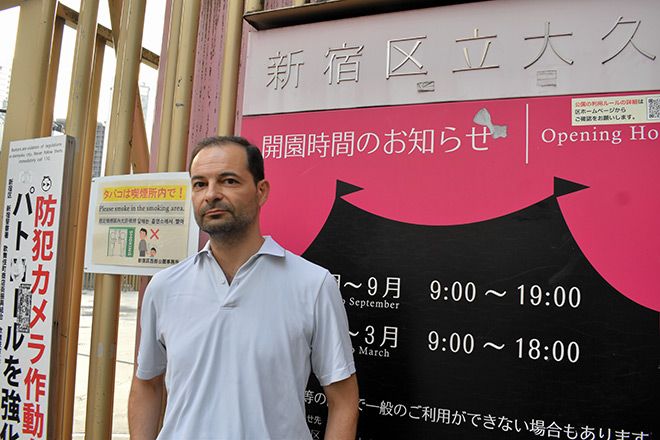
The reporter toured the Kabukicho district with Sebastien Brochot, a French specialist and trainer in the prevention of sexual violence, under the guidance of female activist Mirai Kisaragi.
Kisaragi has been assisting women who are on the front lines of sexual exploitation, such as on the street and on social media.
Brochot works for the “Resource centers for workers intervening with perpetrators of sexual violence” (CRIAVS), a public center for the prevention of sexual abuse, in a region covering Paris and its surroundings.
He was seen eyes wide open at the sight of women who fiddled with their smartphones as they stood, half in hiding, in the back of hotel entrances in Kabukicho.
“Oh, they are so very young!” he said.
Tears filled his eyes as he said: “The scene evokes the thought of my niece, who is 14.”
The women standing on the streets of Kabukicho to prostitute themselves have been featured in the news in France with the moniker of “tachinbo joshi” (standing girls).
EVEN ‘DATING,’ ‘MATCHING’ ARE SEX TRADE LINGOS
The CRIAVS, for which Brochot works, has offices across France.
The agency works to prevent cases of sexual abuse, including by training police officers, medical practitioners and other professionals who typically deal with sexual violence perpetrators and for providing counseling to pedophiles.
In Kabukicho, Brochot stared in surprise at the profusion of free “information bureaus” for sex industry clients and of billboards publicizing host clubs everywhere on the street.
He shook his head in disbelief when Kisaragi explained to him that ads that tout “dating,” “matching” and other similar services are also being used for “papa-katsu” (sugar-daddying) and other forms of the sex trade.
At one point, Brochot stopped at the sight of a man, likely a john, talking to a woman on a crowded street.
Kisaragi, who has been active since 2021, explained that the women on the street include many minors, some of them in their early teens.
“Why are those children left without protection?” Brochot asked.
Japan’s Law Banning Child Prostitution and Child Pornography criminalizes buying sex from persons under 18. Suspects were detained in 416 child prostitution cases in 2024.
In reality, Kisaragi said that only accounts for a small fraction of the numbers of minors being victimized.
In France, acts of buying sex in conspicuous places dropped sharply in number after the law to punish prostitution clients was enacted.
But similar acts have moved to less conspicuous places, such as social media platforms, to avoid arrest, according to sources.
Brochot said that represents a major issue in itself, but he noted that, unlike in France, buying sex seems to be a form of “entertainment” in Japan.
Some tourists visiting Japan travel to Kabukicho to see the “standing girls,” whose presence has been in the news overseas.
“Perhaps buying sex is being seen as an original cultural aspect of Japan by people outside the country,” Brochot said.
UNWANTED PREGNANCIES FROM SEX TRADE, ABUSE
Elsewhere, Brochot expressed bafflement at the sight of women in maid costumes lining up along a street on both sides to solicit customers.
Many of them work for “concept cafes.” Kisaragi told him that those female touts are there to explain about the charge system and other terms and to lure male customers to their shops.
“I was feeling embarrassed all the time, as I walked along here, for fear I could be taken for a customer with lustful eyes looking for these women,” Brochot said. “It frightens me to think that the Japanese don’t find this state of things unusual.”
Kisaragi said that many of the women on the street cannot feel at ease at their homes, because of abuse and other problems, and they are also socially isolated.
She said some of the women have told her that they have suffered additional abuse in the sex trade.
It is, however, not easy for them to complain about their suffering, because the female sex sellers are the ones who face investigations for “accosting” their customers, and are also the ones whom society calls into question.
No small number of male sex buyers argue, by comparison, that they are “helping” those women by employing them, Kisaragi said.
“Exploitation of females is taken for granted in Japan,” she said. “The problem is the buyers, the exploiters, are not being called into question.”
The sex trade can also bring about unintended pregnancies.
Brochot visited the offices of Piccolare, a government-approved, Tokyo-based nonprofit that is providing assistance to expectant and nursing mothers who face troubles and difficulties.
Kaori Nakajima, Piccolare’s head director, said that as the backdrop to some unwanted pregnancies lie the problems of sexual abuse and sexual suffering, such as from the sex trade or sexual acts without consent.
Nakajima quoted more than a few women as saying that they have no money and belong nowhere. They say that they cherish whatever brief rest they can grab when they do their laundry, take a shower and sleep until the checkout time in a hotel they go to with a man at the end of a given day.
Some become pregnant under similar settings, with no clues as to who fathered their child.
“A woman may be talking about a ‘boyfriend’ or an ‘ex,’ but listening to her more closely, you sometimes learn that the man is, in fact, preying on the money she has earned as a result of being sexually exploited,” Nakajima said.
It causes pain and requires an effort for the women to talk about how they have been abused in the sex trade or how they have been forced into violent forms of sexual intercourse in exchange for money. The women never consult with police.
“The female sex sellers should not be criminalized, but rather be protected (like they are in France), so they can report their suffering,” Nakajima said. “The problem lies with society that is giving tacit approval to a situation like this, whereby the sex industry is the only available haven for women in isolation.”
AloJapan.com