
Beneath four miles of ocean and a mile of rock and sediment, an international team, including USU’s Srisharan Shreedharan, recently uncovered new information — a hidden reason for the devastation of the 2011 magnitude 9.1 Tohoku earthquake, the most powerful ever recorded in Japan and the fourth most powerful recorded in the world.
As reported in the journal Science, a layer of clay acted as a lubricant during the quake, allowing the megathrust to move near the surface and creating a “tear line” that displaced large portions of the seafloor. This produced an intense tsunami that devastated coastal communities and critically damaged a nuclear power plant.
It is the first of several paradigm-shifting insights achieved on a four-month deep-sea expedition in which Shreedharan, earthquake physicist from the Quinney College of Agriculture and Natural Resources, participated aboard the scientific research vessel D/V Chikyu.
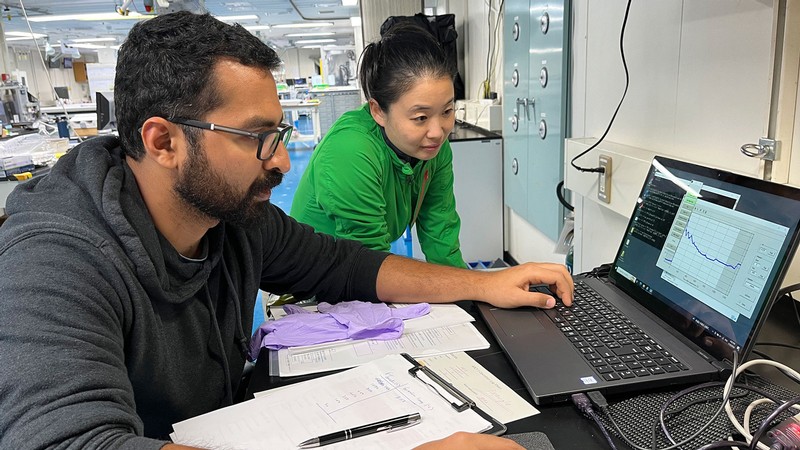
Shreedharan joined the expedition as a physical properties specialist aboard the deep-sea research vessel that drilled through the fault and into sediment on the Pacific Plate at the Japan Trench. As rock core samples were extracted from the plate boundary, the team was able to immediately collect geologic information in a way never before available.
“The samples were tested within minutes of reaching the surface, delivering pristine data,” Shreedharan said. “It created mountains of information and a new understanding of deformation at the Japan Trench that we can build on for years.”
The work was the deepest scientific ocean drilling ever conducted and set a new documented record with a total drill-pipe length of 7,906 meters beneath the sea surface.
Typically, subduction zone earthquakes begin deep underground and lose strength as the rupture moves upward. The 2011 Tohoku earthquake defied that expectation, growing stronger near the surface, a puzzling outcome that researchers like Shreedharan can now better explain.
The opportunity to revisit the exact location of this region of high-slip after the initial rapid reconnaissance expedition in 2012 represents the first time that researchers reinvestigated a site like this to ask key questions. How long does it take for a seismically active zone to “reset” after a large quake, allowing stress to begin rebuilding along active layers? A hundred years? Or just weeks or even hours? New research set to be published this year will explore this topic using data gathered during the expedition.
“It’s the first time anyone has had the opportunity to collect time-lapse data sets at such an important subduction zone with global implications for seismic hazards,” Shreedharan said.
The team achieved unprecedented sample recovery (compared to 20-30% in 2012) and pierced the actual plate boundary interface multiple times — a world first for scientific drilling of a plate boundary fault, made possible by recent engineering advances, with core drilling occurring more than 5.5 miles beneath the hull of the ship.
“The scale of the engineering involved was mind-blowing,” Shreedharan said.
Ultimately the goal of his 60 days aboard the ship was to gather and translate detailed fault-zone knowledge into better earthquake hazard assessments for communities around the world, including Utah, Shreedharan said, deciphering where they might occur, how they might act, and the potential consequences. Utah has one of the most earthquake-prone areas in the continental U.S. The Wasatch fault is a different type of system than the Japan Trench, but the rock mechanics and re-strengthening processes learned there are applicable to fault systems worldwide, he said.
Coinciding with publication of the study is the release of a 30-minute documentary about the expedition. The film follows dozens of scientists through the 105 days at sea as they plan, drill, recover core samples and install long-term observatories that reach into the fault zone.
AloJapan.com