
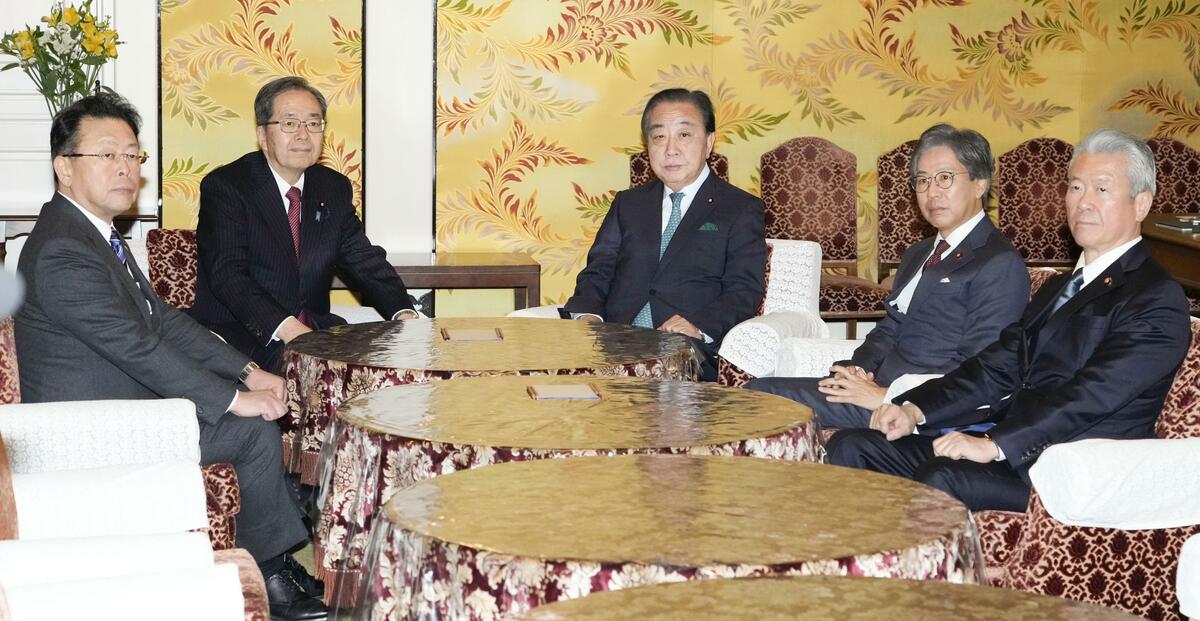
TOKYO – Japan’s main opposition Constitutional Democratic Party of Japan and the Komeito party, formerly a longtime ruling coalition partner, agreed Thursday to form a new party ahead of a possible snap election, a major shift in the balance of power in the parliament.
The agreement, reached under the banner of bringing together centrist forces, comes as the two parties seek to put up a united front against the conservative ruling camp of the Liberal Democratic Party and its coalition ally, the Japan Innovation Party.
The development may change the outlook for a possible election as Prime Minister Sanae Takaichi, who has hawkish views on national security, has enjoyed high approval ratings in media polls, leading to a realignment of Japanese politics.
The election is likely to be held on Feb. 8, with official campaigning starting from Jan. 27, senior members of ruling parties said.
Komeito chief Tetsuo Saito told reporters after meeting with CDPJ leader Yoshihiko Noda, a former prime minister, “It is important for centrist forces to rally together.”
House of Representatives members from the CDPJ and Komeito will join the new party, while the two original parties will continue to exist for members of the House of Councillors, respectively, even after the new party is launched, according to Saito.
Noda told reporters separately, “An opportunity to put centrists at the center of Japan’s politics has come.”
The move comes after Komeito ended its 26-year coalition with the LDP less than a week after Takaichi won the party’s leadership race on Oct. 4. Recent speculation of a February election accelerated coordination between the parties.
Lawmakers whom Komeito had been planning to field in single-seat constituencies, including Saito, will withdraw, he said. Candidates from Komeito are expected to be placed higher on proportional representation lists, sources familiar with the matter said.
Noda said he has shared the view with Saito that it is desirable for them to jointly lead the new party. He added the party’s name could be revealed as soon as Friday.
Komeito is backed by Japan’s largest lay Buddhist organization, Soka Gakkai, which long provided key campaign support to the LDP. The prospect of the Komeito support base being mobilized against the ruling camp is set to alarm it.
Itsunori Onodera, a senior LDP lawmaker, told reporters prior to the new party announcement that he believed the arrangement “could have some impact in closely contested and highly competitive districts” for the ruling party.
The backing of Soka Gakkai is estimated to be worth around 10,000 to 20,000 votes in each constituency. With the CDPJ supported by Japan’s biggest umbrella group for labor unions, the new party could have a strong base to compete.
Noda and Saito used to belong to the same political group, the now-defunct New Frontier Party that existed for three years from 1994 to challenge the dominance of the LDP, which has held power almost continuously since its founding in 1955.
Saito said, “It may be possible to form a new centrist bloc with like-minded figures and, in some cases, cooperate with the LDP in advancing policies.”
The CDPJ and Komeito are willing to align on shared policy priorities, such as promoting the introduction of an optional separate-surname system for married couples and pursuing reforms in response to the LDP’s slush fund scandal, the sources said.
Noda, meanwhile, said the opposition Democratic Party for the People, which has become an emerging force in recent elections under policies critics often describe as populist, was among the groups he would consider calling on to join.
But DPP leader Yuichiro Tamaki ruled out the possibility of participating, telling reporters that he found the new party’s centrist banner “extremely vague.”
On Wednesday, Takaichi expressed her intention to dissolve the lower house shortly after this year’s ordinary parliamentary session convenes on Jan. 23, despite having pledged to swiftly proceed with measures to ease public pain from inflation outpacing wage growth.
The CDPJ holds 148 seats in the lower house, while Komeito has 24, for a combined total of 172. The LDP and its junior coalition partner the JIP hold a razor-thin majority of 233 seats in the 465-member chamber.
AloJapan.com