
Emerging artists at Art Collaboration Kyoto
Gallery / 8 images
No matter where in the world they take place, most art fairs offer a similar experience: wandering around a vast, hangar-like space with white booths, exposed ceilings and industrial track lighting, and maybe an immersive installation sponsored by a luxury car brand or premium vodka. Art Collaboration Kyoto (ACK), which takes place every year in November in Japan’s historic capital, offers something different.
It’s smaller, more intimate and less crassly commercial than any other art fair I’ve attended. The building where it’s held, the Kyoto International Conference Centre, is a fascinating object in itself: a vast concrete behemoth of jutting walkways and upturned pyramids, its austere quality offset by the dense foliage surrounding it. Inside, the layout has each exhibiting gallery nestled in a temporary wooden structure, which creates a softer, warmer atmosphere. The curatorial approach is likewise distinct, with each booth housing two galleries: one international and the other based in Japan, each complementing the other – either thematically or visually – in an interesting way.
And while art fairs typically do take place alongside a programme of events in their home city, Kyoto’s abundance of historical architecture offers some unique possibilities. During my visit to ACK, I find myself taking off my shoes and padding through Buddhist temples, seeing artworks framed by Shoji panels and lush gardens, the leaves having turned the brightest shades of red and orange I’ve encountered in the natural world. It certainly beats chugging prosecco at a gallery in Mayfair.
According to director Yukako Yamashita, ACK is deeply committed to supporting young and emerging artists. This takes many forms, including partnerships with local schools and universities, a series of workshops hosted by top Japanese artists, and the Pommery Prize, sponsored by the champagne brand of the same name and awarded each year to an artist with a connection to Kyoto. The fair also features a programme of public artworks, co-curated by Martin Gelman – an established figure on the international art scene – alongside Coco Kimula, a Japanese curator who is still in her mid-twenties. “Letting different generations co-exist is definitely one of the most important elements for ACK,” Yamashita, wearing a resplendent kimono, tells Dazed.
In terms of the works submitted by the participating galleries, ACK relied on “trusting their own sensibilities in terms of the artist selection”, she adds, although their proposals are carefully considered beforehand. There is an effort to pair older and more established galleries with younger Japanese upstarts, promoting a collaboration which is cross-generational as well as international. “We’re showing figures like David Hockney as well as really young, up-and-coming Japanese artists in their twenties,” says Yamashita.
Below, you’ll find some of the best contemporary art exhibited at this year’s ACK, from melancholy textiles to satirical paintings and more.
Nanae Mitobe, Art Collaboration Kyoto, Japanese art
Gallery / 7 images
There’s something deeply satisfying about the tactile quality of Nanae Mitobe’s work, so much so that it’s difficult to resist the temptation to reach out and touch it. Based between Vienna and Japan, the painter uses thick, crunchy brush strokes and incorporates sculptural elements – a clarinet, for example – which protrude from the canvas. I love the way she paints faces, which are almost abstract in their reduction to the barest essentials. Her work is often engaged in political satire, but even when she’s poking fun at her subjects – Donald Trump probably wouldn’t be flattered by her recent portrait series – they are oddly adorable.
NOH Sangho, Art Collaboration Kyoto, South Korean art
Gallery / 4 images
Normally, I’m not a fan of artists using AI, but in NOH Sangho’s case, I make an exception. While many of his pieces are inspired by AI-generated images, he draws and paints them himself, rather than letting a robot do the hard work, and the effect produced is delightfully off-kilter. The Great Chatbook 3 (2023), an oil-painting tapestry of images drawn from the internet, is quite staggering to see in person: in its scale, level of detail and surrealism it reminded me of Hieronymus Bosch’s In the Garden of Earthly Delights, and like that painting, it was something I could look at for a very long time without getting bored. While some digital art deploys a visual language of intentional garishness, The Great Chapbook takes the transient ephemera of the internet, such as Kermit the Frog dressed as a cowboy, something looks like a two-headed Pikachu, and affords it a timeless beauty.
Motoko Ishibashi, Art Collaboration Kyoto, Japanese art
Gallery / 3 images
Born in Nagasaki and currently based in London, Ishibashi’s work combines elements of the visual languages of both Japan and Britain. Interested in mass consumerism, objectification and digital culture, she draws influences from images produced by online fandoms, as well as forms of Japanese erotica like hentai. While some of her past work has been more explicitly concerned with sexual representation (such as her 2021 series of paintings of giant, disembodied asses), the pieces she exhibited at ACK were less straightforwardly figurative. At first glance, they are close to abstraction. Like staring at a magic eye painting, it took me a while to discern the figures beneath the layers of colours and patterns in ‘commercial zone’ – smiling faces, dogs, a hand grasping a grab rail or possibly the bar of a cell. Hers is interesting, richly layered work which rewards close attention.
Sophie Thun, Art Collaboration Kyoto, photography
Gallery / 4 images
Thun is a Polish artist based in Vienna, whose work combines conventional photography with ‘photogram’ – a technique associated with modernist innovators like Man Ray, which involves creating a photographic image without a camera by laying an object over light-sensitive material. In Thun’s work, the ‘object’ is usually herself, her own hands and body layered over monochromatic self-portraits. Thon has described her practice as a way of making the processes of photography visible, but it’s more than just an interesting technical exercise. She took many of her self-portraits alone in hotel rooms while travelling for work, and they evoked a powerful sense of melancholy and isolation.
Aoyama Satoru, Art Collaboration Kyoto, Japanese art
Gallery / 3 images
Saturo is a textile artist who makes embroideries with an old industrial sewing machine, some of which are so realistic they could almost be photographs. While his work has always been directly concerned with capitalism and the labour movement, the two pieces at ACK which struck me the most seemed absent of any political content: depicting images of Tokyo at sunset, ‘Foundscape (Good Evening Tokyo, 2020)’ and ‘Foundscape (Memory of a Fading Place, 2024)’ are both hauntingly nostalgic and autumnal, like Seasonal Affective Disorder distilled into a single image. Whether he’s creating images of protests or quiet scenes like these, for Saturo these are fundamentally conveying the same thing: as he once put it in an interview, it’s “a reflection on things that are disappearing or invisible in contemporary society”.
Yukino Yamanaka, Art Collaboration Kyoto, Japanese art
Gallery / 2 images
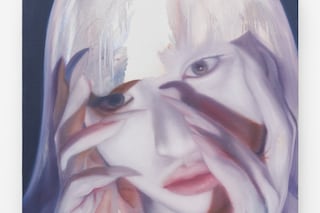
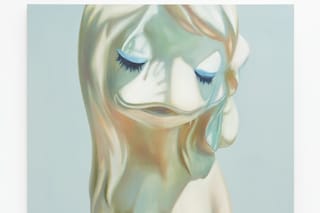
Born in 1999, Yanabaka is one of the youngest artists exhibiting at ACK. While working in one the most traditional of mediums – oil painting – her work has a futuristic, dream-like quality, like it’s drawn from the internet’s collective subconscious. Some of her portraits are more straightforward, even as the paint drips down the canvas, while another, Lacy, depicts a strange figure with a duck-like beak – at first I found this so bizarre as to be actively unappealing, but the longer I looked, the more compelling I found it.
Charlotte Keates
Gallery / 8 images
Charlotte Keates creates paintings of interiors, inspired by architectural drawings and blue-prints (there’s a touch of David Hockney too). She thinks of her work as “dystopian”, as she put it in an interview, but while there’s maybe something unsettling about the absence of human figures, I found her paintings very groovy and inviting. Who wouldn’t want to step inside a world of swimming pools, palm trees and mid-century decor?
Omari Douglin
Gallery / 5 images
Brooklyn born, LA-based artist Omari Douglin works across a wide range of mediums and materials, including oil, acrylic and, memorably, large-scale paper mache sculptures. His paintings deploy idiosyncratic colour schemes (notably organges and browns) and humour, often playing with and subverting recognisable archetypes from contemporary culture.
AloJapan.com