
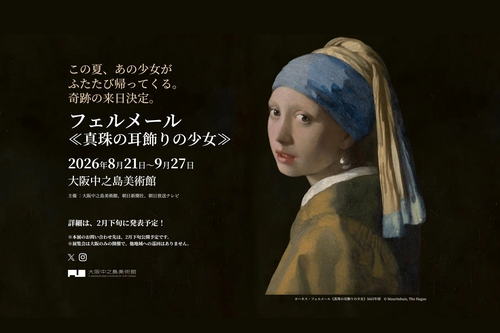
For the first time in more than a decade, a masterpiece that almost never travels is going abroad – and it’s heading to Asia.
In August 2026, Vermeer’s Girl with a Pearl Earring will visit Japan for a special exhibition at the Nakanoshima Museum of Art, Osaka, marking the painting’s first appearance in Asia since its blockbuster 2012-2014 world tour. The Mauritshuis in The Hague – where the painting normally resides – will close temporarily for summer renovations and has announced a rare loan of its star piece.
With Osaka as its exclusive stop, the exhibition will run for just five weeks, from 21 August to 27 September.
Girl with a Pearl Earring will be exhibited in Osaka from August to September 2026
Today, Girl with a Pearl Earring is a globally recognized icon. But for more than two centuries after its creation, it remained relatively unknown – and so did its creator, Johannes Vermeer.
Vermeer (1632–1675) lived his entire life in the Dutch city of Delft. A contemporary of Rembrandt and Frans Hals, he is now regarded as one of the great masters of the Dutch Golden Age. Little is known about his life, but records show he worked as both an artist and an art dealer, a business passed down from his father. Neither role brought much financial stability.
In the early 1670s, an economic downturn triggered by Louis XIV’s invasion of the Netherlands devastated the art market. Vermeer fell into debt and died at the age of 43. His widow, left with 11 children, was forced to declare bankruptcy and sell off his paintings to pay creditors.
For generations, his work received little attention and was sometimes misattributed to other artists. It wasn’t until the 19th century that art historians began to take serious notice. Even then, Girl with a Pearl Earring didn’t draw much interest. When it appeared at an auction in The Hague in 1881, it sold for the equivalent of less than one U.S. dollar. The buyer, having no heirs, donated it to the Mauritshuis in 1902.
The Mauritshuis is located in The Hague, Netherlands
The painting’s transformation into a global icon truly began in 1995, when it was selected as the poster image for a major Vermeer retrospective at the National Gallery of Art in Washington, D.C. From that moment, it became one of the most familiar images in Western art.
Its last international tour took place from 2012 to 2014, with stops in Tokyo, Kobe, Los Angeles, Atlanta, New York, and Bologna. In Japan alone, more than 1.2 million people visited the exhibition, making it the most attended art show in the world that year.
Girl with a Pearl Earring is one of the most familiar images in Western art
Much of the painting’s allure lies in its sense of mystery. Often called the “Mona Lisa of the North,” the work is not a traditional portrait, but a tronie – a stylized study of a facial type or expression, rather than a depiction of a specific person. Dutch artists often painted tronies of soldiers, scholars, musicians – or, in this case, “a young beauty”, dressed in exotic costume, with a silk turban and an impossibly large pearl earring.
At first glance, the pearl appears luminous and solid. But on closer inspection, it’s created with just two strokes of white paint: a soft reflection below and a thick dot of light above. There is no hook and no chain – just the suggestion of a pearl, rendered entirely with light.
The pearl is rendered with two strokes of white paint
Vermeer is known to have worked slowly, sometimes spending months on a single painting. He is believed to have produced no more than 50 works in his lifetime, and only about 36 are definitively attributed to him today. Nearly all of them are held in public collections, spread across museums in the Netherlands, Germany, the United Kingdom, France, and the United States.
In 2004, Young Woman Seated at the Virginals became the first Vermeer to appear at auction in more than 80 years, selling at Sotheby’s London for £16.2 million. A decade later, Saint Praxedis sold at Christie’s New York for US$6.24 million. Though its attribution was initially debated, the Rijksmuseum later confirmed it as authentic.
Young Woman Seated at the Virginals sold for £16.2 million at Sotheby’s London in 2004 (Not included in the upcoming exhibition)
Saint Praxedis sold for US$6.24 million at Christie’s New York in 2014 (Not included in the upcoming exhibition)
The Mauritshuis currently holds three paintings by Vermeer: Girl with a Pearl Earring, the mythological Diana and her Nymphs, and View of Delft, a rare cityscape of his hometown. While only Girl has been confirmed for the Osaka exhibition, further details are expected in February.
The host venue, the Nakanoshima Museum of Art, is located on an island between two rivers in central Osaka. Though traditionally a business and political district, Nakanoshima has become a cultural hub in recent years.
Alongside the Vermeer exhibition, visitors can explore several nearby institutions, including the Osaka City Museum of Oriental Ceramics, the National Museum of Art, Osaka, and the Children’s Book Forest Nakanoshima – a whimsical library designed by architect Tadao Ando.
Diana and her Nymphs | The Mauritshuis (Not yet confirmed for loan)
View of Delft | The Mauritshuis (Not yet confirmed for loan)
Girl with a Pearl Earring | Special Exhibition in Japan
Venue: Nakanoshima Museum of Art, Osaka
Address: 4-3-1 Nakanoshima, Kita-ku, Osaka, 530-0005, Japan
Date: 21 August – 27 September
Opening Hours: 10 am – 5 pm (Closed on Mondays, or the next weekday when Monday is a public holiday)
Ticket Price: To be announced
Instagram: vermeerosaka2026
AloJapan.com