

The Japanese Yen (JPY) reverses a modest Asian session dip against a softer US Dollar (USD), though it lacks bullish conviction amid mixed fundamental cues. The growing acceptance that the Bank of Japan (BoJ) will stick to its policy normalization path marks a significant divergence in comparison to dovish US Federal Reserve (Fed) expectations and offers some support to the lower-yielding JPY. Apart from this, rising geopolitical tensions turn out to be another factor that benefit the JPY’s safe-haven status.
Investors, however, remain uncertain about the likely timing of the next interest rate hike by the BoJ. Moreover, concerns about Japan’s fiscal situation hold back the JPY bulls from placing aggressive bets. The USD, on the other hand, struggles to attract any follow-through buying amid rising bets for more interest rate cuts by the Fed. This, in turn, might keep a lid on any intraday move up for the USD/JPY pair as the market focus remains glued to a host of important US macroeconomic releases due this week.
Japanese Yen traders seem non-committal amid mixed fundamental cuesJapan’s fiscal position remains a source of concern, especially after the cabinet approved Prime Minister Sanae Takaichi’s record-setting ¥122.3 trillion budget. Furthermore, investors remain unsure about when the next Bank of Japan interest rate hike might occur amid expectations that energy subsidies, stable rice prices, and low petroleum costs would keep inflation low into 2026.BoJ Governor Kazuo Ueda said on Monday that the central bank will continue raising rates if economic and price developments move in line with forecasts. Ueda added that adjusting the degree of monetary support will help the economy achieve sustained growth, and that wages and prices are likely to rise together moderately, keeping the door open for further policy tightening.The outlook pushed yields on the rate-sensitive two-year and the benchmark 10-year Japanese government bonds (JGB) to their highest level since 1996 and 1999, respectively. The resultant narrowing of the rate differential between Japan and other major economies holds back traders from placing aggressive bearish bets around the Japanese Yen amid intervention speculations.The US Dollar struggles to capitalize on the previous day’s positive move amid dovish US Federal Reserve expectations and concerns about the central bank’s independence under US President Donald Trump’s administration. Traders also seem reluctant and opt to wait for key US macro data, which could offer more cues about the Fed’s rate cut path and provide some meaningful impetus.Wednesday’s US economic docket features the ADP report on private-sector employment, the ISM Services PMI, and JOLTS Job Openings. The focus, however, will remain glued to the US Nonfarm Payrolls (NFP) report on Friday. The latter would play an important role in determining the next leg of a directional move for the USD ahead of the latest US consumer inflation figures next Tuesday.USD/JPY needs to weaken below 156.15 confluence to back case for deeper losses
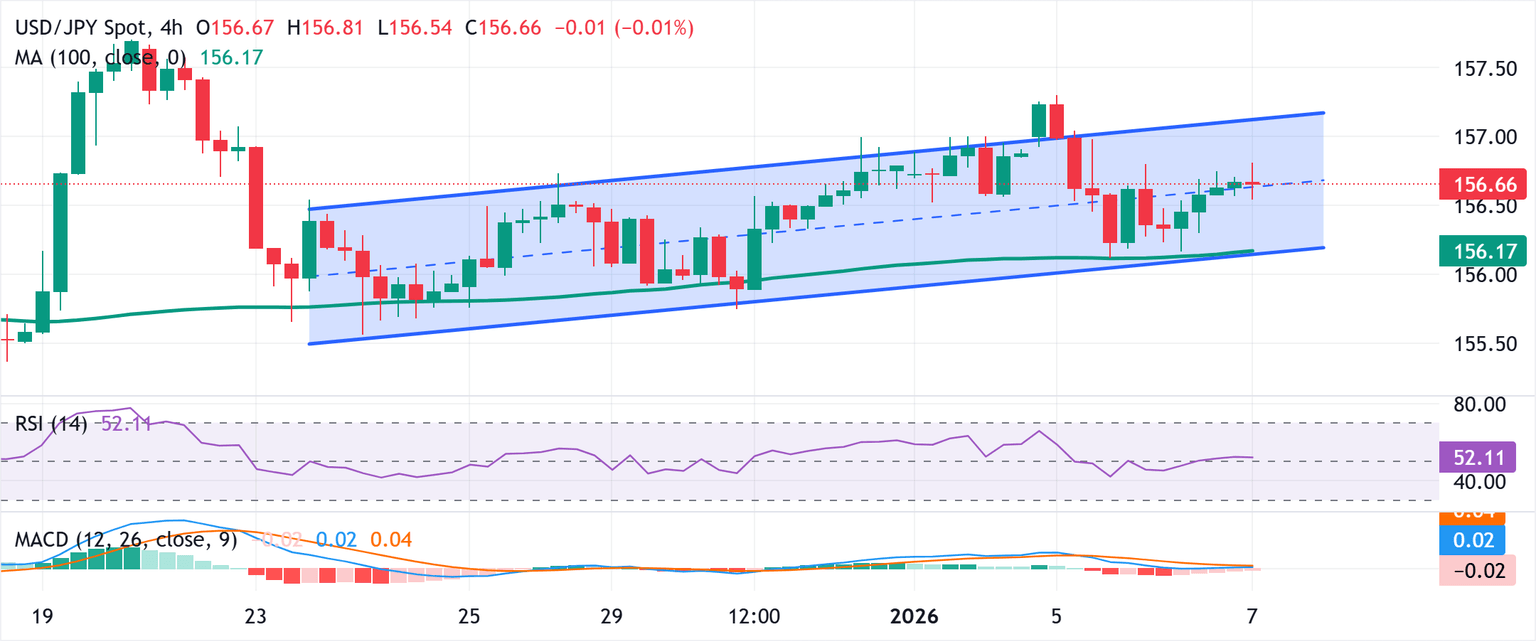
The USD/JPY pair’s overnight move up validated the 156.15 confluence support – comprising the 100-period Simple Moving Average (SMA) on the 4-hour chart and the lower boundary of a short-term ascending channel. The said area should act as a key pivotal point, which, if broken decisively, will be seen as a fresh trigger for bearish traders and pave the way for deeper losses.
Meanwhile, the Moving Average Convergence Divergence (MACD) histogram is slightly negative and contracting around the zero line, suggesting fading bearish momentum. The Relative Strength Index (RSI) prints 52, neutral with a modest positive tilt. The rising SMA supports a buy-on-dips stance, though subdued MACD readings signal limited follow-through for now. RSI near the midline reinforces a consolidative tone within the channel.
Initial support is at the 156.15 confluence, while resistance stands at 157.15, or the upper boundary of the channel. A close above the latter could unlock further gains, whereas failure to overcome it would keep USD/JPY contained inside the rising corridor.
(The technical analysis of this story was written with the help of an AI tool)
Bank of Japan FAQs
The Bank of Japan (BoJ) is the Japanese central bank, which sets monetary policy in the country. Its mandate is to issue banknotes and carry out currency and monetary control to ensure price stability, which means an inflation target of around 2%.
The Bank of Japan embarked in an ultra-loose monetary policy in 2013 in order to stimulate the economy and fuel inflation amid a low-inflationary environment. The bank’s policy is based on Quantitative and Qualitative Easing (QQE), or printing notes to buy assets such as government or corporate bonds to provide liquidity. In 2016, the bank doubled down on its strategy and further loosened policy by first introducing negative interest rates and then directly controlling the yield of its 10-year government bonds. In March 2024, the BoJ lifted interest rates, effectively retreating from the ultra-loose monetary policy stance.
The Bank’s massive stimulus caused the Yen to depreciate against its main currency peers. This process exacerbated in 2022 and 2023 due to an increasing policy divergence between the Bank of Japan and other main central banks, which opted to increase interest rates sharply to fight decades-high levels of inflation. The BoJ’s policy led to a widening differential with other currencies, dragging down the value of the Yen. This trend partly reversed in 2024, when the BoJ decided to abandon its ultra-loose policy stance.
A weaker Yen and the spike in global energy prices led to an increase in Japanese inflation, which exceeded the BoJ’s 2% target. The prospect of rising salaries in the country – a key element fuelling inflation – also contributed to the move.
AloJapan.com