
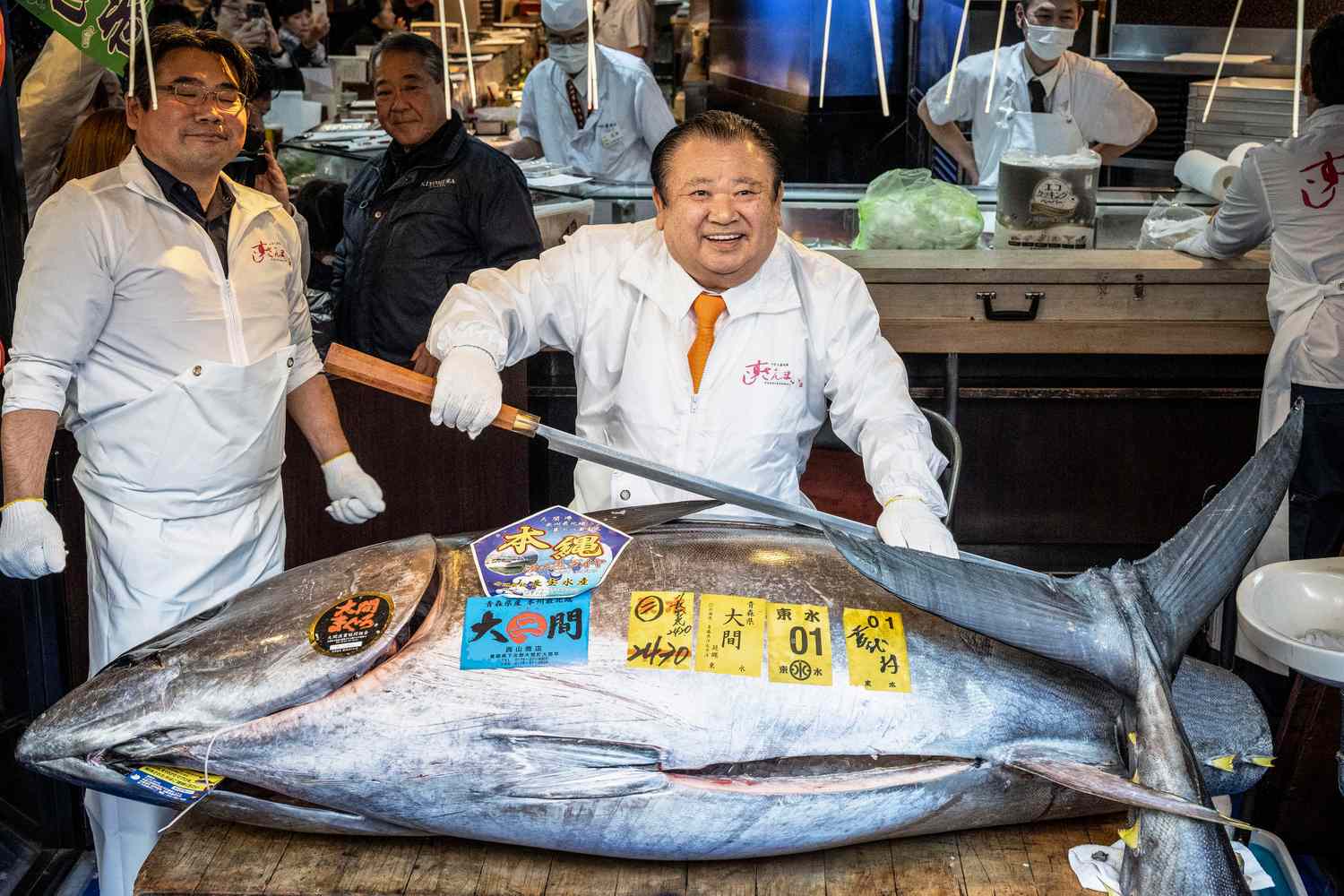
Sushi Zanmai owner Kiyoshi Kimura, known as Japan’s “Tuna King,” paid a record-breaking $3.2 million for a 535-pound Pacific bluefin tuna at Toyosu Market’s first auction of 2026.The prized fish, caught off Oma at the northern tip of Honshu Island, reflects Japan’s deep culinary and cultural reverence for bluefin, a species prized for its rich marbling and buttery texture.Kimura’s winning bid is an act of prestige rather than profit — he serves the rare fish at regular menu prices, a gesture honoring tradition and good fortune.
“It’s in part for good luck,” confessed an elated Kiyoshi Kimura to the press thronging him, moments after he paid a record-breaking $3.2 million at auction on Monday, January 5, for the biggest and most desirable Pacific bluefin, a massive 535-pounder, in the Toyosu Market’s clamorous first bluefin auction of the new year. “But when I see a good-looking tuna, I cannot resist. I haven’t tasted it yet, but it’s got to be delicious.”
That’s an understatement from the owner of Japan’s Sushi Zanmai restaurant chain, replete for the sale in his regulation bloodstain-proof, blaze-white nylon market jacket, under which a jolly orange necktie could be seen. Kimura’s richly deserved national nickname is “The Tuna King.” His heart-stopping $3.2 million bid for this gleaming, fresh deep-blue fish smashed the previous Toyosu Market record by more than a million dollars, set by Kimura (at $2.1 million) in 2019. It’s considered a matter of great prestige as well as a harbinger of good fortune to take the big fish at the market’s annual kickoff sale. We could reasonably say that “Tuna King” Kimura is perennially in the tumble at the event: He won the biggest bluefin of the new year six times prior to the market’s 2018 move to its new Toyosu facility.
Why the most expensive tuna is never sold at a profit
The 2026 price works out to about $ 6,000 per pound for this bluefin. But it’s a bellwether of the broad cultural regard in which the Japanese hold this particular species within their cuisine, as well as a sharp metric of the honor of being able to butcher and to serve it, that the winners of the Toyosu new year’s bluefins do not sell the fish to their customers at or above the auction price. Rather, they dive into the sales fray knowing they will lose money, often substantial sums. In their restaurants, as Kimura modestly noted of his own chain in the aftermath of Monday’s dawn sale, the winning fish is priced like any other bluefin at the table.
Kimura, who founded his restaurant chain at Tsukiji Market, the predecessor to the Toyosu Market, in 1979, immediately had the bluefin transported – by hand, on a wooden cart – to his flagship restaurant at the Toyosu Market, where it was put on regal display at the front of the shop. Notably, the big bluefin, at 535 pounds, just about double the weight of a mature North American buck, was caught off Oma, a tiny fishing town at the northernmost point of Honshu Island, upon which Tokyo lies.
The record-setting tuna was caught off Oma, a small fishing town at the northern tip of Japan’s main island. The surrounding waters funnel baitfish from two major seas, creating ideal feeding grounds. As a result, Oma has become legendary for producing Japan’s largest bluefins.
Photo by STR
Why Oma produces Japan’s greatest bluefin
Here’s the key: The strait between Honshu and its northern neighbor, Hokkaido Island, connects the North Pacific with the Sea of Japan. This means the interplay of these massive waters and their respective shoals sluices giant schools of baitfish that shelter in the strait, which is why the waters off Oma enjoy the renown as a feeding ground for the Japanese fishery’s biggest bluefins. Toyosu Market’s first and biggest bluefin of 2025, a 608-pounder, was also caught off the shores of Oma. Not coincidentally, in one shard of good news out of the oceans these days, the bluefin population in the North Pacific, long feared endangered, is considered to be on the rebound.
From muscle to marbling, how bluefin is judged
As ever in matters bluefin in Japan, it’s all about the cuisine. What the buyers are looking for is the grain of the flesh and the flavorful white-line marbling of the ultra-nutritious fat. To reveal that, as well as other qualities of the particular bluefin up for sale, Toyosu Market’s butchers make one long cut along the lower body to open the abdominal wall of muscle without gutting the fish, and they make a second traditional cut perpendicular to the axis of the fish by slicing off the tail fin with a couple of steaks’ worth of the tail itself, sticking that piece in one of the massive gill openings up by the head so that it won’t be misplaced.
Thus laid out, minus their tails and lying side-by-side on the market’s viewing pallets, the tightly muscled fish look like so many hydrodynamic silver-and-blue artillery shells, torpedoes perhaps, of a special sort.
The bluefin attains its torpedo-like top cruising speed of around 45 miles an hour easily because the main locomotive muscles engaged are the long ones located high up, close to the spine — including, in chefs’ terms, the backstraps, or filets. Other species rely on the muscles just under their skin.
As it cuts through schools of bait in a feeding frenzy, the bluefin swims with brute power from its dorsal side. The muscles up there carry little fat. In the bluefin, this is why the sets of muscles with the heaviest marbling of the prized fat, or in sushi speak, toro, are found opposite the spine, down in the belly. These fatty chunks of the abdominal wall are the sashimi pieces that literally melt in your mouth. The long, tenderloin steaks up top yield the sushi.
All that power and blood and action is tasteable in bluefin. For his central role in delivering these 535 pounds of seriously ravishing flavor from the deep ocean off Oma to the public, the Tuna King was quite sanguine about having to part with $3.2 million in an eyeblink on Monday morning. Kimura is, after all, no virgin at Toyosu. He’d gone in wanting to pay less, arguably a lot less, but what’s “more” and what’s “less” tends to blur when confronted with a quarter-ton peak bluefin at market in Japan.
In the event, the market, in the form of the white-hot bidding, paid its own tribute to the fish. The victorious Kimura put it this way: “The price shot up before you knew it.”
AloJapan.com