
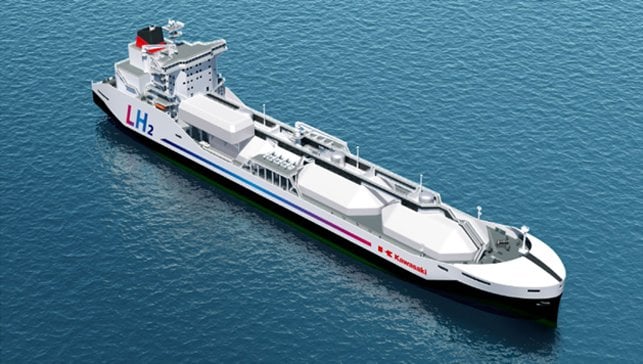
A new project supported by the Japanese government is designed to provide the foundation for the future hydrogen supply chain. Four years after Japan demonstrated the world’s first liquified hydrogen carrier, the new project seeks to construct the next vessel on a commercial scale.
The Green Innovation Fund Project is supported by Japan’s New Energy and Industrial Technology Development Organization (NEDO). The project has a budget of approximately $2 billion and is designed to demonstrate the entire supply chain for liquified hydrogen.
Japan Suiso Energy (JSE), which was established in 2021 to develop the hydrogen supply chain, will lead the project, and Kawasaki Heavy Industries will build the world’s largest liquefied hydrogen carrier with a capacity of 40,000 cubic meters at its Sakaide Works. It will be approximately 250 meters (820 feet) in length and expected to have a commercial speed of 18 knots. They plan to conduct the first demonstration of loading and unloading and voyages at sea by 2030.
The vessel will have pioneering technology, including a high-performance insulation system to reduce the generation of boil-off gas (BOG) from the cryogenic storage. A double-wall vacuum jacketed piping system will keep the material at an extremely low temperature for efficient and safe transfer between the onshore facility and the liquefied hydrogen tanks on the vessel.
The shape of the hull and the draft have been especially designed considering the low density of liquified hydrogen. As a result, the vessel will require less power and achieve higher propulsion efficiency. It will use a hydrogen gas supply system with a compressor and a heat exchanger that will enable boil-off gas generated from the liquefied hydrogen cargo tanks to be used as a propellant.
The project is also building a liquified hydrogen terminal in Ogishima, Kawasaki City. It will be the world’s first commercial-scale facility equipped with one of the world’s largest liquefied hydrogen storage tanks (storage capacity of 50,000 cubic meters), marine cargo handling equipment (including both shipping and receiving functions), hydrogen liquefaction equipment, hydrogen gas transmission equipment, and liquefied hydrogen tanker truck loading equipment. JSE will be the project owner, and a joint venture led by Kawasaki Heavy Industries will be the main contractor responsible for the design and construction of the facilities. Groundbreaking for the facility was conducted in November 2025.
Stay on Top of the Daily Maritime News
The maritime news
that matters most
Get the latest maritime news delivered to your inbox daily.
Kawasaki Heavy Industries built in 2021 the first liquified hydrogen carrier, Suiso Frontier, for the project. It had a capacity of 1,250 cubic meters and was used for a demonstration voyage that loaded hydrogen in Australia and transported it to Japan.
Japan looks to develop a new renewable energy import business as it works to transition from coal-fired energy plants.
AloJapan.com