
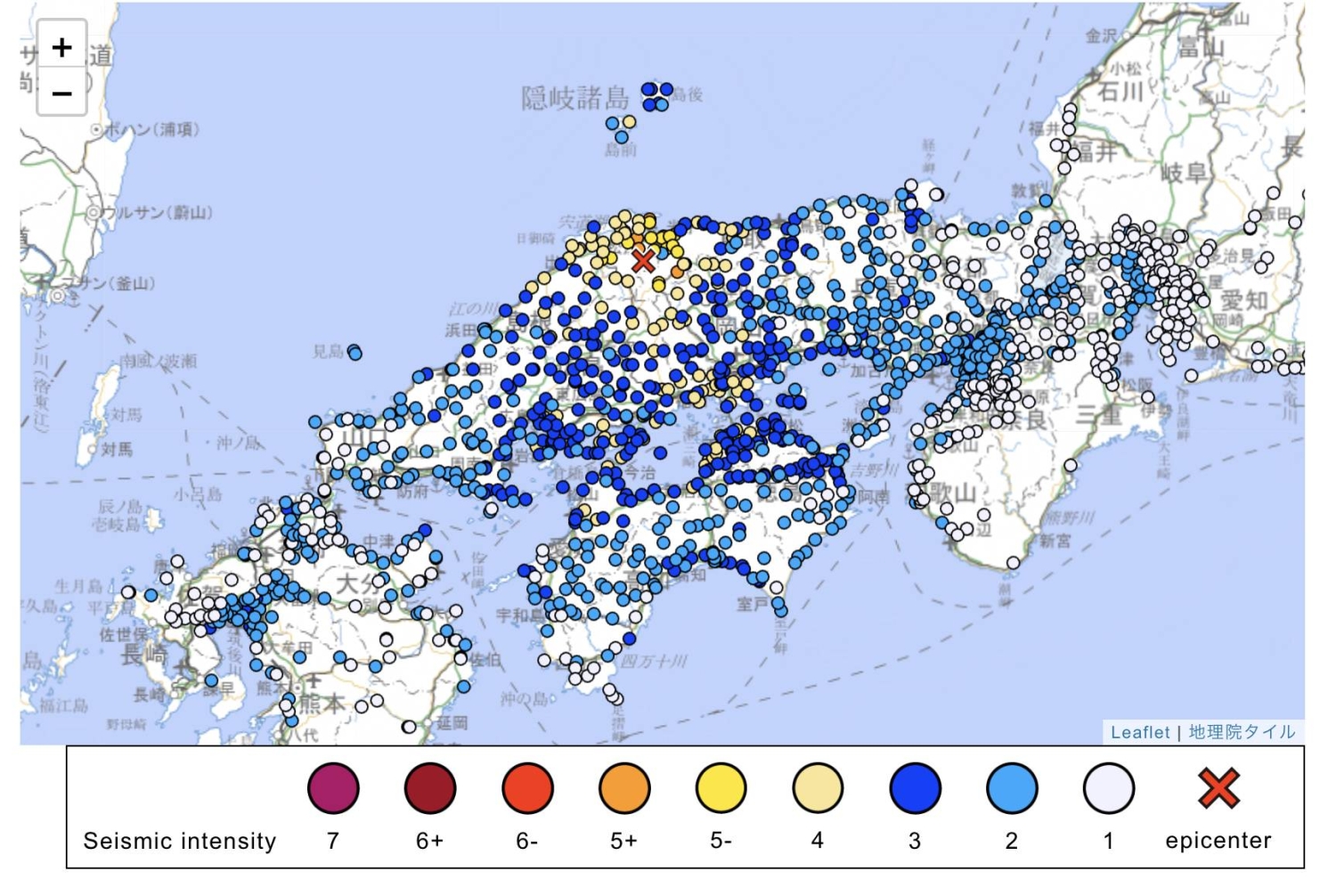
A series of earthquakes rocked Shimane and Tottori prefectures on Tuesday morning, beginning with a magnitude 6.2 shake at 10:18 measuring a strong 5 on Japan’s seismic intensity scale.
The epicenter of the initial quake, which occurred at a depth of 10 kilometers, was recorded in eastern Shimane Prefecture, but shaking was felt across wide areas of western Japan, triggering early warning alerts on television broadcasts and mobile phones.
A seismic intensity level of strong 5 was recorded in Shimane’s Matsue and Yasugi, as well as in Tottori’s Sakaiminato, Hino and Kofu.
There was no threat of a tsunami, the Japan Meteorological Agency said.
As of 11:40 a.m., 10 quakes had followed the initial shake in the area, including a magnitude 5.1 temblor that measured a weak 5 on the intensity scale.
Speaking to reporters on Tuesday morning, Prime Minister Sanae Takaichi said the government is assessing the extent of the damage and asked local residents to make necessary preparations for potential aftershakes of the same level.
Chief Cabinet Secretary Minoru Kihara said that, as of 11 a.m., nuclear power plants in the region hadn’t been affected by the quake. Shimane Prefecture hosts a plant run by Chugoku Electric Power Co.
The Maritime Self-Defense Force said on X that it will conduct a damage assessment in the affected areas.
Due to a power outage resulting from the quake, JR West halted services on the Sanyo Shinkansen line between Hiroshima and Okayama, with operation expected to return to normal at 1 p.m. A number of local trains were also impacted by delays as a result of the quake.
The series of early warning alarms and quakes jolted nerves in the region. News footage showed powerlines swaying and buildings shaking, while TV anchors reporting from the region wore hardhats.
Tuesday’s initial quake is the strongest to hit Japan so far this year. In December, Aomori Prefecture was struck by a magnitude 7.5 earthquake, causing a number of injuries. On Jan. 1, 2024, a magnitude 7.6 quake struck the Noto Peninsula, resulting in 698 deaths and causing widespread destruction.
More information:
Staff writer Gabriele Ninivaggi contributed to this report.
AloJapan.com