
00:05
Towering waves with boats at their mercy.
00:08
Katsushika Hokusai’s “The Great Wave off Kanagawa.”
00:15
Behind the waves is the familiar image of Mt. Fuji.
00:25
At 3,776 meters in height, Fuji is Japan’s tallest mountain.
00:37
Its refined grace and its seasonal beauty have charmed people since ancient times.
00:50
Mt. Fuji is also famous for its great spiritual power.
00:55
Worshipped as a presence beyond human understanding,
00:58
it has long been an emotional support for many Japanese people.
01:09
You couldn’t make a Mt. Fuji if you tried.
01:14
To see it is to be filled with awe.
01:22
Its beauty has inspired artists across the ages.
01:28
Some of this art even crossed the ocean to influence European artists.
01:41
In 2013, Mt. Fuji became a World Heritage Site,
01:46
recognized as a “sacred place and source of artistic inspiration.”
01:53
The site extends far beyond the mountain itself.
01:57
UNESCO registered 25 further locations,
02:00
such as the surrounding natural landscape and various shrines, as part of our global heritage.
02:09
Mt. Fuji is the spiritual heart of Japan.
02:13
Join us on a deeper exploration of this mountain.
02:24
Mt. Fuji over a serene lake.
02:27
This view is emblematic of the mountain’s beauty.
02:33
Many people flock to the shore to admire this view.
02:41
Mt. Fuji’s World Heritage Site includes five nearby lakes.
02:46
Each offers a different, yet equally stunning perspective of the mountain.
02:59
Known as the “Fuji Five Lakes,” they were formed by the mountain itself.
03:12
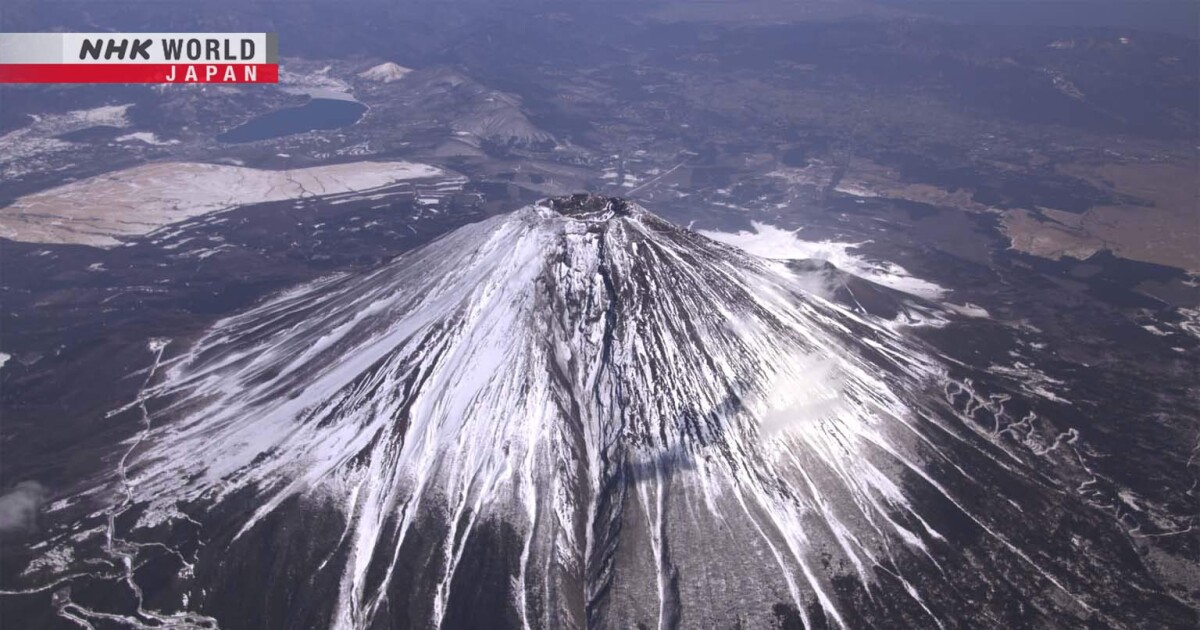
The large depression at the summit is a crater.
03:16
Mt. Fuji is an active volcano that erupted repeatedly until about 300 years ago.
03:29
Its volcanic activity began around 100,000 years ago.
03:34
Repeated eruptions transformed the local terrain.
03:42
The Jogan eruption of the 9th century was particularly fierce.
03:46
Written records of it still remain.
03:53
The lava flowed all the way down to the lake, only then coming to a halt.
03:58
The waters boiled, killing the fish in an instant.
04:02
Homes were swallowed by lava, and people fled, leaving everything behind them.
04:17
The lava flow from repeated eruptions eventually divided one enormous lake,
04:22
creating the Fuji Five Lakes.
04:31
There are other water-filled attractions in this region.
04:35
The water of these falls comes from the large volume of snow and rain that falls on Mt. Fuji,
04:41
which is then filtered down through the volcanic rocks.
04:50
The clear waters of this pool were filtered underground for decades before rising to the surface.
04:57
Yet another blessing from Mt. Fuji.
05:19
The fiery volcano Mt. Fuji was long a source of awe and terror for local residents.
05:31
They built countless shrines around the peak, praying that its flames might be calmed.
05:40
One of the earliest such shrines is Yamamiya Sengen-jinja, which is around 1,900 years old.
05:52
Although it’s a shrine, there is no pavilion or main hall.
05:56
Instead, there is a “yohaijo,” a place to worship from afar.
06:02
It stands on the remnants of an ancient lava flow.
06:14
People came to pay their respects to the mountain itself.
06:17
This eventually evolved into the worship of Mt. Fuji.
06:27
Mt. Fuji held awesome power, and over time, people came to seek that strength.
06:40
Those people were samurai.
06:42
From the 12th century, samurai ruled Japan,
06:46
and wars broke out over the centuries that followed.
06:51
In the hopes of securing victory, samurai donated to shrines dedicated to Mt. Fuji, and participated in rites.
07:05
The man who put an end to the wars and laid the foundations for 250 years of peace was Tokugawa Ieyasu.
07:18
As a child, he lived near Mt. Fuji where worship of the mountain ran deep, and was a faithful believer himself.
07:31
Fujisan Hongu Sengentaisha Shrine is a World Heritage Site.
07:37
Dedicated to Mt. Fuji, it’s also home to buildings Ieyasu erected for the shrine after winning victories on the battlefield.
07:49
He donated over 30 such buildings in a display of his deep faith.
08:00
The civil wars were a brutal time. Lives were always on the line.
08:07
I suspect many clung to their faith in Mt. Fuji as a result.
08:14
Faith in the power of nature ran very deep in people at the time.
08:27
There are 1,300 Sengen shrines around Japan dedicated to the worship of Mt. Fuji.
08:33
Faith in the mountain is still alive and well today.
08:43
You couldn’t make a Mt. Fuji if you tried. It is unknowable.
08:50
To see it is to be filled with awe.
08:57
“Mt. Fuji’s climbing season opens today. Climbers first visit a shrine.”
09:04
Many people dream of climbing Mt. Fuji at least once.
09:14
Each year, during two brief summer months, more than 200,000 people come to climb the famous mountain.
09:32
Many climbers make a wish as they watch the sun rise from the highest point in Japan.
09:42
It only became possible for large groups to climb Mt. Fuji when its eruptions began to calm 300 years ago.
09:53
Before that, people saw the summit as a paradise.
09:57
During the Edo period, only men were permitted to climb.
10:05
They established groups known as “Fujiko” and carried flags on their trips to paradise.
10:16
The de facto capital of Edo was home to nearly a thousand such “Fujiko” groups.
10:26
One location that climbers would visit before their attempt is still welcoming visitors today.
10:35
This cave was formed by the lava from an eruption around 1000 CE.
10:44
A cave behind a shrine building.
10:47
Lava from an eruption swallowed a large tree before cooling.
10:52
The tree burned away, leaving a hollow which formed the cave.
11:02
Centuries ago, people viewed this place as a womb.
11:12
They believed it was a place of rebirth.
11:19
Entering it helped wash away the sins of their present life before their climb to the summit.
11:34
Mt. Fuji’s emblematic beauty has made it a source of inspiration for many artists.
11:44
Its snowy cap melts in high summer.
11:48
Sunlight on Mt. Fuji’s bare slopes glows red.
11:57
Edo-period ukiyoe artist Katsushika Hokusai depicted this aspect of Mt. Fuji.
12:07
Known as “Red Fuji,” this beloved image has a distinctive composition,
12:13
with a mackerel sky that showcases the mountain’s hue.
12:23
This is Hokusai’s best-known work: “The Great Wave off Kanagawa.”
12:32
The perspective draws the viewer to look up at the raging waves,
12:36
and the still, magnetic presence of Mt. Fuji in the distance.
12:44
Ukiyoe artist Utagawa Hiroshige was also captivated by Mt. Fuji.
12:52
This is the location shown in “Hara” from Utagawa’s Tokaido Road series.
13:05
Travelers on the road and marshland, with Mt. Fuji soaring in the background.
13:10
It’s a vibrant scene of everyday life with this famous peak.
13:22
It’s such a beautiful mountain that artists wanted it in their works.
13:30
It’s a hugely inspiring view.
13:34
Its form is so simple. So how best to showcase it?
13:40
That became a key question for artists.
13:47
Many of these ukiyoe prints influenced artists in Europe.
13:51
They sparked the japonisme trend which swept the continent in the late 1800s.
13:59
The famous Dutch painter Vincent van Gogh was also moved by this trend.
14:09
His interest can be seen in this painting: “Portrait of Père Tanguy.”
14:19
The background includes an ukiyoe print of Mt. Fuji, an expression of van Gogh’s fascination with Japan.
14:32
When people hear ‘Japan,’ they think of Mt. Fuji.
14:36
It’s a symbol of Japan and Japanese culture. A truly iconic mountain.
14:47
The sacred peak of Mt. Fuji.
14:50
A focus of faith and art, and the emotional heart of Japan.
AloJapan.com