
Growing up in 2000s Hong Kong, my cultural tastes were overwhelmingly shaped by Japanese film and television. From Suspense X (2008), an emotional, delicate tale about a lone man brilliantly covering up his crush’s accidental murder out of muted love and sacrifice, to Museum (2016), a fast-paced, stirring film featuring the diverse slasheresque murders by serial killer kaeruotoko, Japanese crime suspense have been no stranger to me. But after twenty years of consuming contemporary Japanese crime suspense productions out of comfort from their familiarity, the genre had grown to be almost formulaic and unremarkable, merely a part of my dinner routine.
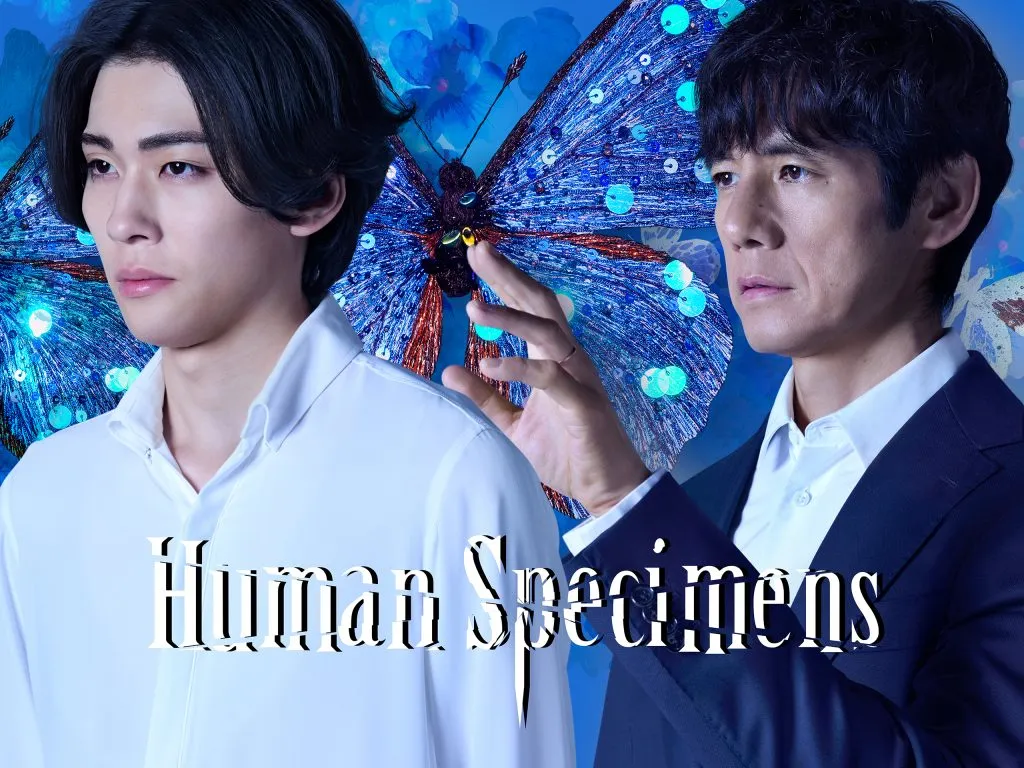
Released in the run up to Christmas on Prime Video, Human Specimens is a five-episode crime suspense series based on Kanae Minato’s novel of the same title (Ningen Hyōhon, 2023). As the ending credits of episode five faded, I found myself physically and emotionally catatonic. In the following week I proceeded to rewatch the series five times in full and an additional five more times for the last thirty minutes of episode five. Even as the suspense diminished, the emotional weight I felt only intensified on each rewatch. In defeat, I must turn against my earlier words and admit that I was captivated by Human Specimens like no other show before.
Under a sensational guise of preserving humans as specimens, like butterflies, all in the name of ‘art’, Human Specimens assumes in its tone and structure a typical skeleton of Japanese crime suspense. Thus, my enchantment was puzzling. Upon reflection, I came to realise that what was so electrifying about Human Specimens was precisely this typicality: it is the peak of contemporary Japanese crime suspense, the greatest expression of its curious, emotional and grotesque character.
Minato Kanae: the queen of iyamisu
One cannot speak of contemporary Japanese (crime) suspense without mentioning Minato Kanae, the ‘queen of iyamisu‘. Termed by mystery critic Aoi Shimotsuki in 2006, iyamisu (‘eww mystery’) refers to a subgenre of mystery/suspense fiction that emphasises dark human nature and ramps up its grotesqueness, often creating a sense of numbing nausea.
Minato’s most well-known media adaptation is certainly Confessions (2010), a masterpiece threaded by juxtaposition from start to finish: a series of horrific events begins with secondary school teacher Yuko Moriguchi declaring to avenge the murder of her daughter by two students in her class. The film is narrated in an almost absurd, comical manner, and played through a desaturated bluish lens which leaves only the colour of blood red to ‘pop out’ on the screen. Confessions is near colourless yet vividly cathartic, as the audience follows Yuko pulling her silent trigger to the Werther effect.
Film adaptations of Minato’s novels will never be less than promising. Her monstrously emotional and psychologically grilling portrayal of human bonds, especially within families, often sits at the heart of the conflict. As a result, her plots tend to be character-led, with the storyline largely propelled by social and emotional relations rather than grandiose external happenings. With a signature juggling of narrative perspectives, Minato’s writing features a brilliant balance between describing settings and skulls. Rendering her plots elegant, this technique also makes her novels highly adaptable. Indeed, eighteen years into her career, Minato boasts twenty-one standalone novels, four short story collections and twenty serial/film adaptations.
Human Specimens
Published in 2023 in celebration of her fifteenth author anniversary, Minato declares Human Specimens to be her best work. Having read excerpts of the novel and watched its the serial adaptation, I too am convinced that Human Specimens is the supreme representation of Minato’s elegant and piercing charm.
In a scenic forest, a man chases after his rogue dog, only to stumble upon a gruesome sight: six young men, lifeless and arranged artfully in clear display cases, each topped with specimens of a unique butterfly species. After the crime scene is discovered, Shiro Sakakil, a renowned professor of butterflies, turns himself in to the police. Quoting his ‘research report’, Shiro recounts the motives leading to his murders. Shiro sees his victims as butterflies, so beautiful that they must be preserved and cherished at their most flourishing moment. The specific ecologies of each butterfly species corresponds to the victim’s temperament and life story. Out of his six victims, Shiro’s greatest work – “the most beautiful specimen in the world”, as stated in his report – was his only son, Itaru.
At this point, Human Specimens might feel as if it echoes every cliche, though this is not why I deem it ‘typical’ of Japanese crime suspense. “I have no more regrets. This is everything. If it pleases you, please sentence me to death,” Shiro concludes. Even the least engaged audience member will sense something incomplete in Shiro’s confessions. His motives felt too well-scripted, his circumstances too coincidental. Yet Shiro’s eyes reflect the depths of a forbidden world of beauty and madness, the “kingdom of butterflies” of which he is a mere herald.
Delicate performances are delivered by, remarkably, seasoned Japanese actor Hidetoshi Nishijima as Shiro, and kabuki youngblood Ichikawa Somegorō VIII as Itaru. With kinship shaping the core conflict of Human Specimens, Shiro’s filicide, Nishijima and Ichikawa assume the perfect distance of father and son in this beautifully tragic tale.
Typical of contemporary Japanese cinema, especially human drama films, Human Specimens employs soft, intimate lighting with modest, nostalgic wide shots. For a story questioning the meaning and boundaries of art, colours play a vital role; they are vibrant and abnormally arranged, and linger uncomfortably mundane.
To me, the charm of Japanese crime suspense lies in its raw and honest narration. Its messages are not tucked away in an underexposed vignette, but rather everything is laid out bare and bluntly. Human Specimens is no exception – the metaphors so explicit they are literally placed together in one display case. Just like the specimens themselves, the looming themes of kinship and love, of creation and destruction are impossible to miss. For they are so typical of Japanese crime suspense, and so incredibly curiously, emotionally, and grotesquely portrayed in Human Specimens.
Post Views: 331
Liked this article? Why not share it?
Related
AloJapan.com