

Dark matter is believed to make up most of the matter in the universe, yet it has never been directly detected. One theory suggests it may be composed of extremely light particles, so light they behave more like waves than solid particles. This quality makes them almost impossible to observe using current experimental methods based on classical detection.
Physicists at the University of Tokyo and Chuo University have turned to quantum technologies to address the limitations of traditional detectors. These scientists, led by Hajime Fukuda, propose a new detection method using quantum sensor arrays. Their approach aims to track the motion of light dark matter, not through collisions, but by recording how it moves through space.
Using Quantum Sensing to Follow Invisible Particles
Rather than relying on the typical approach of observing atomic recoil from a potential dark matter collision, Hajime Fukuda and his colleagues suggest measuring the spatially distributed signals collected across an array of quantum detectors. These sensors, operating under quantum mechanical principles, can register extremely weak disturbances that may indicate the presence and movement of dark matter.
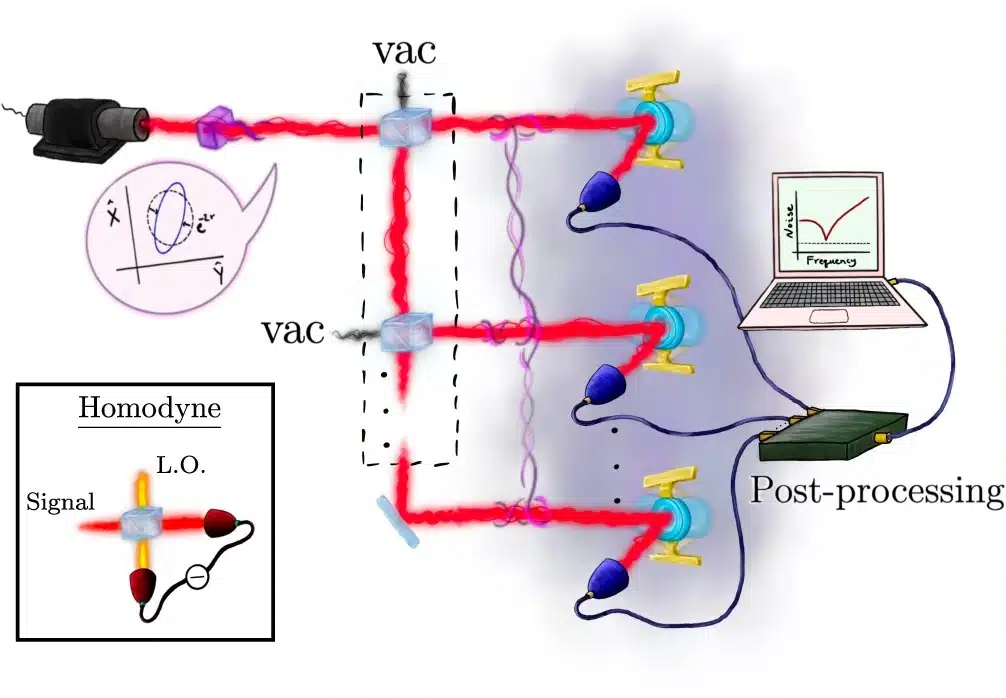 Illustration of a distributed quantum sensing (DQS) proposal. Credit: Communications Physics
As reported by Physical Review Letters, this new method provides a way to determine both the velocity and direction of dark matter particles. According to the research team:
“We found that we can measure the velocity of light dark matter not by measuring spatially extended signals (recoil tracks) but by measuring by spatially extended detectors.”
The distributed quantum sensing protocol changes that by exploiting the geometry and coherence of the sensor array to extract directional information.
Expanding Detection Beyond Interaction Types
Previous strategies to detect light dark matter have depended heavily on specific theoretical models. For instance, using elongated detectors or classical arrays often required assumptions about the kind of interaction occurring between dark matter and ordinary matter. These methods are limited in scope and often less sensitive.
 Left: averaged signal versus the parameter shown; dashed lines give how many measurements are needed for a 3σ detection at different noise levels. Right: the same quantity versus angle to the Galactic center, with and without annual modulation; dashed lines again show required measurements, with color indicating noise strength. Credit: Physical Review Letters
Fukuda notes that their new quantum approach is more general and “far more sensitive,” because it does not rely on the details of the interaction. Instead, it uses the spatial structure of the sensor data itself to determine the particle’s path. The researchers say this allows for a broader application across multiple models, potentially improving the reach of dark matter searches.
According to the article, earlier proposals were“dependent on the detailed type of the interaction,” while the quantum sensor array introduced by this team avoids that limitation. That makes it a promising candidate for future experimental setups.
Preparing For Real-world Testing
Though the method remains at the theoretical stage, the research offers a direction for experimental follow-up. The team sees possibilities in refining the technique to detect spatial patterns in dark matter distribution. This would require advancements in quantum engineering and improvements in data extraction from sensor arrays. :
“We showed that quantum methods could play an important role in high-energy physics,” stated Fukuda in the interview with Phys.org.
He also indicated that future research may expand the method to measure how dark matter is distributed across space, and not just how it moves.
AloJapan.com