
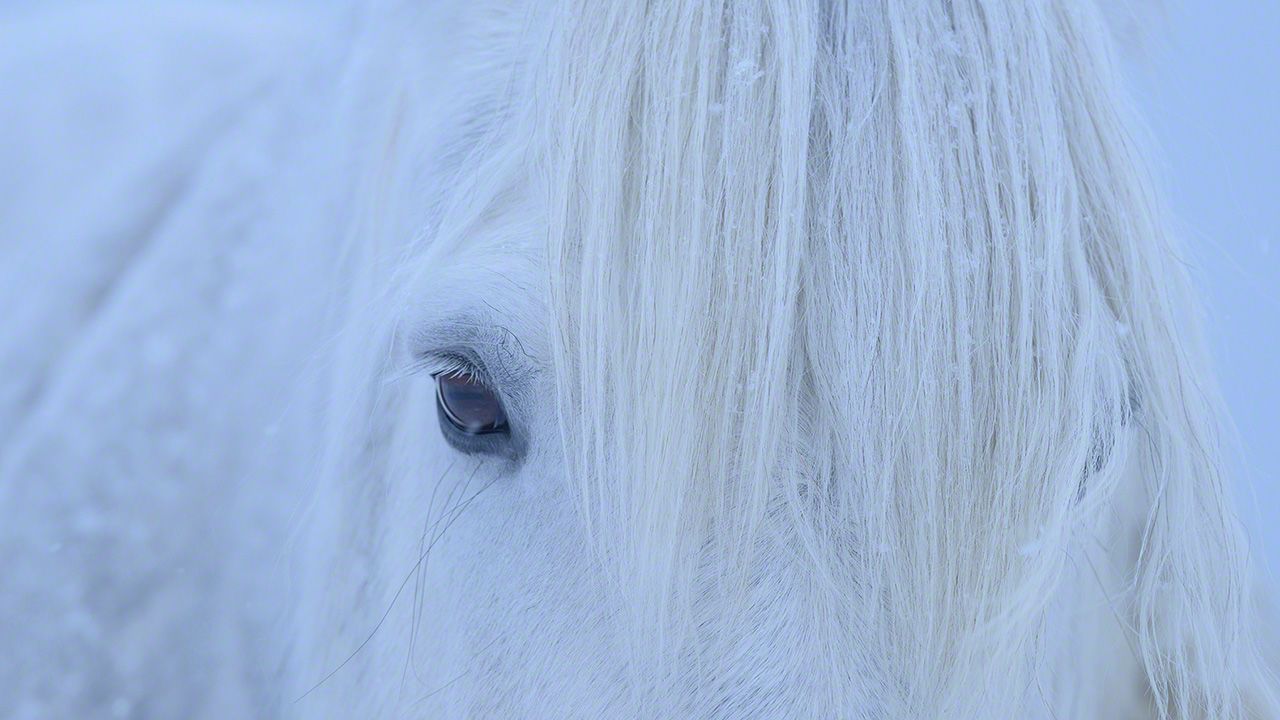
A collection of photographs, marking the Year of the Horse in 2026, of Yururi Island in Hokkaidō, which has been uninhabited for over 50 years, but became known for its population of horses left behind by former residents.
Horses Living Shoulder to Shoulder
As temperatures plunge below freezing in the depths of winter, the horses of Yururi Island off Hokkaidō’s eastern coast keep warm by huddling together on snowy plains, their breath white in the cold air. They seek shelter in the hollows of ravines when winds howl and graze quietly on snowfields when the sun emerges. With only a light covering of snow, they can easily find their winter staple: bamboo-grass shoots.
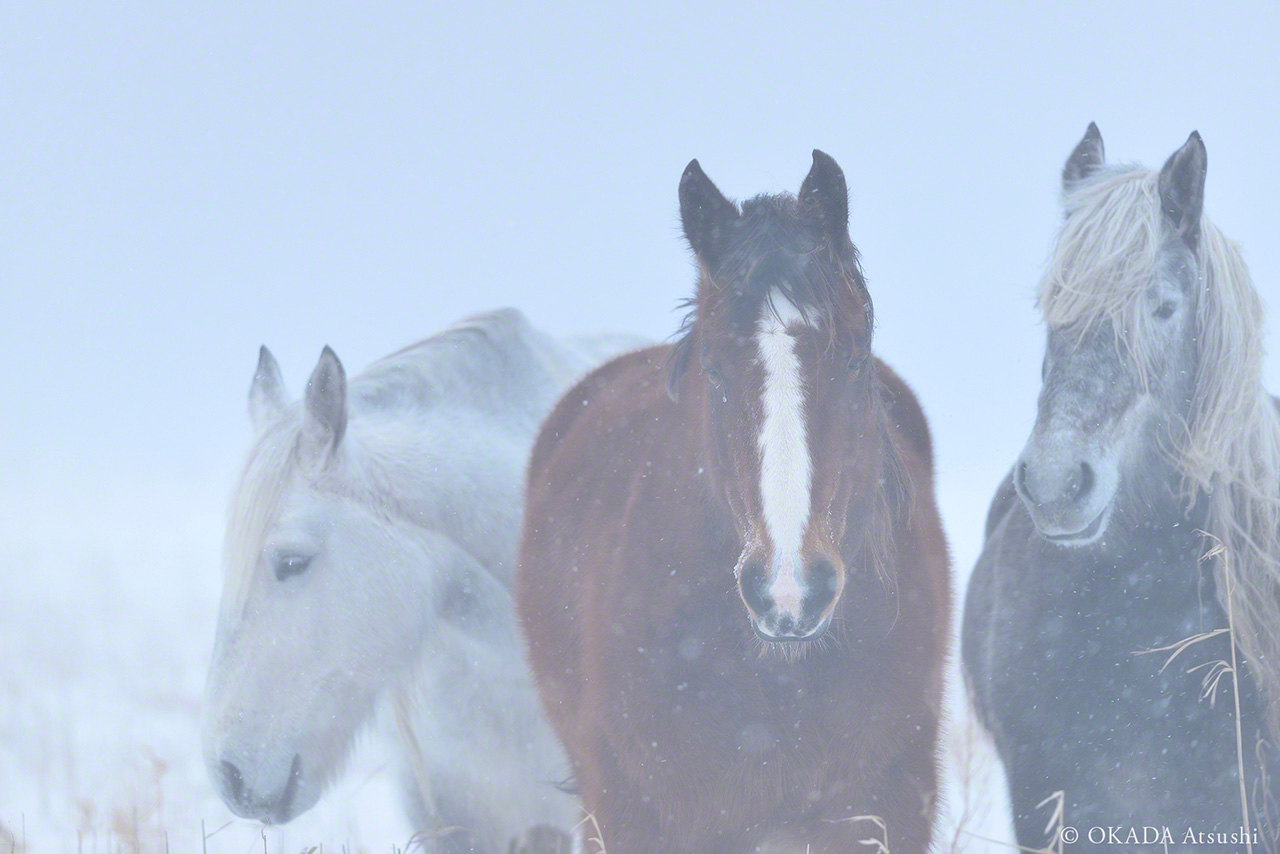
Huddling together in the snow, February 2014. (© Okada Atsushi)
The island is largely open grassland, with most of its 8-kilometer coastline ending in dramatic cliffs. Only researchers may land, and the horses show no fear of human visitors; they simply watch calmly, neither begging for food nor attempting to flee.
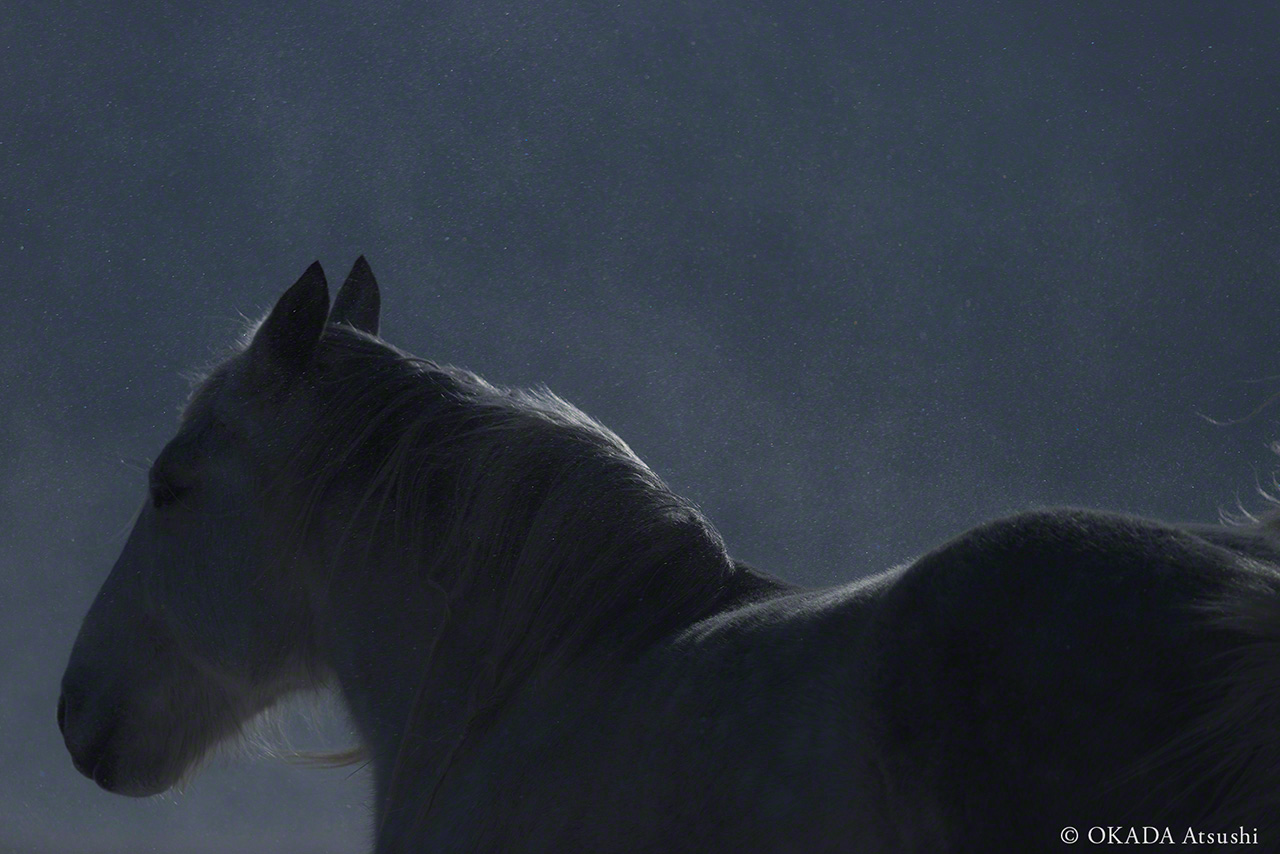
Fine snow swirling around a horse in the subzero cold, February 2014. (© Okada Atsushi)
Yururi lies 2.6 kilometers off the Konbumori fishing port on the Nemuro Peninsula. From the mainland, it appears as a flat, disk-like silhouette. In spring and summer, dense sea fog often hides it completely, so it is known as a “phantom island.”
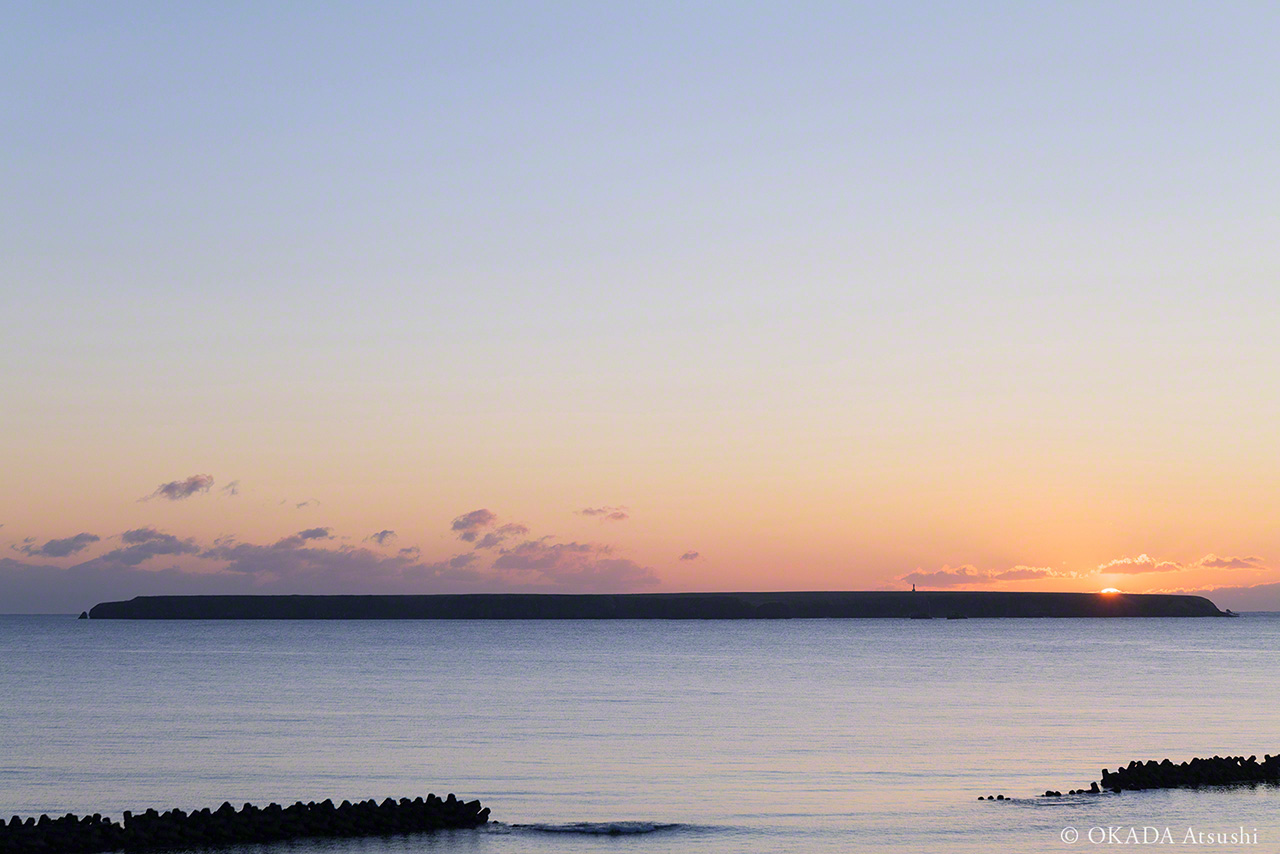
The sun rising behind Yururi Island, seen from Konbumori on the southern coast of the Nemuro Peninsula. (© Okada Atsushi)
I first set foot there in the summer of 2011, arriving on a small fishing boat. What I found were horses living freely, without restraint.
The “Veins” of the Island
There are no roads or houses; the only manmade structure is a lighthouse standing at the island’s center. At night, its beam casts a soft glow across the darkness. Guided by moonlight and the lighthouse’s sweep, I sometimes followed the herd until dawn.
Seen from above, the grassy fields are etched with intricate lines like the veins of a leaf. These are horse paths, worn into the earth over many years.
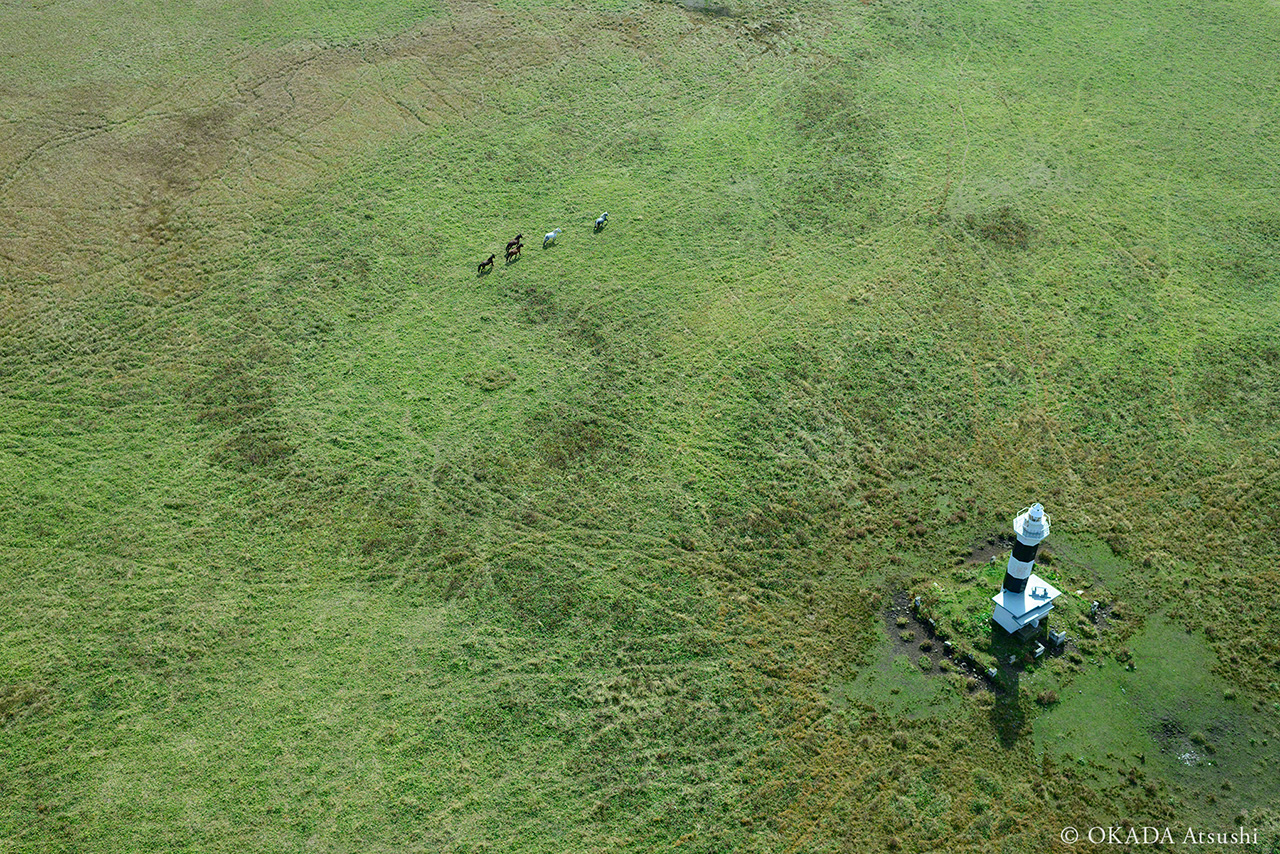
Horse paths spread out from the lighthouse like the veins of a leaf, October 2014. (© Okada Atsushi)
As spring arrives, the horses shed their winter coats and rub against one another—a grooming behavior that strengthens social bonds.
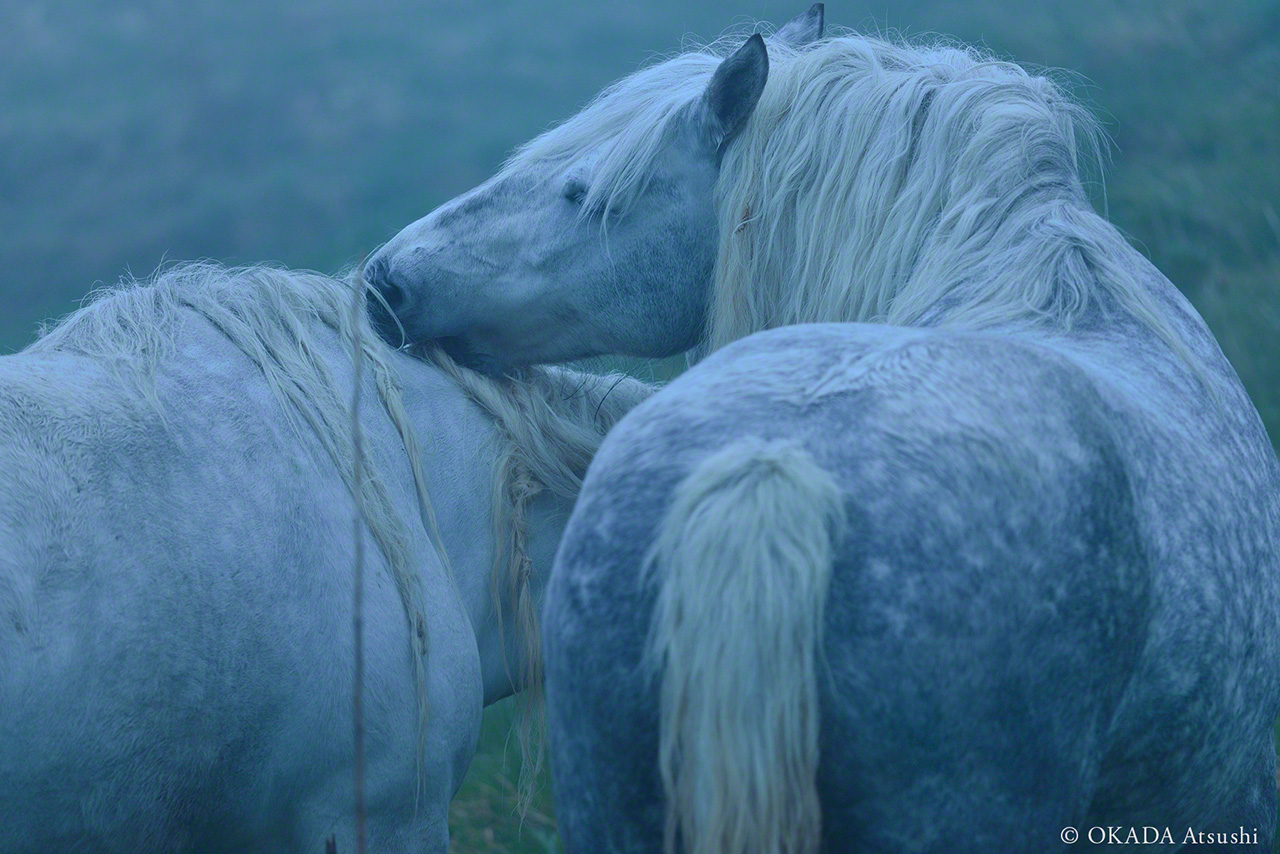
Horses grooming one another, May 2017. (© Okada Atsushi)
Wildflowers emerge from under the melting snow: a world of quiet beauty that includes such endangered species as the bog orchid, small cranberry, and pogonia, all blooming softly in the grass.
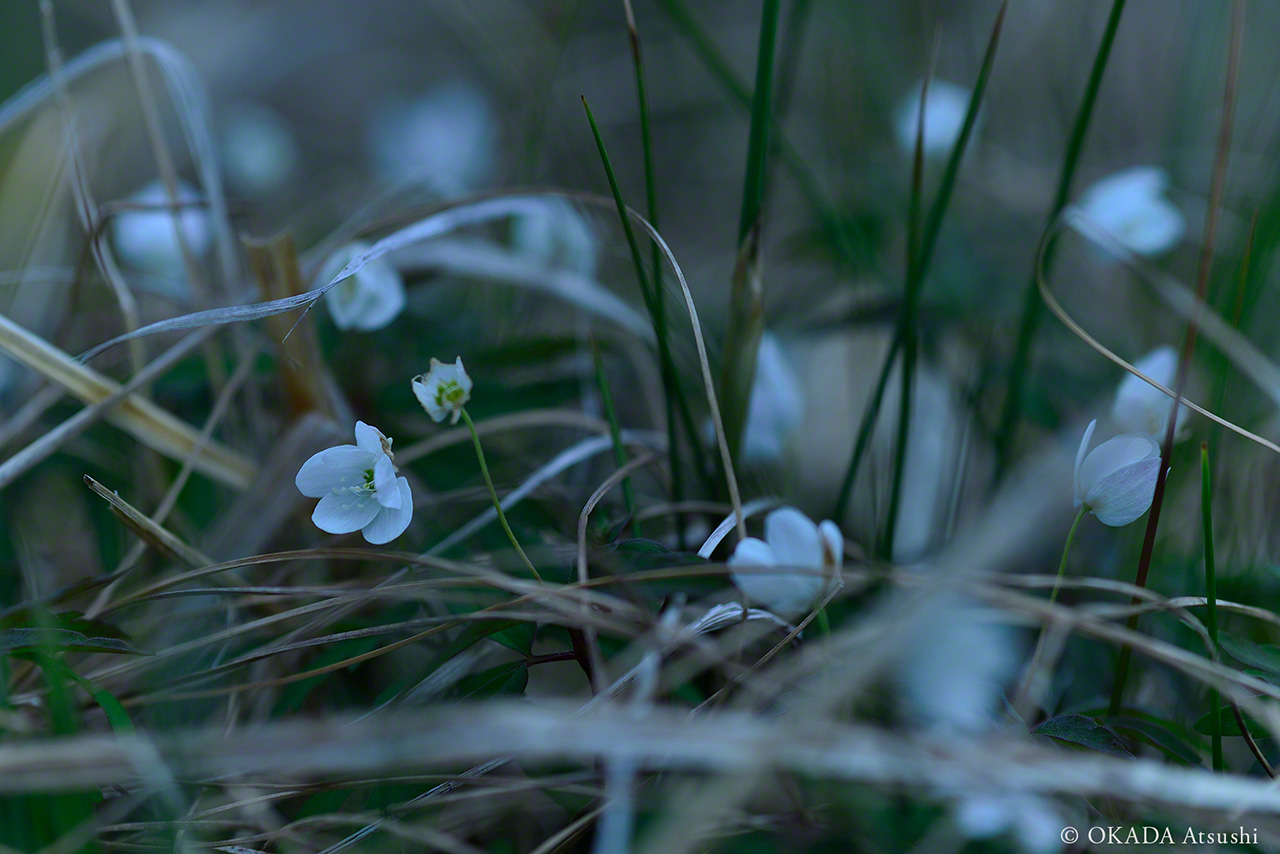
Small anemones blooming in spring. (© Okada Atsushi)
Living Witnesses to History
The Yururi horses descend from the Nihon Kushiro breed, a powerful draft horse with sturdy legs, broad chests, and powerful muscles. At the start of the twentieth century, the Japanese government prioritized horse breeding as a pillar of military and industrial power, and ranchers in eastern Hokkaidō crossed native Dosanko horses with European breeds, eventually producing exceptional horses with roots in the French Percheron. These horses were perfectly sized for Japanese handlers and became essential for clearing the Hokkaidō wilderness and transporting supplies in wartime. They were widely celebrated as the nation’s first successful domestically improved breed.
The horses stand as living witnesses to history, a testament to an era when Japan’s industries and the lives of its people were deeply intertwined with these animals.
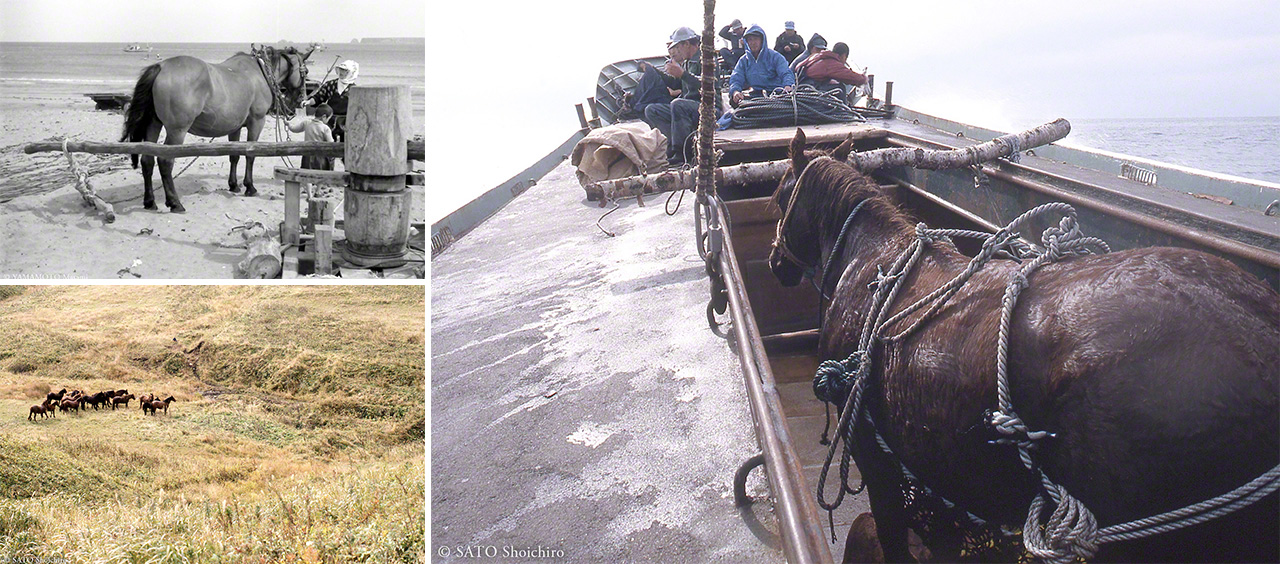
Clockwise from top left: Horses played a vital role in the local fishing industry in the 1940s–60s (© Yamamoto Masami); horses being transported off the uninhabited island (year unknown, © Satō Shōichirō); a herd roaming the island. (year unknown, © Satō Shōichirō)
The island was once a bustling hub for kelp harvesting, home to nearly 10 fishing huts at its peak. Horses were indispensable for hauling heavy loads of kelp up to the drying grounds atop the cliffs and transporting essential supplies. The first horse was brought to the island around 1950.
As Japan entered a period of rapid growth, however, the fishermen began returning to the mainland, where kelp-drying space was easier to secure. The last resident left the island in 1971. A few horses remained, and through natural breeding, their numbers eventually grew to about 30. With an abundance of bamboo grass for grazing and several streams providing fresh water, the island became an ideal sanctuary for these animals. Former residents would return periodically to check on them and manage the herd.
But as the former islanders aged, caring for the horses became increasingly difficult. In 2006, Yururi’s role as a natural pasture came to an end, and the stallions were removed from the island. The remaining herd, now consisting only of mares, was destined to quietly fade away. When I first visited the island in 2011, the number had already dwindled to 12. By 2013, there were 10, and just 5 by 2014. By 2022, there were only 2 horses that were born and raised on this island. They, too, will one day disappear.
A Carpet of Wildflowers
Reaching the top of the island’s cliffs reveals a delicate landscape, indistinct like a scene from a half-remembered dream. Yururi feels like a paradise not only because wild horses live freely but also because vibrant wildflowers dot the summer fields.
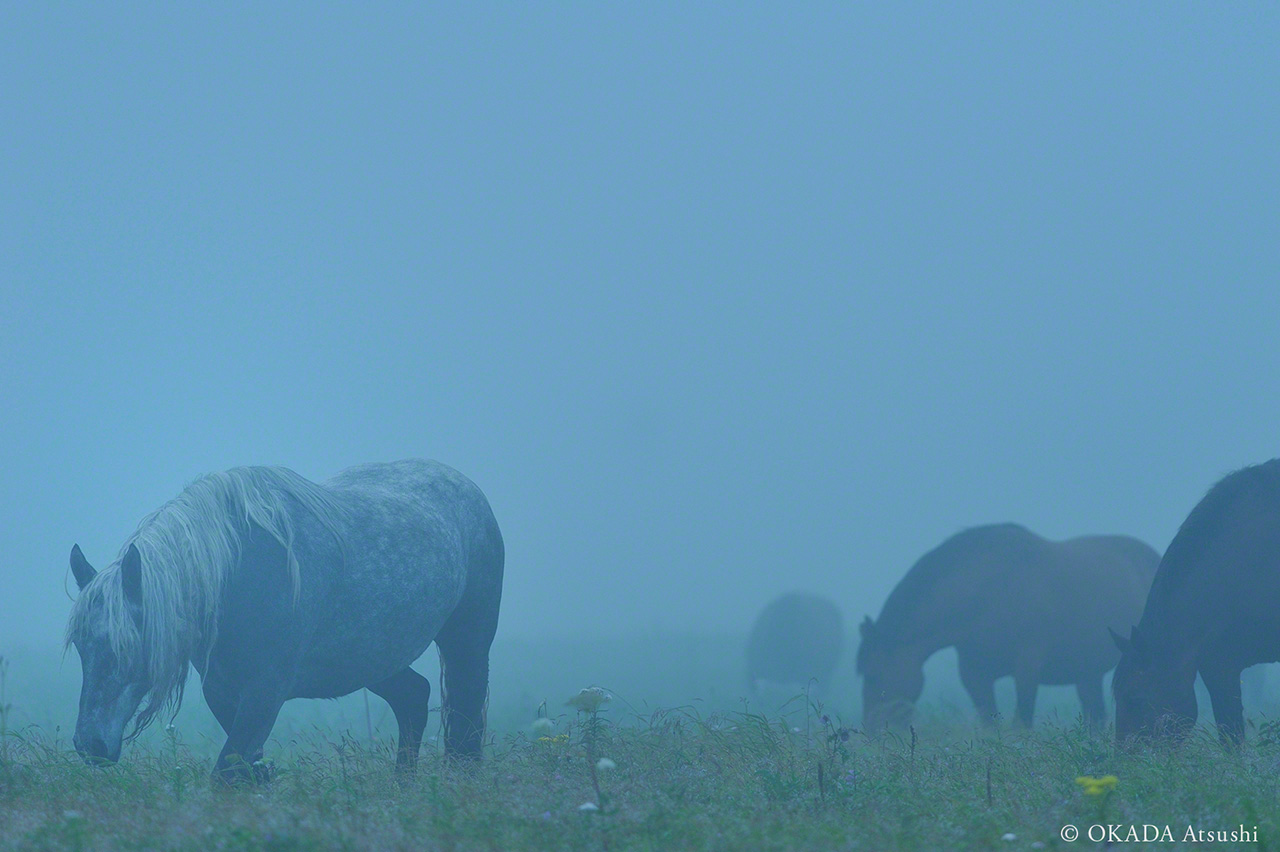
Grazing in the summer mist in a field of wildflowers, August 2013. (© Okada Atsushi)
The island also displays the “flower garden effect”: when horses eat the taller grasses, low-growing lilies and orchids flourish, turning the meadows into a lush green carpet embroidered with small, dainty blossoms.
There is also a curious local phenomenon. Several plants that typically bloom in shades of purple produce white flowers as well on Yururi. These include the plantain lily, spotted orchid, Ezo geranium, ladybell, self-heal, and tufted vetch.
Shrouded in Thick Fog
From spring to summer, warm moist air from the Pacific meets the cold waters of the Kuril Current, blanketing the island in thick fog. At the island’s center lies a raised bog, formed by thick layers of peat made from accumulated plant remains. These high-altitude moors are typically found in mountainous areas like Oze, but on Yururi, they appear at an elevation of only 30 to 40 meters. This unique ecosystem supports 24 endangered species, including the saxifraga, pogonia, and bog orchid.
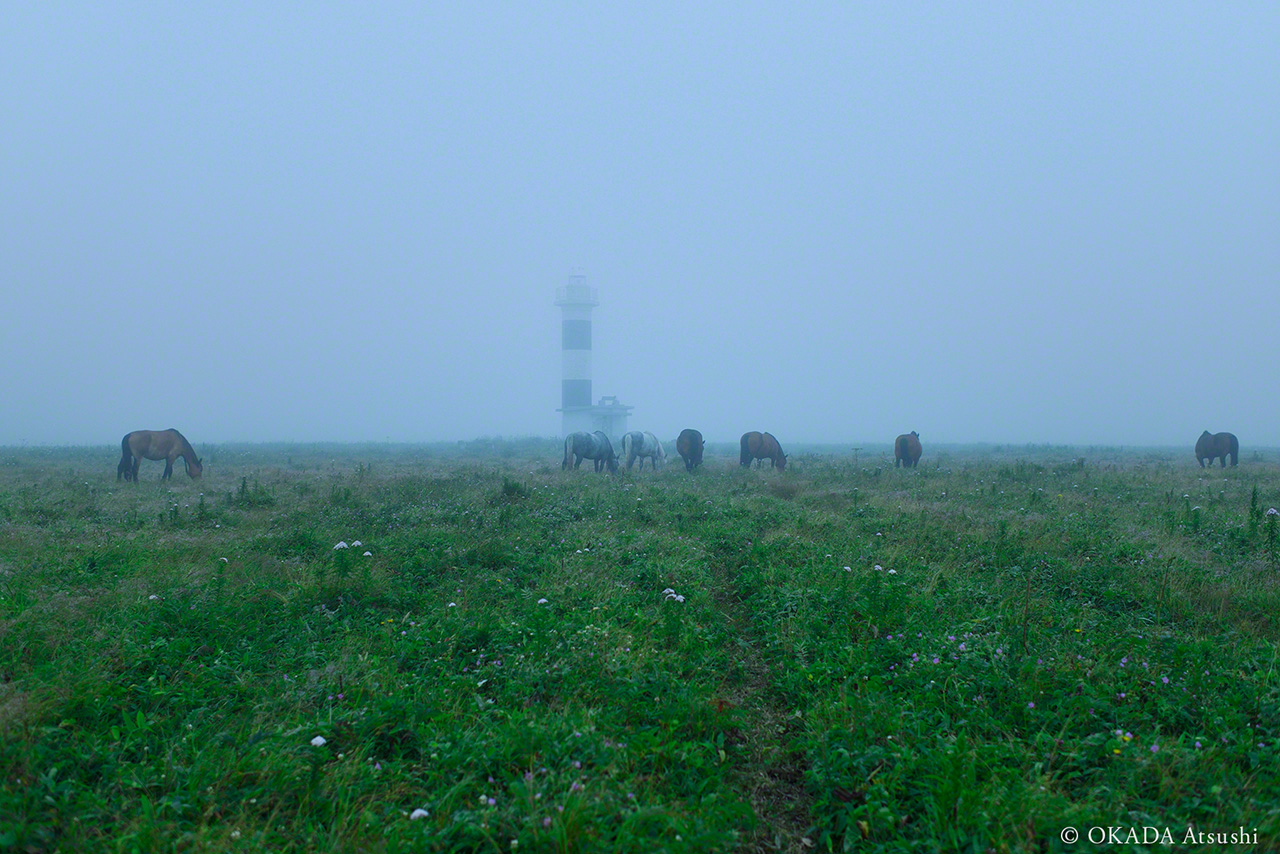
Summers are shrouded in fog, August 2013. (© Okada Atsushi)
For the horses, the water stored within this raised bog is truly life-sustaining. They owe their very existence to Yururi’s delicate natural equilibrium.
The Island of Cormorants
Yururi’s name comes from the Ainu language, meaning “island of cormorants.”
Hokkaidō designated Yururi as a natural monument in 1963, and it has since been protected under multiple conservation measures—becoming a Hokkaidō nature conservation area in 1976, a national wildlife protection area in 1982, and one of the Ministry of the Environment’s 500 important wetlands in Japan in 2001. The primary catalyst for these protections is the presence of rare seabirds.
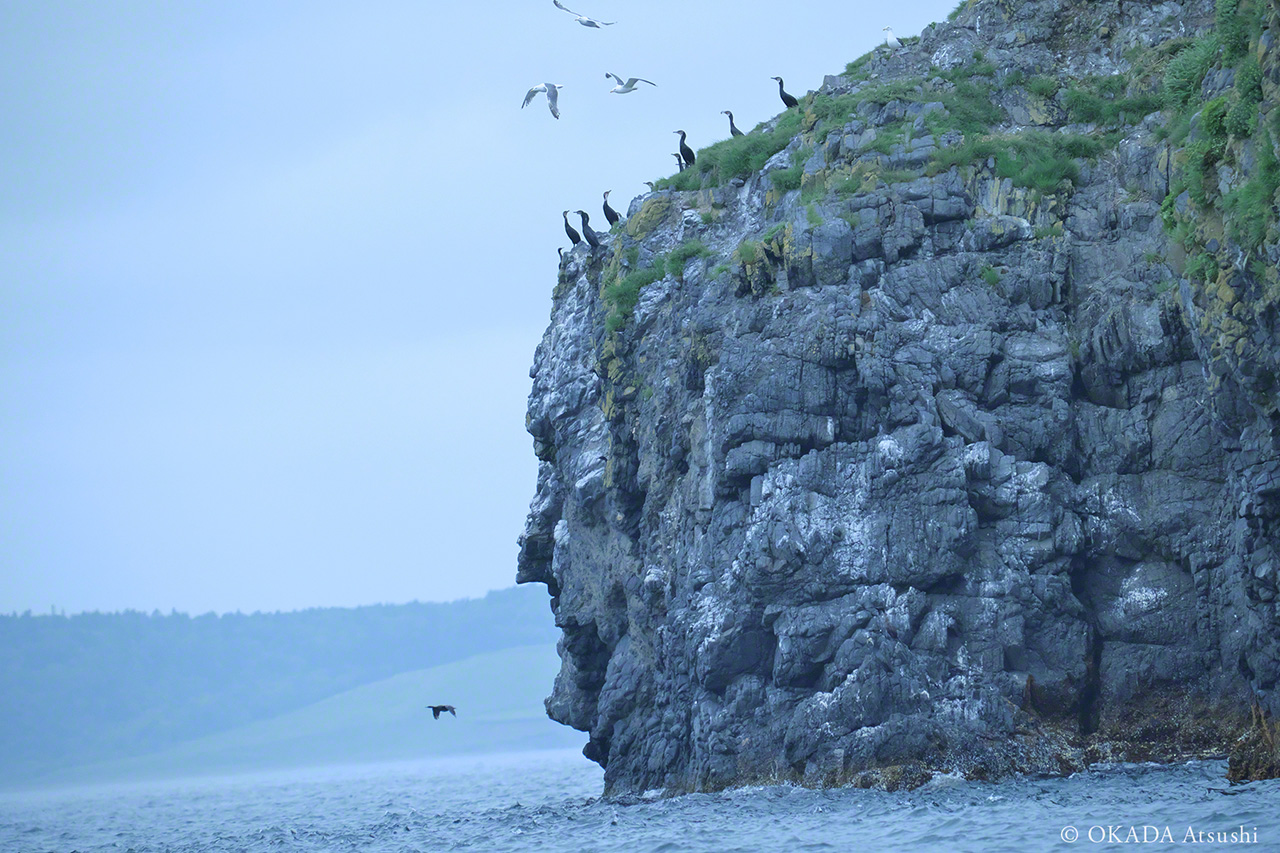
Many rare seabird species inhabit Yururi’s surrounding waters, July 2020. (© Okada Atsushi)
The spectacled guillemot is perhaps the island’s most iconic seabird; its pitch-black body is punctuated by white, goggle-like rings around its eyes. There is also the tufted puffin, known for its striking orange beak and dark plumage; a few nesting pairs have been confirmed on Yururi and adjacent Moyururi.
When the sea fog lifts, a fleeting autumn arrives. The meadows turn a flaxen gold, and the wildflowers fade. The horses begin to grow their thick winter coats, preparing for the cold months ahead.
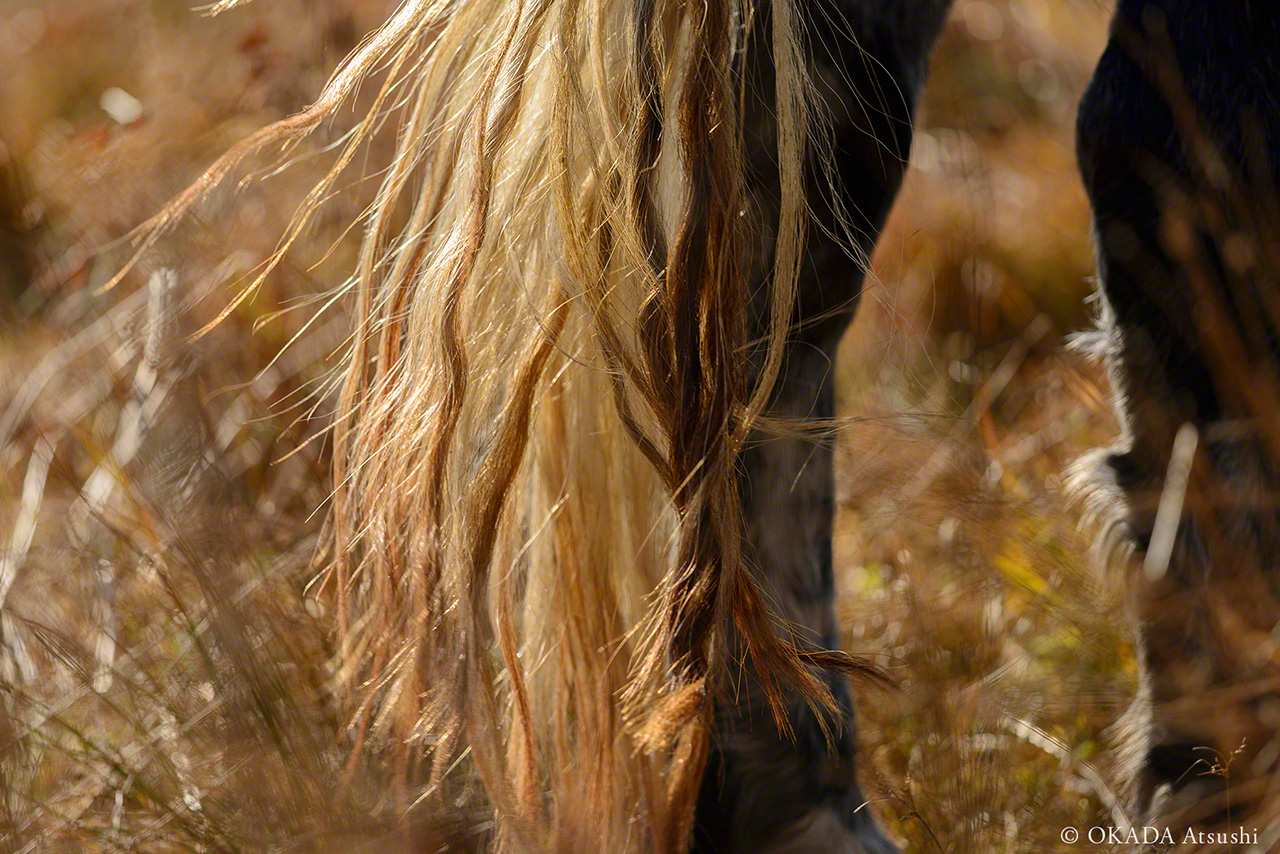
In autumn, Yururi is covered in flaxen wild grasses, November 2017. (© Okada Atsushi)
I have visited these fields countless times to photograph the dwindling herd, capturing the remaining flickers of life as the horses vanish one by one. Watching them disappear is heartbreaking, yet looking back, I find myself in awe of the profound, fleeting beauty they leave behind.
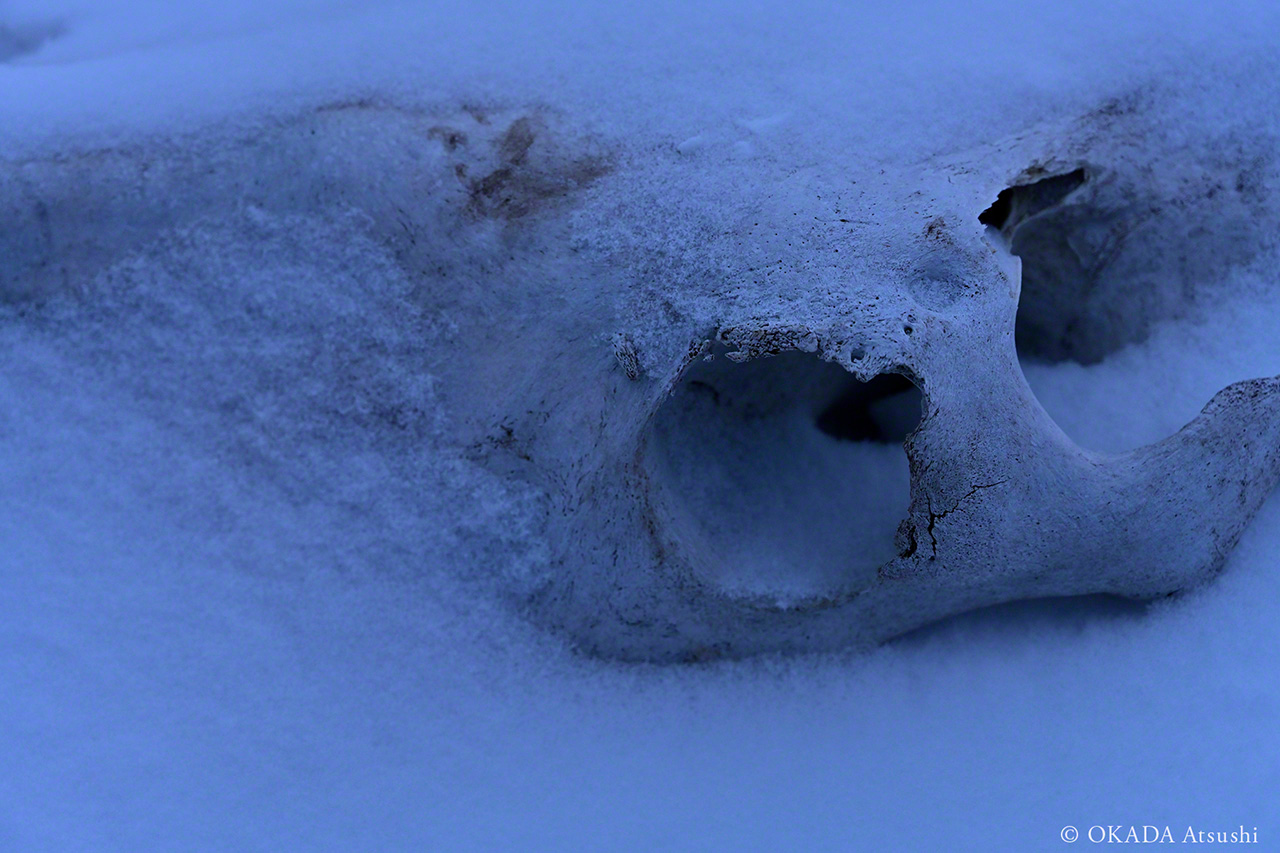
Many horses now sleep beneath the soil of the island’s meadows, February 2019. (© Okada Atsushi)
The last descendants of the horses that sustained local livelihoods on Japan’s northeastern fringe during the turbulent postwar years now find themselves left behind by the march of time. As they fade away one by one, what will the last horse see as she looks out across the island for the final time?
(As of summer 2025, Yururi Island is home to two island-born horses and two additional mares introduced in 2018.—Ed.)
(Originally published in Japanese. Banner photo: A wild horse living on Yururi Island in eastern Hokkaidō, photographed in February 2019. © Okada Atsushi.)
AloJapan.com