
00:03
Light at the end of a tunnel.
00:09
For Japanese citizens 130 years ago, it symbolized a miracle.
00:24
This waterway runs through residential Kyoto.
00:27
Unlike natural urban rivers, this artery is man-made.
00:38
Shiga Prefecture, which neighbors Kyoto beyond its eastern mountains, is home to Lake Biwa, Japan’s largest lake.
00:46
From there, abundant water flows to Kyoto through tunnels and waterways.
00:55
The Lake Biwa Canal stretches some 30 kilometers in length.
01:06
In 1869, the emperor moved to Tokyo.
01:10
The city’s population declined by nearly two-thirds, causing significant loss to industry and the economy.
01:17
The city had lost its vitality.
01:25
The Lake Biwa Canal was planned as a way to turn the city around.
01:32
Kyoto lost its role as the capital and fell into decline.
01:40
The determination to reverse that produced a physical symbol of the city’s modernization.
01:48
Even today, the canal functions as a lifeline, supporting the daily needs of Kyoto’s residents with water, electricity and more.
01:57
It is also a valuable tourist attraction.
02:04
Core Kyoto explores the impact of the Lake Biwa Canal and how it has enriched Kyoto life for over 100 years.
02:27
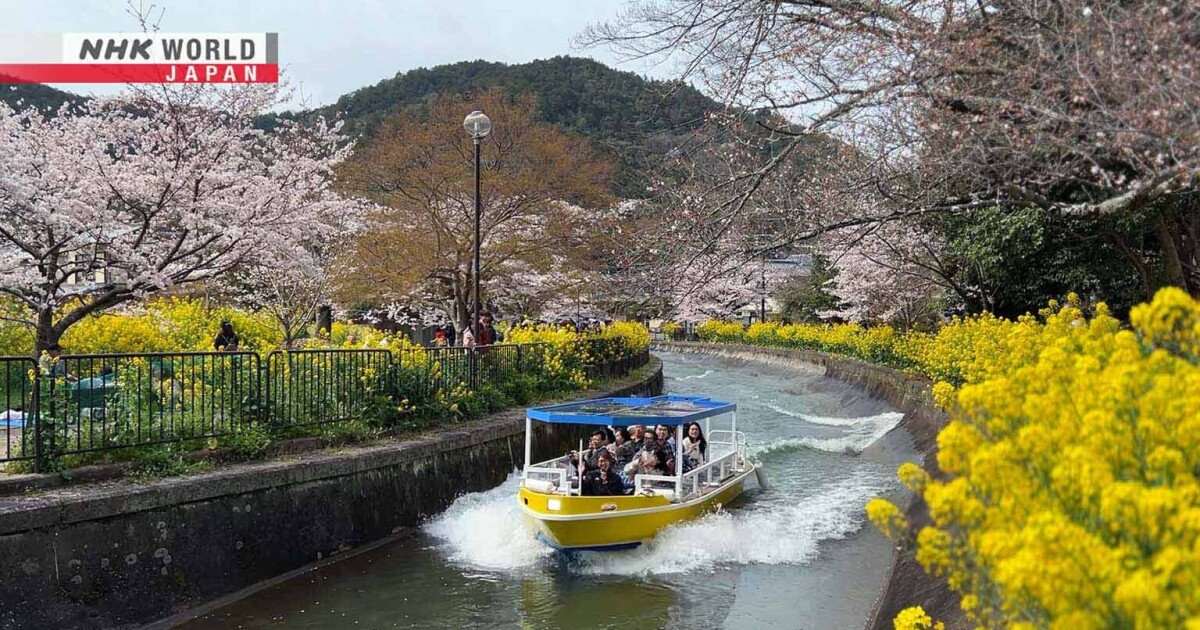
Sightseeing boats that traverse the canal have been in regular operation since 2018.
02:40
Let’s give the crew on shore a big wave. Off we go!
02:54
Long ago, boats plied the waters carrying cargo and passengers until 1951.
03:01
In 2018, canal traffic was revived with sightseeing boats, fulfilling the wishes of Kyoto residents.
03:14
In spring and autumn, the boats carry visitors back and forth along the main 8-kilometer-long route between Shiga and Kyoto.
03:22
As the popular event is seasonal, reservations fill up quickly.
03:34
Cherry blossoms in spring create the illusion of a floral tunnel.
03:46
The turning leaves in fall show a relaxed Kyoto landscape.
04:00
With a depth of just over 1 meter and a width spanning 4.5 to 6 meters, the canal was clearly designed for rowboats 130 years ago.
04:13
Moreover, the tunnels are long and dark; thus, piloting prowess is required to maneuver motorized vessels.
04:22
When passenger boats were reintroduced, the call went out for experienced captains.
04:32
The canal is narrow and shallow –
04:39
so you need to steer the boat near the center, both up- and downstream.
04:47
It’s more challenging than most waterways.
04:52
Segawa Akihiko has been navigating boats for five decades since his 20s,
04:57
gaining his sea legs aboard overseas vessels and large cruise boats on Lake Biwa.
05:08
Though he had retired from the sea,
05:10
Segawa returned to the waters upon hearing that passenger boats would be reinstated on the canal, which traversed his home turf.
05:18
The idea of introducing people to the canal was irresistible.
05:23
The waterway is wonderful, and can hold its own against any other.
05:31
You’ve got tunnels, residential areas, and forested sections.
05:40
The canal provides variety in scenery, the sound of water, and birds.
05:48
There is much to enjoy.
06:10
In 1885, as Kyoto’s population dwindled, construction on the canal began, in an effort to rejuvenate the city.
06:21
The equivalent of twice Kyoto Prefecture’s annual budget was invested in the project, which took five years to complete.
06:33
The mountains separating Kyoto from Lake Biwa made traveling between them challenging.
06:38
The prefectural governor at the time reasoned that a waterway would make access for cargo and passengers from the north and east easier.
06:52
The design was entrusted to an engineering major, Tanabe Sakuro, a fresh college graduate.
06:58
He was selected for the position because his graduation thesis focused on the design of a canal stemming from Lake Biwa.
07:10
At the time, major civil engineering projects relied on the design and supervision of engineers from overseas.
07:17
Although the canal’s structure employed Western technology,
07:21
it was the first time everything, from design to construction, was carried out solely by Japanese.
07:30
However, stumbling blocks lay ahead for a project of this magnitude.
07:37
The most challenging was the excavation of the 2.4-km tunnel.
07:44
Construction was stymied by the hard earth and incessant gush of groundwater.
07:54
Tanabe rose to the challenge, employing Japan’s first usage of vertical shafts.
08:02
Workers dug a shaft straight down from the mountaintop, perpendicular to the intended tunnel.
08:08
Construction then proceeded in four directions, from within and without the tunnel, for four years.
08:19
The first canal was completed in 1890.
08:27
Boats soon began journeying along the new waterway linking Kyoto with Lake Biwa.
08:35
They transported rice, lumber, coal, and other goods in both directions.
08:40
In its heyday, the canal saw annual transport of 220,000 tons of cargo and 300,000 passengers, making it a key mode of transportation.
08:56
It was also used to generate hydroelectric power, boosting the mechanization of Kyoto’s factories.
09:05
In 1895, with that electricity, Kyoto became the first Japanese city to introduce a commercial electric railway.
09:20
The streetcars became a highlight when Kyoto hosted the National Industrial Exhibition.
09:30
The venue was lined with various pavilions displaying some 170,000 state-of-the-art products, arts, and crafts from all over the country.
09:44
The exhibition drew one million visitors, three times Kyoto’s population at the time.
09:56
These many achievements, made possible by the Lake Biwa Canal, paved the path for Kyoto’s recovery.
10:13
The infrastructure laid for the canal’s construction continues to bolster Kyoto life even today.
10:27
Hydroelectric power is generated here, using water from the Lake Biwa Canal.
10:36
Canal water is drawn into the power plant to support round-the-clock operation of the turbines.
10:42
Those, in turn, supply power to Kyoto.
10:49
The Keage Power Plant generates some 17.8 million kWh of electricity per year.
10:56
That’s equal to the annual power usage of about 5,700 average households.
11:03
We hope to carry on our forefathers’ work, providing electricity from Keage.
11:11
The canal also sources the city’s water supply.
11:17
After the first canal was completed, Kyoto’s population began to grow again.
11:21
The city realized it needed to secure a greater water supply, so a second canal was completed underground in 1912.
11:32
Japan’s first rapid filtration equipment was installed in a water purification plant,
11:37
and Kyoto residents enjoyed safe drinking water originating from Lake Biwa.
11:48
Today, the lake’s water reaches the taps of 1.44 million Kyoto residents,
11:54
and accounts for 99 percent of the city’s water consumption.
12:13
A serene Japanese-style garden.
12:19
The water that flows through it is drawn from the Lake Biwa Canal.
12:32
The garden belongs to Murin-an, built about 130 years ago.
12:39
The villa was originally owned by Yamagata Aritomo, who twice served as Japan’s prime minister.
12:50
The ample windows offer expansive views of the spacious garden.
12:59
The Higashiyama mountains to the east create a towering backdrop,
13:03
while the lush greenery and broad lawn create an impressive setting.
13:10
The brook meandering through the garden imbues a sense of vibrancy.
13:25
The scenery changes right before your eyes as you stroll through Murin-an.
13:32
You can enjoy it like an unfolding story.
13:35
It was distinctively designed to be enjoyed using all five senses.
13:45
Yamagata designed the garden on his over-3,000-square-meter estate, in collaboration with famed garden architect Ogawa Jihei.
14:02
Earlier gardens often had ponds as their central feature.
14:08
But Yamagata Aritomo loved flowing water.
14:15
The wandering brook provides a rippling sound and the reflection of light.
14:30
The Lake Biwa Canal, which flows nearby, was initially intended for transportation and irrigation,
14:36
but several estates in the area arranged to draw some of its water into their gardens.
14:50
The waterfall and the mountainous backdrop is reminiscent of the countryside.
14:59
Very nostalgic scenery.
15:04
The sound of water flowing nearby is soothing.
15:10
The atmosphere is totally different from that of everyday life – very calming.
15:20
Other stories lie buried in the canal’s history.
15:28
Ishida Jun’ichiro, a specialist in modern architectural history, finds this structure particularly intriguing.
15:37
This is the Suirokaku.
15:40
It was built to straddle the valley for the canal’s branch line flowing north.
15:52
Water flows above the Suirokaku aqueduct, carrying canal water northward.
16:01
Situated on the grounds of Zen Buddhist temple Nanzen-ji, it was designed by the canal’s engineer Tanabe Sakuro.
16:10
When it was built, from the 1880s to the 1890s –
16:15
people were just starting to prize Kyoto’s historical landscape.
16:20
Having the aqueduct pass through Nanzen-ji, a major temple –
16:26
encouraged the addition of decorative features.
16:32
The use of Western design drew some opposition, even criticism.
16:42
But the features ultimately won the hearts of the citizens.
16:53
Another of the canal’s historical legacies lies nearby.
17:01
These rails here were laid on a slope.
17:09
This incline railway was put to good use when the boats exited the tunnel.
17:16
There was an elevation difference of 36m from there to the Nanzen-ji boat pool.
17:24
They compensated by loading the entire boat – cargo and all –
17:30
onto a trolley and lowering it.
17:34
It was like a prototype of a cable car.
17:45
While the incline is no longer in use, the spot has become known for its cherry blossoms each spring.
17:57
The canal’s historical heritage fulfills different needs in different eras.
18:16
Heian Jingu was built in 1895, to mark the 1,100th anniversary of the capital’s establishment in Kyoto.
18:34
The gardens, covering an area of 33,000 square meters, surround the Shinto shrine.
18:46
Although created and maintained by human hands, the gardens are home to many living creatures.
18:56
The ponds are fed with water from the Lake Biwa Canal.
19:04
Researchers travel here to investigate the pond’s inhabitants.
19:17
They retrieve the baskets and examine the number and types of freshwater fish living in the pond.
19:28
One of these created quite a surprise.
19:34
– A striped bitterling.
– Isn’t it pretty.
19:38
It is the most valuable species here.
19:42
They are all but extinct in Lake Biwa, but miraculously they’re still found at Heian Jingu.
19:53
The research is a collaborative effort between the shrine and the Lake Biwa Museum, located on the lake’s shores.
20:03
Lake Biwa, Japan’s largest freshwater lake, is four million years old and home to over 60 endemic species.
20:12
The museum researches and exhibits the lake’s history, culture, and wildlife.
20:23
Kawase Seigo, a specialist in freshwater fish, conducts research on fish living in the Heian Jingu ponds.
20:40
He notes that 13 species of fish found in Lake Biwa have made the shrine ponds their habitat.
20:51
Heian Jingu’s ponds are large, protected bodies of water, so Kawase speculates that this makes it easier for the fish to breed.
21:02
The shrine’s pond water is sourced from the canal, which is how fish have come to live here.
21:10
Non-native fish in Lake Biwa have greatly reduced the population of endemic fish.
21:15
So it took several coincidences to produce their miraculous survival here.
21:23
The man-made canal was intended to foster industrial and economic growth,
21:28
but, as Kawase notes, Lake Biwa fish were conserved here by coincidence.
21:34
Lessons in biodiversity research have emerged from this discovery.
21:40
Nature and biodiversity are difficult and can’t tolerate an excess or absence of human intervention.
21:49
The Heian Jingu gardens are managed by the priests with a balanced approach.
21:56
That’s why nature’s being maintained here.
22:01
The shrine is in town, but our ponds are linked to Lake Biwa –
22:08
enabling these prized fish to survive.
22:13
I hope they enjoy enduring protection along with the shrine culture.
22:27
In spring, boat passengers are greeted with cherry trees in full bloom,
22:31
along with yellow rapeseed flowers, as they enter Kyoto’s Yamashina area.
22:45
The rapeseed flowers are planted and tended each year by local residents.
22:59
Ninety-two-year-old Tanaka Toshihiro has lived by the canal for decades.
23:09
His daily routine includes caring for the flowers he has planted along the banks.
23:18
– “Domo.”
– “Konnichiwa.”
23:21
Today we’re going to plant seedlings.
23:28
Let’s start together over there.
23:40
Others in the community also lend a hand.
23:48
On this summer day, everyone is busy replanting seedlings that will blossom in the fall.
23:58
These are a type of cosmos.
24:03
Every year, we plant rapeseed blossoms for the spring and yellow cosmos for the fall.
24:12
I’m removing the weeds between the cosmos plants. Got to keep it clear.
24:24
The deer eat all the shoots – the tender part on top.
24:31
So we set up a double layer of netting as protection. It’s a lot of work.
24:43
The volunteers engage in this annual effort to bring joy to visitors coming to view the canal.
24:51
The endeavor dates back some 30 years, to when one neighbor planted rapeseed flowers on a whim.
24:58
If we planted lots more, the flowers might become famous nationwide, along with the cherry blossoms.
25:09
The neighbor who started this said he’d bring me seedlings, if I was really committed.
25:21
So I thought I’d have a go. That’s how it started.
25:34
Other neighbors who love the canal landscape joined in,
25:38
spreading the blooms over an increasingly broad area, that in time extended to both sides of the canal.
26:06
I love it when people are overjoyed by the flowers.
26:13
Visitors are always surprised.
26:18
They’re amazed that this is so close to downtown Kyoto.
26:26
You’ve got flowing water here and the mountains nearby.
26:33
I think you can’t beat the Lake Biwa Canal landscape.
26:51
Kyoto experienced major changes in the latter half of the 19th century.
26:59
Architectural expert Ishida Jun’ichiro believes that the canal megaproject was indispensable
27:05
in realizing Kyoto’s modernization.
27:09
The project was a culmination of the introduction of advanced Western engineering –
27:18
the diligence of the engineers, and the desire to revive Kyoto.
27:27
The canal itself was the result that bolstered Kyoto’s modernization.
27:37
The canal continues to sustain the dreams of the Kyoto forefathers, as it quietly supports life in the city.
AloJapan.com