
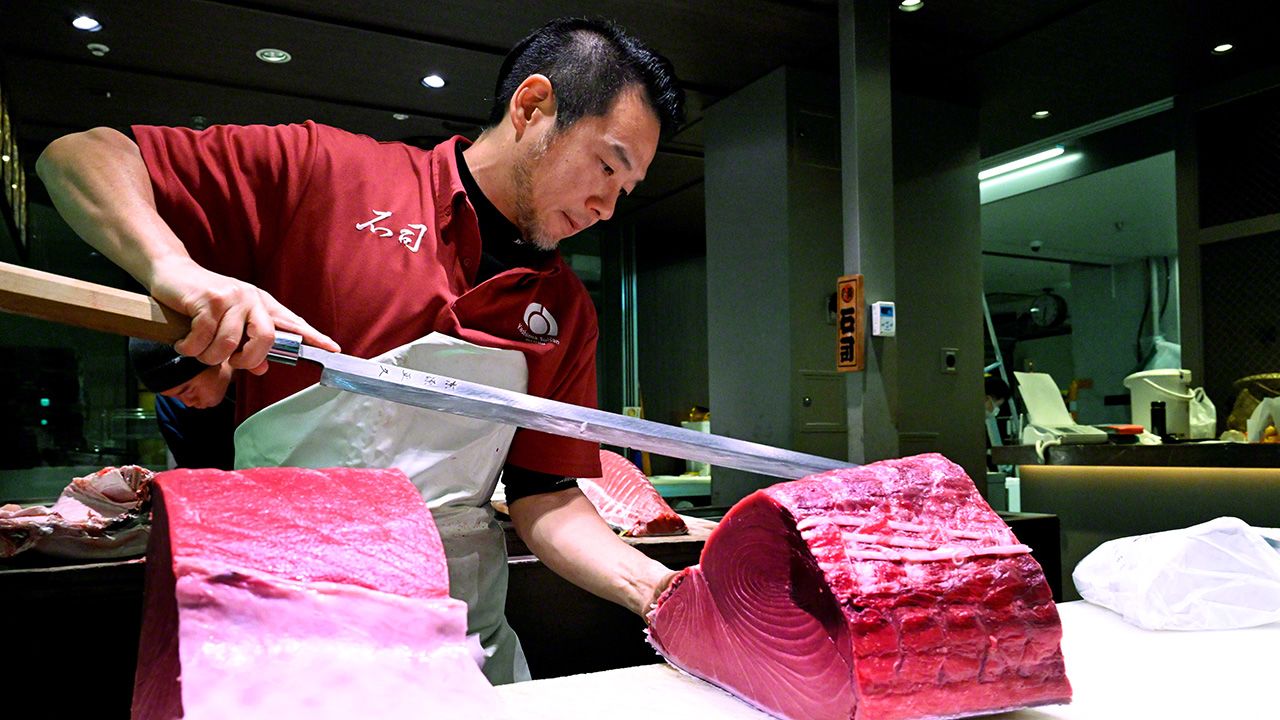
Early each morning, Tokyo’s Toyosu Market hosts its famed auctions for Pacific bluefin tuna. Single fish have gone for more than ¥300 million, earning them the name “black diamonds” of the sea. We take a trip behind the scenes to learn more about what the fishers, auctioneers, and wholesalers at the heart of this daily action.
It’s 5:30 am when a ringing bell heralds the start of the tuna auction at Toyosu Market (the Tokyo Central Wholesale Market). Immediately, a noisy battle erupts over the 200 or so fish lined up for sale. Bidders from various wholesalers stand in front of the tuna, shouting hoarsely in an effort to be heard above the clamor. Seafood from all over Japan is sold at Toyosu Market, but only five wholesalers purchase tuna from the various fishery cooperatives. Their representatives, based at the market, control the bidding each day.
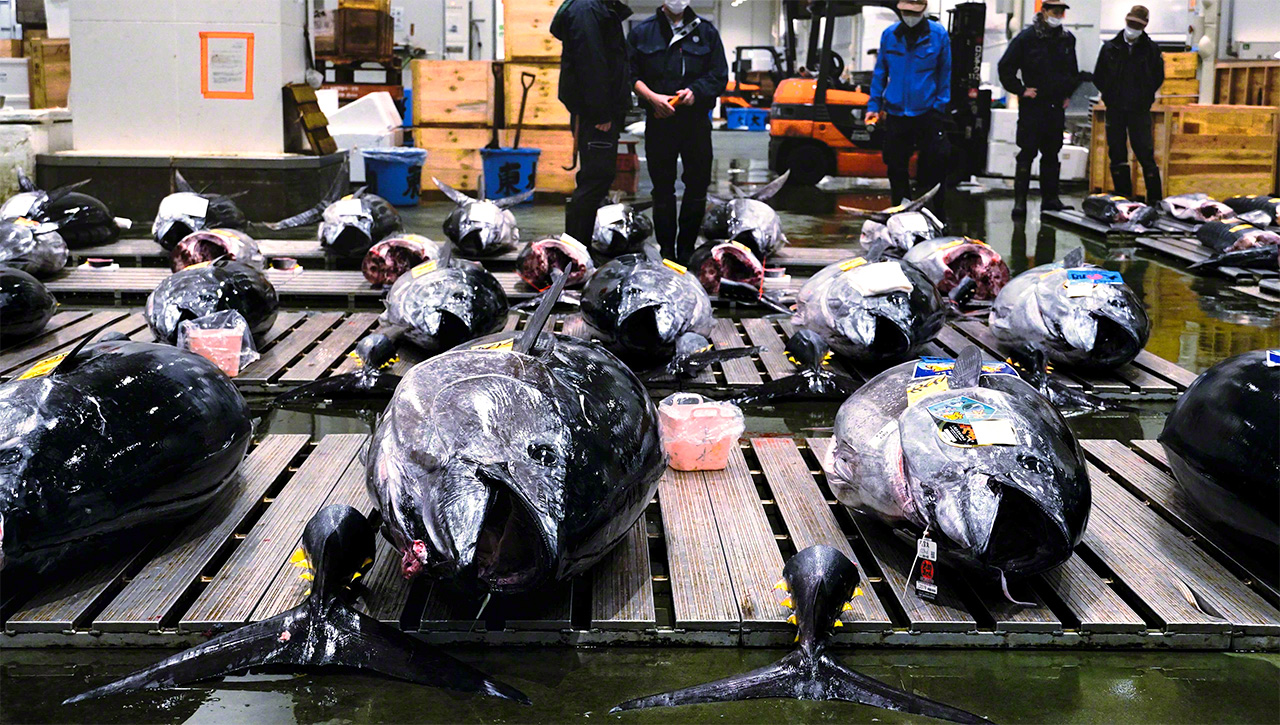
Late autumn to New Year is the season when Japanese Pacific bluefin tuna (hon-maguro), nicknamed “black diamonds,” are auctioned off. (© Uzawa Akihiko)
Sushi restaurants, restaurants, supermarkets and others procure the fish via intermediate wholesalers. When the auction starts, buyers stand in front of the tuna they have their eye on and use hand signals (teyari) to indicate their desired price, and the sellers act quickly to choose the successful bidder.
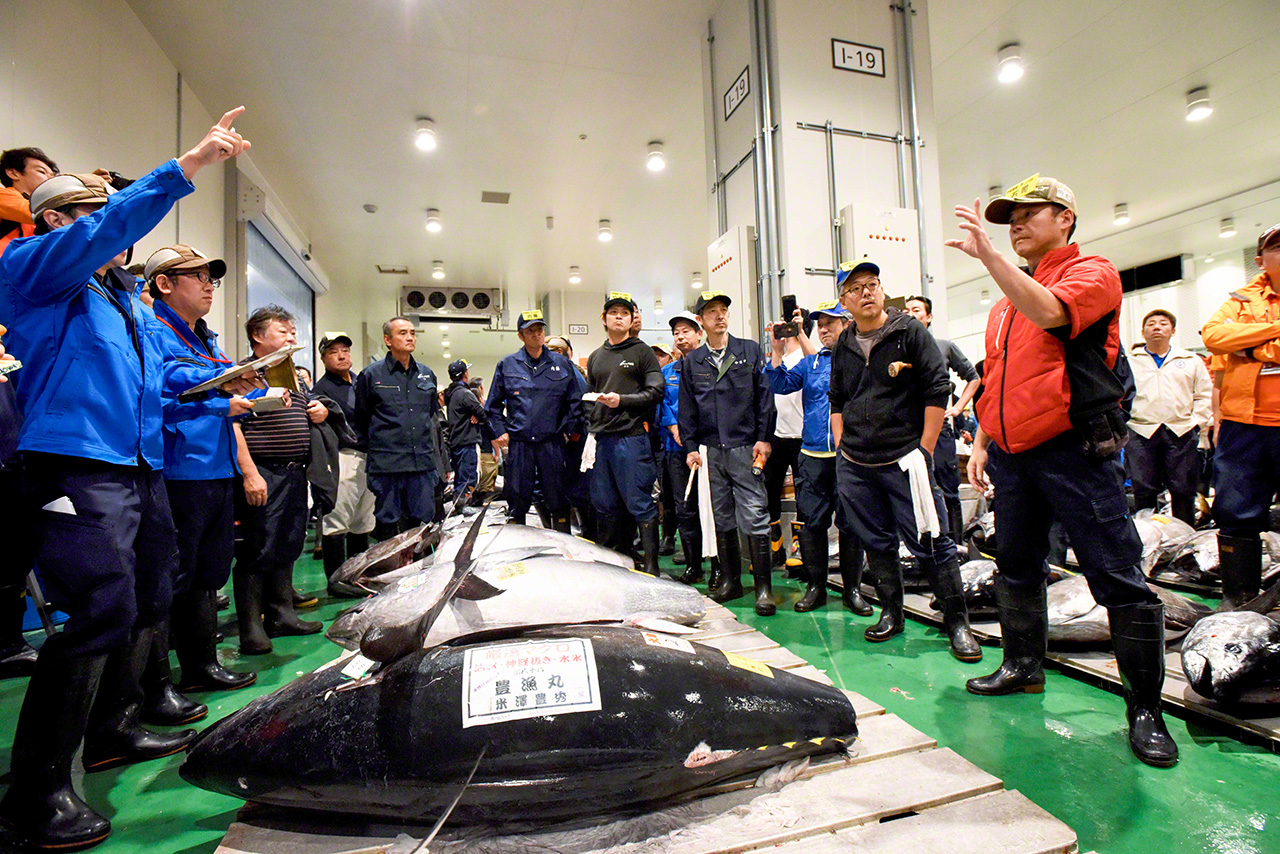
The auction is the site of fierce competition between buyers. (© Uzawa Akihiko)
¥300 Million for One Fish
The tuna is sold through an “ascending price auction,” where the price starts from around ¥5,000 per kilogram, and rises with each bid. The average final selling price is generally between ¥8,000 and ¥10,000 a kilogram. At the end of year, with higher demand, the price of tuna soars, often climbing over ¥20,000, and in some cases even over ¥100,000.
If one 200-kilogram fish sells for ¥20,000 a kilogram, the fisher receives roughly ¥3.2 million of the total price of ¥4 million. The other 20% is divided among the fishing cooperative and wholesale company, as well as paying for expenses such as transportation, ice, and packaging.
In 2019, the first auction of the season made the news when a 278-kilogram tuna from Ōma in Aomori Prefecture, renowned for its high-grade fish, sold for a record-breaking ¥333.6 million. This amounts to ¥1.2 million per kilogram, indicating the excitement created by the first New Year auction to take place at the new market, which opened late in 2018 after it was moved from the previous location in Tsukiji. With ¥250 million falling into the hands of the fisher at the start of the year, their comment that “tuna fishing is like gambling” rang true.
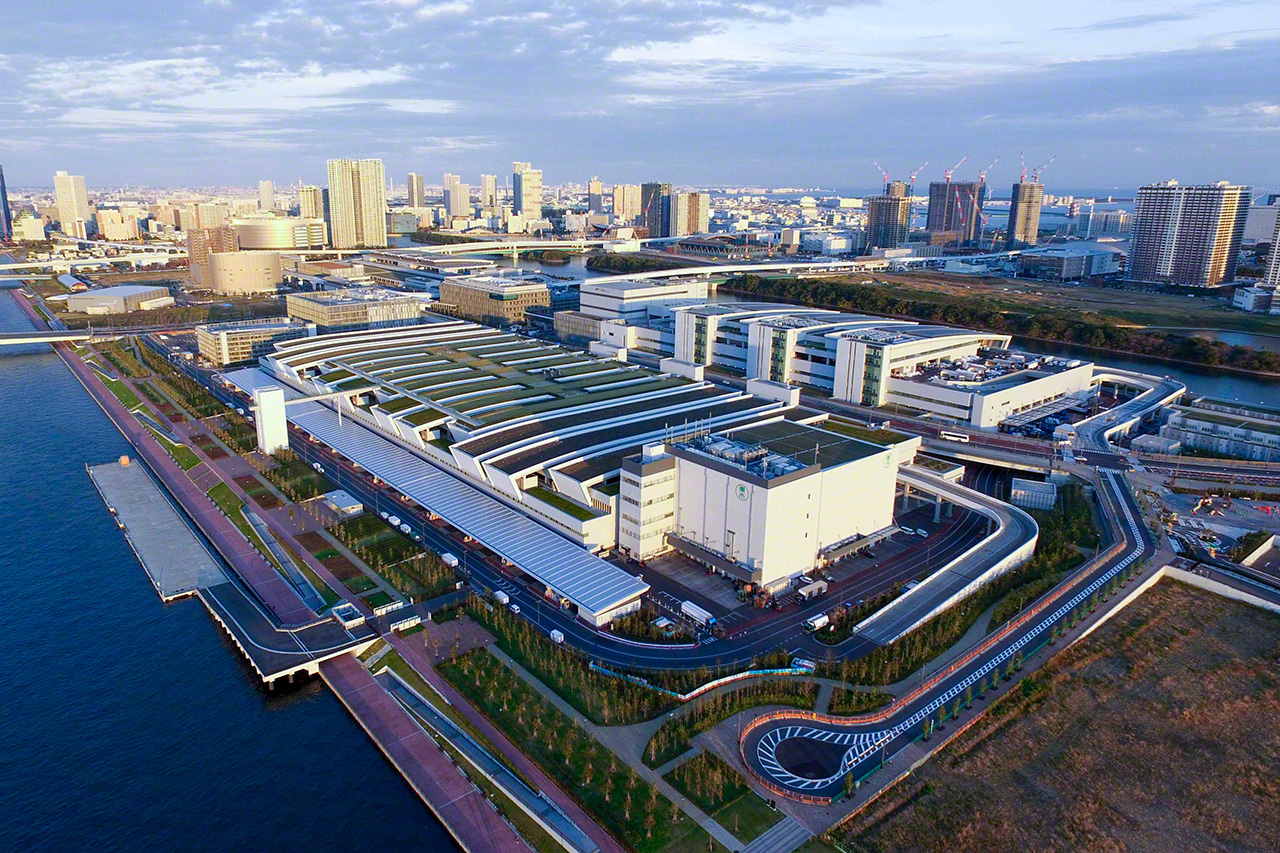
No other market in the world handles as much tuna each day as Toyosu. (© Uzawa Akihiko)
These auctions that decide the fate of fishers began with modest riverside markets in Nihonbashi, Tokyo, during the Edo period (1603–1868), steadily expanding to the present leviathan scale. Where else could you witness the spectacle of a single fish selling for such a price? It’s truly an indication of the importance of seafood throughout Japanese history.
While it pales in comparison with the first auction of the year, on any given day a single tuna can change hands for millions of yen. Complicating the picture is the fact that it is not just the size or brand that decides the final price. The season, the weather, and most of all, the quality of the fish itself impact the outcome. All of this is assessed by the discerning eyes of the buyers, whose decisions have repercussions on the livelihoods of the fishers who battle the rough seas day to day.
The Perception to Instantly Discern Quality
In the auction hall, one man with a dauntless expression, dressed in a scarlet parka, stands out from the crowd. He is Shinoda Takayuki, president of Ishiji, an intermediate wholesaler specializing in tuna.
Toyosu has around 460 intermediate wholesalers dealing in marine products, and about a third of them sell tuna. Of these, only a handful, known respectfully as jōmonoshi (top-shelf traders), specialize in raw Japanese hon-maguro. Ishiji, with an 80-year history, is highly regarded by renowned Edomae (Tokyo-style) sushi restaurants and other high-class establishments across Japan.
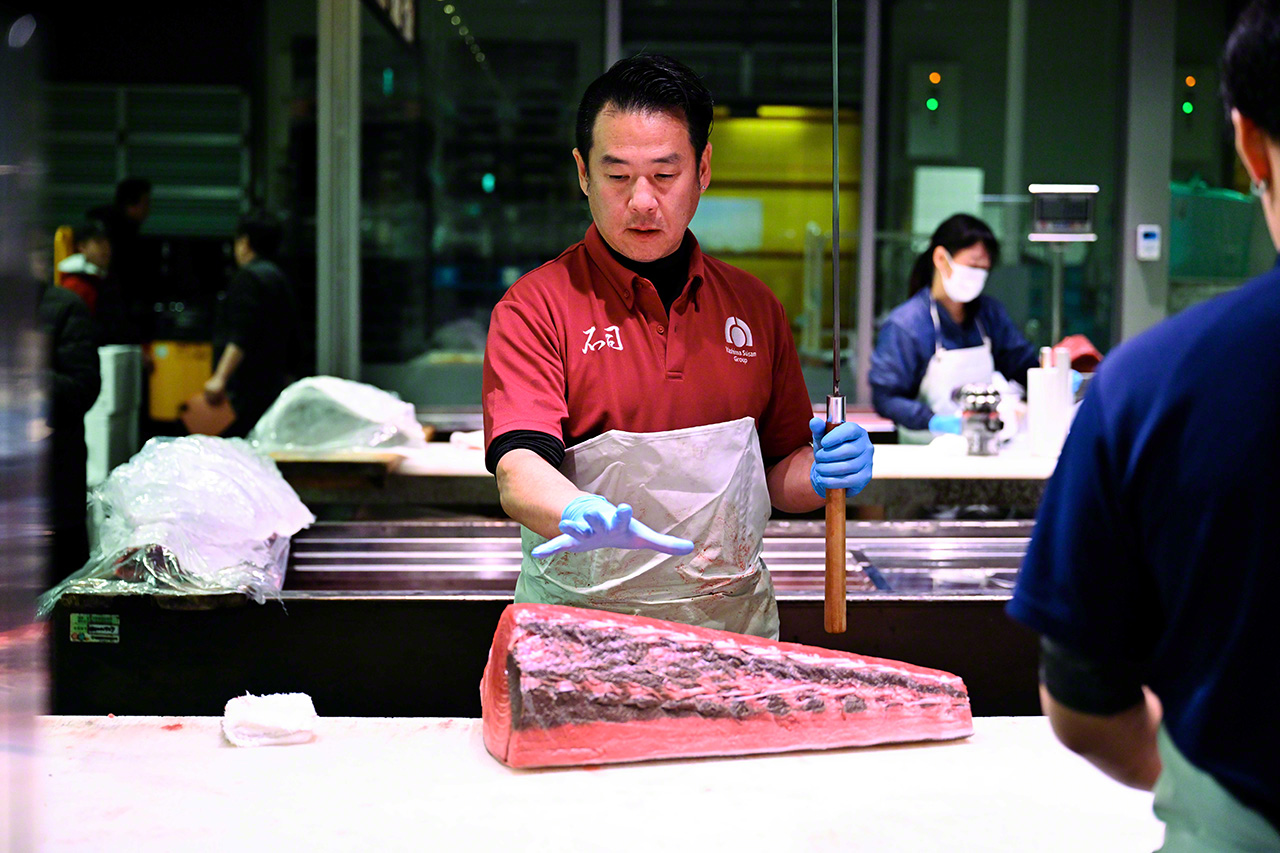
It is entrancing to watch Shinoda, third-generation head of Ishiji, as he works. (© Uzawa Akihiko)
Many buyers are on the floor from 4:30 am, an hour before auction starts. Wielding flashlights , they check the cross sections of the tuna tails, which are cut off and placed atop the fish for inspection. They pick up the tails and feel the fattiness to judge the quality. Each of them ardently gathers evidence to estimate the value of each fish. Shinoda, though, arrives just 15 minutes before bidding begins, quickly inspecting the fish before the main event.
Shinoda explains: “There are only so many high-grade Japanese raw hon-maguro each day. From the appearance, the exterior firmness, and the fattiness of the belly I can recognize the quality instinctively. It’s hard for me to explain the standards I use—really, it’s intuition.”
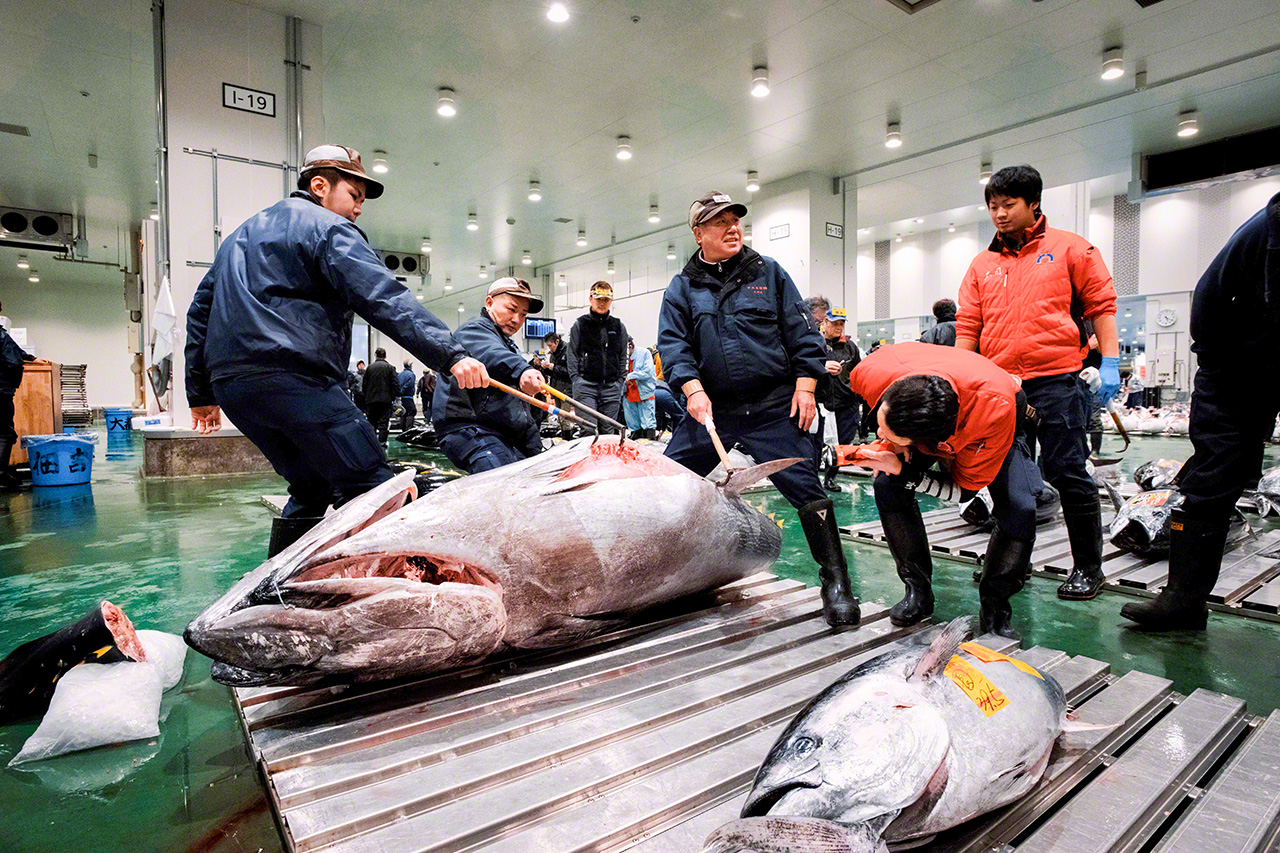
The belly of the tuna is opened to allow for inspection of the fattiness. (© Uzawa Akihiko)
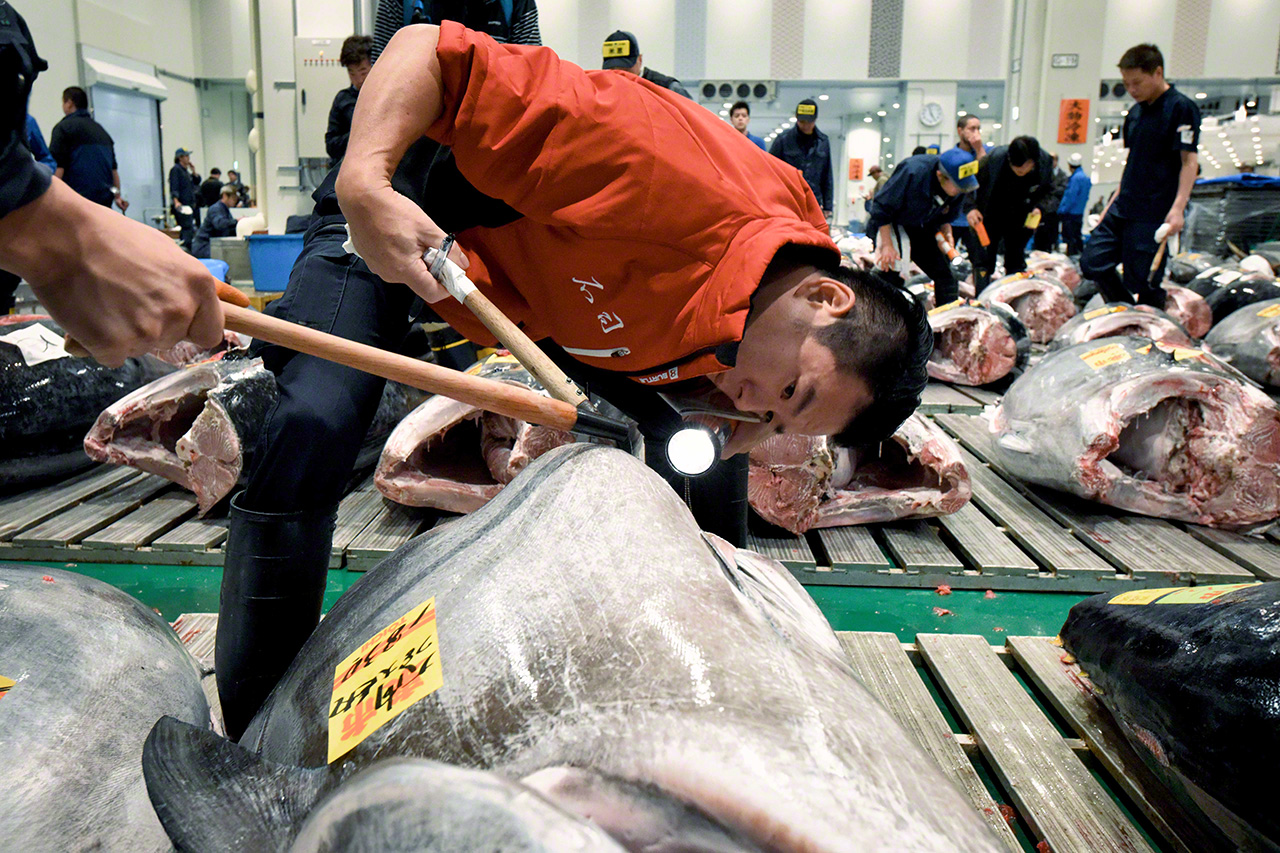
The taste, aroma, and texture varies, even for fish from the same location. (© Uzawa Akihiko)
A label is attached to each tuna listing simply the origin, total weight, the name of the fishing boat, and fishing method. One thing the buyers look out for is burn marks on the fish. If the fish struggles too much after it is caught, its body temperature shoots up, which damages sections of the flesh. Burn marks can be recognized by a grayish tone in the usually vibrant red flesh, a sign that the fish is unfit for sale at a high price. Although a fish may appear completely normal at first glance, there can be multiple burn marks buried deep in the flesh, and failure to notice this can result in significant financial loss. They only become apparent when the fish is sliced. This makes it crucial for the buyer to recognize the signs in an instant. Such expertise is the hallmark of a top-shelf trader.
“The fish must of course be delicious, but all sushi chefs have their own preferences,” notes Shinoda. “Some like tender flesh, while other tend towards fattier fish. There are chefs who refuse to buy fish if they loathe the color. I need to bear all their tastes in mind when I’m bidding. Sometimes I picture their faces in my mind, even if they haven’t placed an order, in anticipation of future business. That’s why I’m the most anxious when cutting open the belly. It’s when the answers are revealed, and I learn whether this tuna will meet my customers’ expectations.”
The Skill of the Cut
On this particular day, Shinoda successfully bids for a 184-kilogram tuna from Ōma and a 204-kilogram specimen from Minmaya, at the Japan Sea end of the Tsugaru Strait, also in Aomori.
The tuna are carted from the auction on a wagon known as a neko to the adjacent Ishiji store, where workers immediately begin to cut up the fish. The knife used exclusively to slice tuna is massive, looking like nothing so much as a Japanese sword.
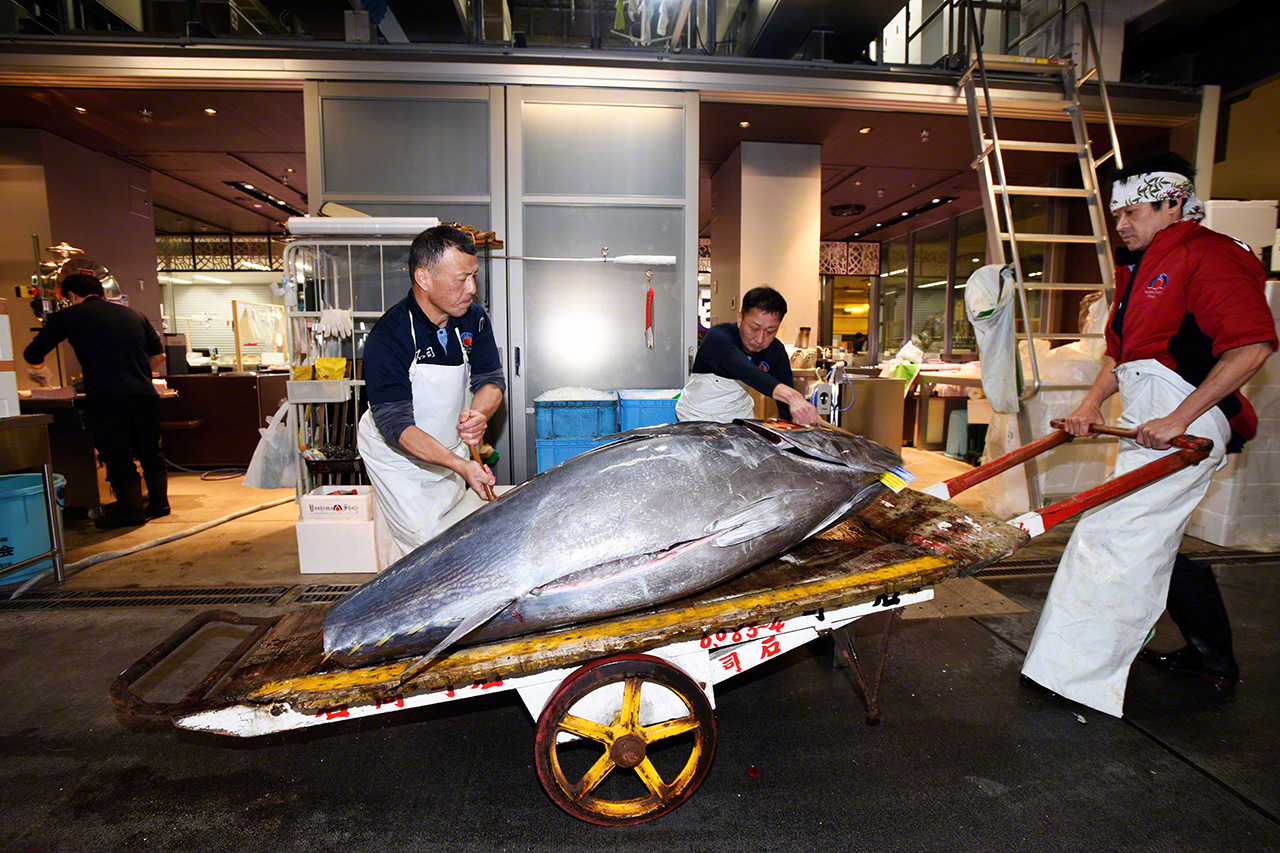
The tuna are quickly carted from the auction to the store on wagons. It requires some effort to move these enormous fish. (© Uzawa Akihiko)
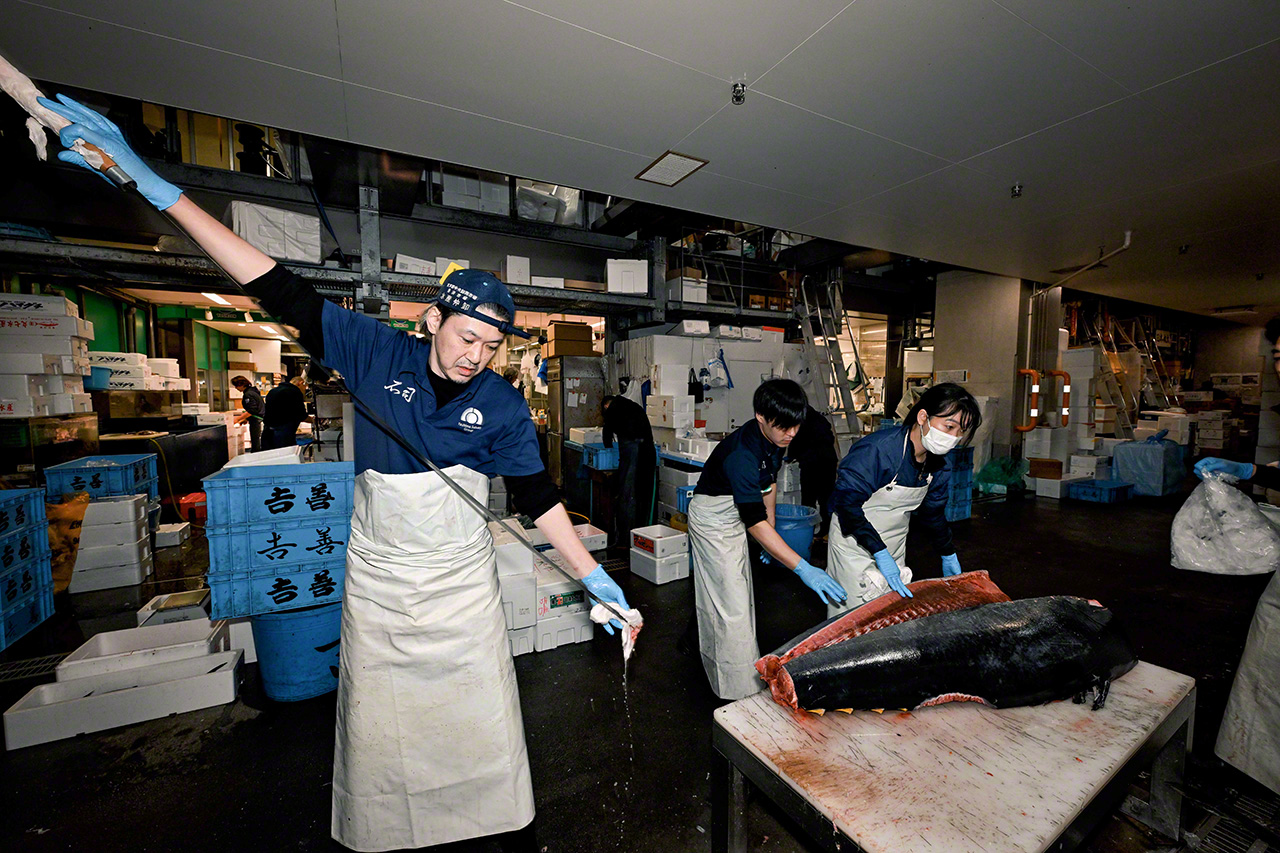
The task of cutting takes several people and a special tuna knife. (© Uzawa Akihiko)
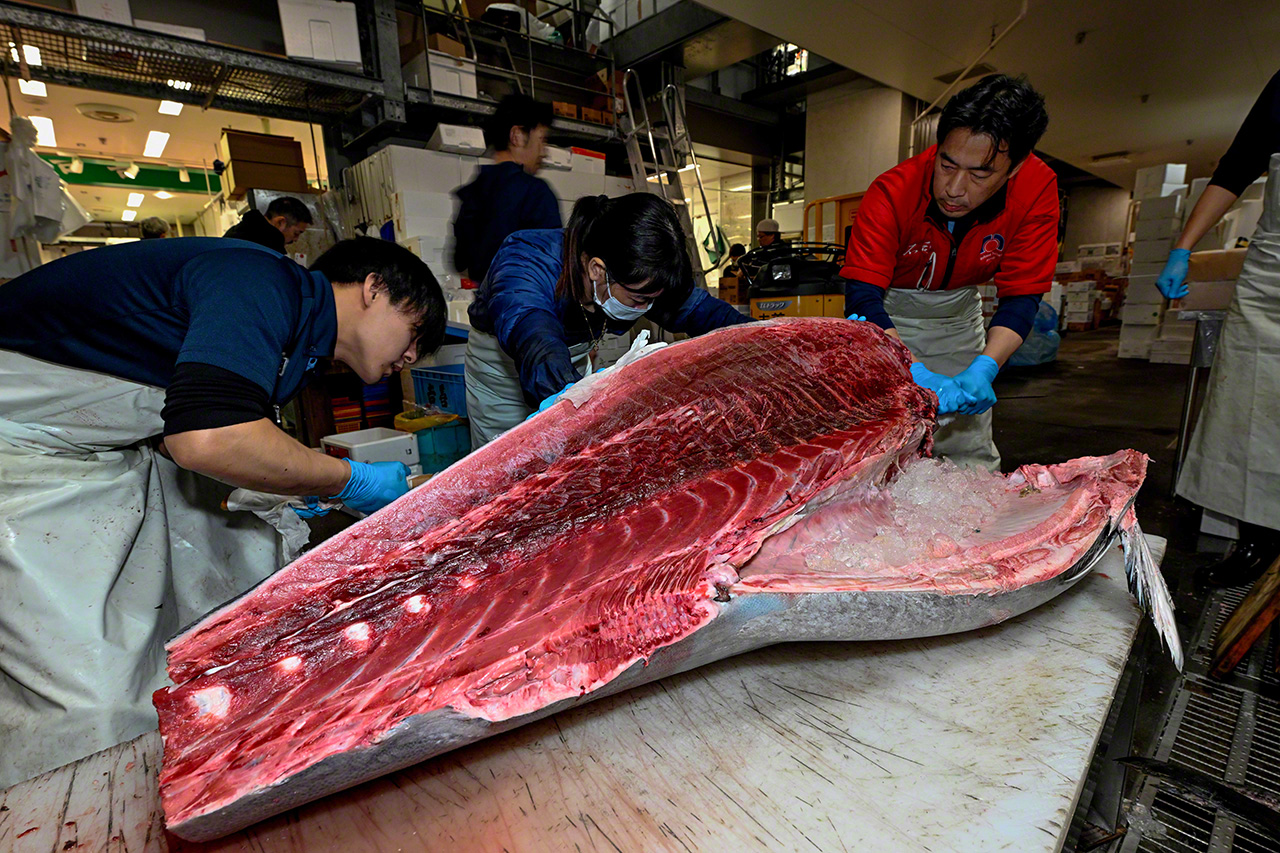
The value of the fish first becomes apparent when its belly is cut open. It’s a tense moment. (© Uzawa Akihiko)
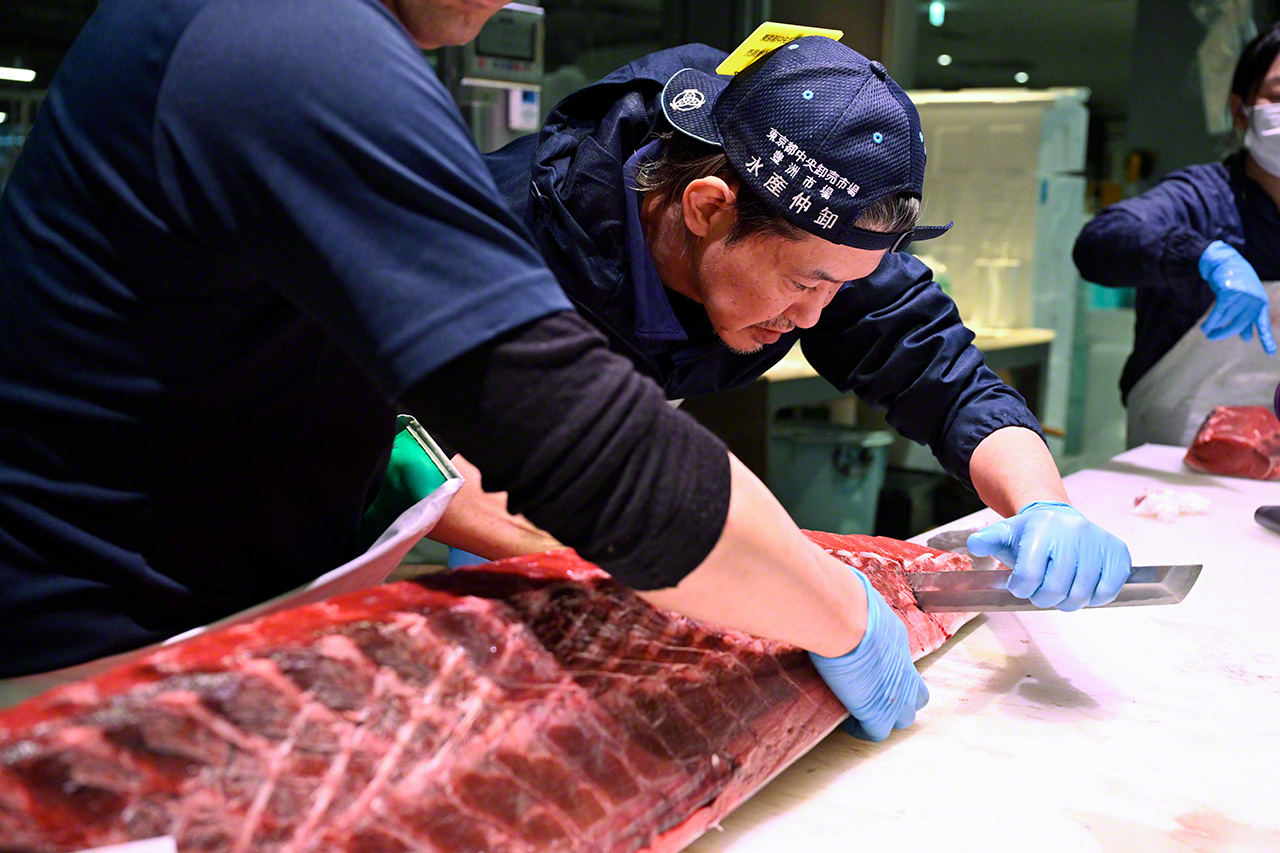
Even after it is cut in half, slicing up the fish still requires two people. (© Uzawa Akihiko)
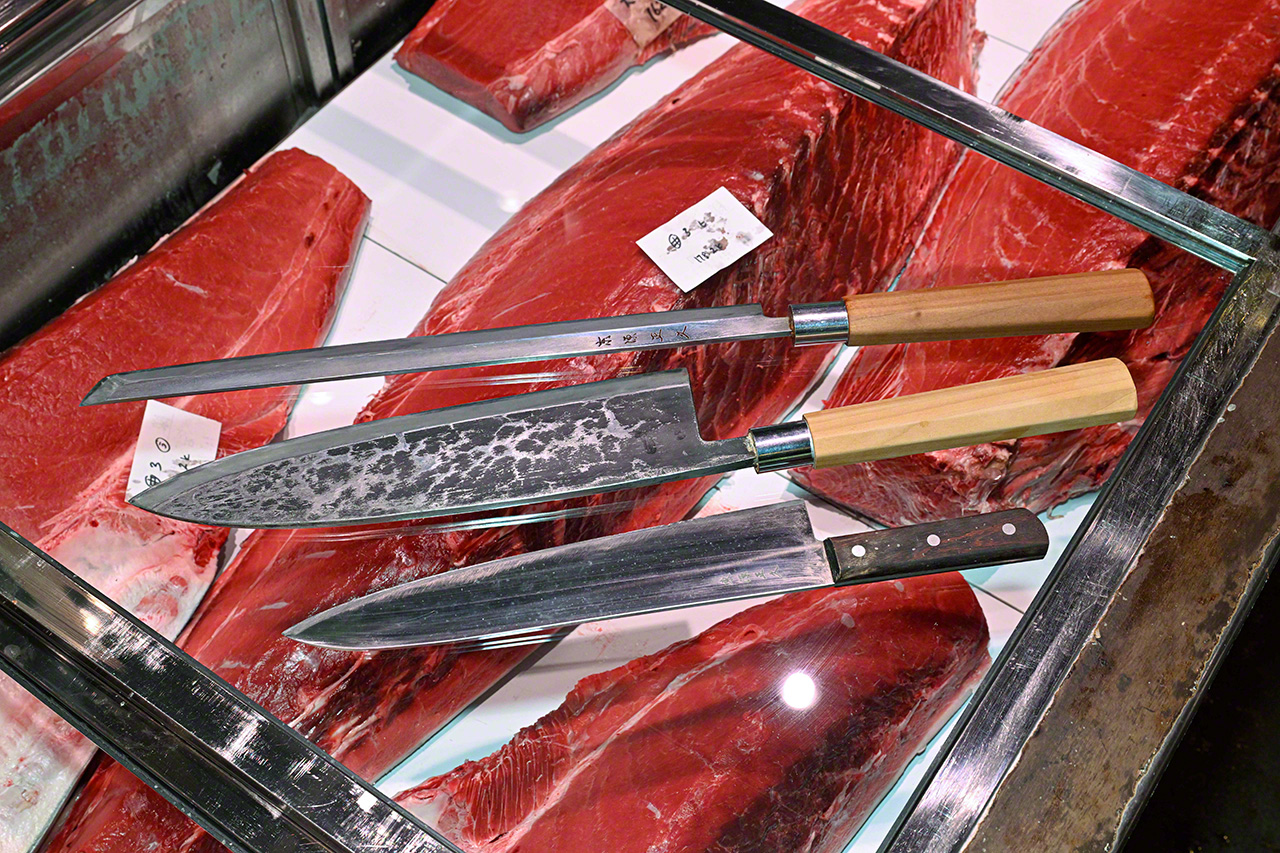
Specific knives are used for different sections. (© Uzawa Akihiko)
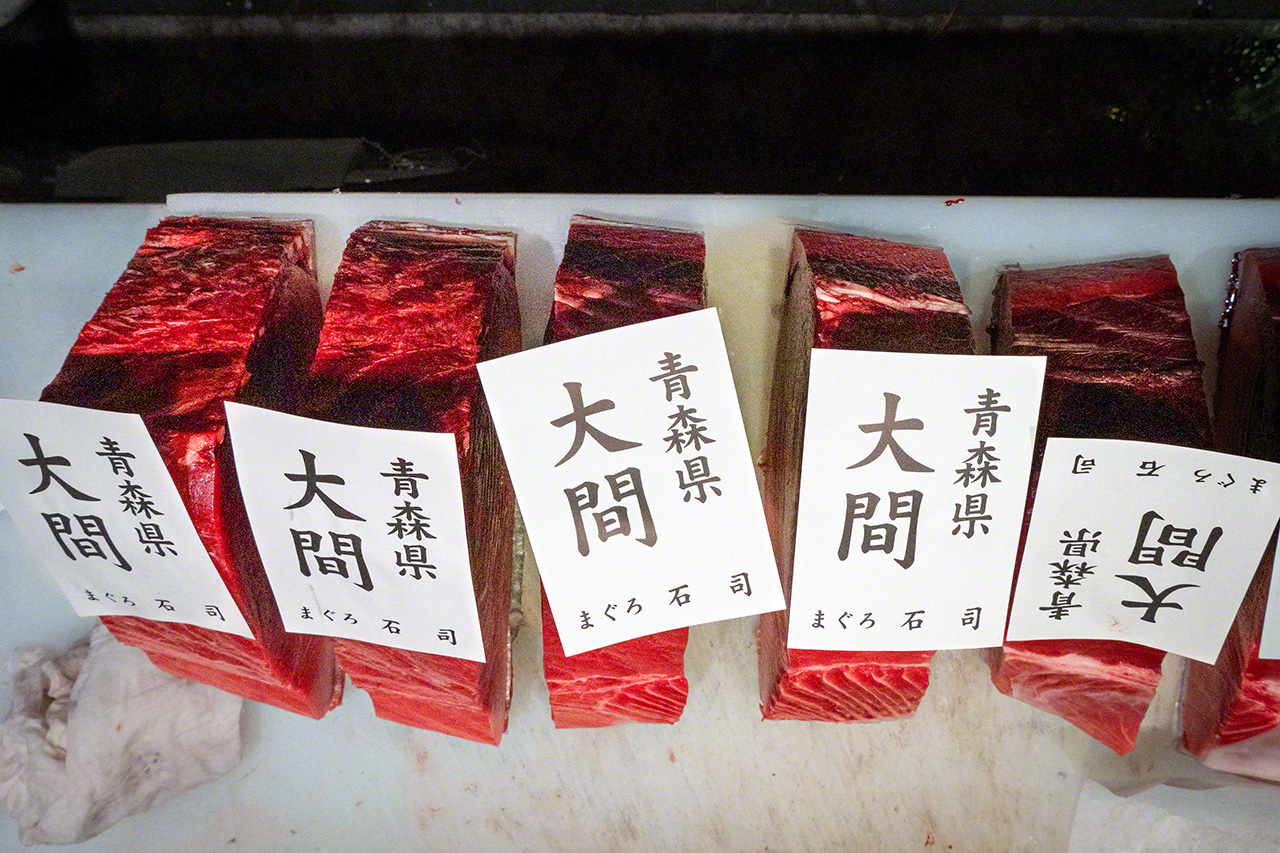
Customers come to the shop in the early morning looking out for fish from Ōma, the Holy Land of tuna. (© Uzawa Akihiko)
Well-Trusted Judgment
The section of the fish from the backbone up is called the “back” (se) and the lower half the “belly” (hara). Further categorization distinguishes the “upper” (gills to the dorsal fin), “mid,” and “tail” sections, known in Japanese as kami, naka, and shimo, respectively. The belly section we call toro has more fat towards the fish’s head, and this hara-kami section is the most valuable. From late autumn to mid-minter, the fish accumulates more fat to resist the cold, producing exquisitely marbled hara-kami.
“Even using our specialized knives, after removing the head and backbone, we still only use around 70 percent of the fish. Tuna therefore has a surprisingly poor yield rate. The hara-kami section of each tuna is limited, so not everyone can afford it.”
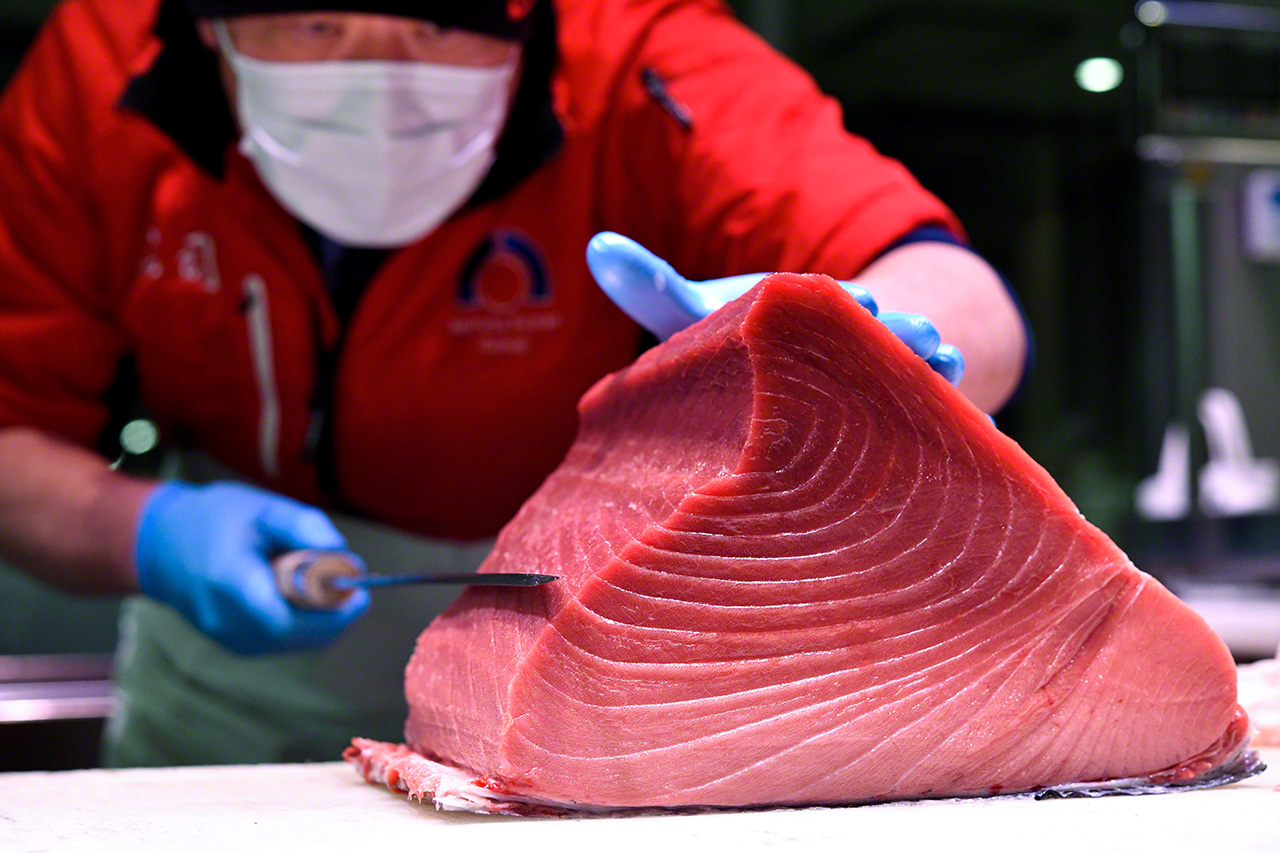
The prized hara-kami cut of the tuna. The white fat is glorious to behold. (© Uzawa Akihiko)
From first thing in the morning, chefs from the top sushi restaurants appear in succession at the Ishiji store. Surprisingly, none of them tries to drive a bargain.
The Tsugaru Strait can experience harsh weather conditions mid-winter, the peak tuna fishing season, with wind speeds up to 30 meters a second and waves over 7 meters high. If boats are unable to go to sea for several days, the supply of top-class tuna to Toyosu dries up. But intermediate wholesalers are too proud to run out of stock and simply blame the weather. They keep a close watch of the weather forecast and bid strategically at auction. The top chefs trust Shinoda above anyone, thanks to his intimacy with the challenges of tuna, and this is why they are happy to pay the price he sets.
“At times, the price can be extraordinary,” admits Shinoda, “but this is no assurance that the quality is good. In the end, that price hits diner’s wallet, so I strive to provide tasty tuna at an acceptable price year-round. I also want to learn more about tuna so I can understand them better. Tuna holds a special allure that drives us to dedicate a lifetime to discover.”
(Originally written in Japanese with the cooperation of Ishiji Toyosu Market Intermediate Tuna Wholesaler. Banner photo: Shinoda Takayuki, third-generation president of Ishiji. His expression as he slices tuna is as intense as the blade is sharp. © Uzawa Akihiko.)
AloJapan.com