

December 31, 2025 — 11:01pm
Save
You have reached your maximum number of saved items.
Remove items from your saved list to add more.
Save this article for later
Add articles to your saved list and come back to them anytime.
Got it
The Howard government was explicitly warned of the risk of catastrophic climate impacts – including bushfires and systemic environmental failure – years before it refused to ratify the Kyoto Protocol, according to former minister Philip Ruddock and newly released cabinet documents.
Speaking at the release of the previously confidential material, made available on January 1 by the National Archives of Australia, Ruddock said the government had received extensive scientific research showing the serious environmental and societal consequences of unchecked greenhouse gas emissions.
The 10-page submission to cabinet, dated August 8, 2005, reveals that ministers were aware of mounting international scientific concern about global warming and the likely consequences of inaction, even as internal debate continued over whether Australia should commit to binding emissions targets.
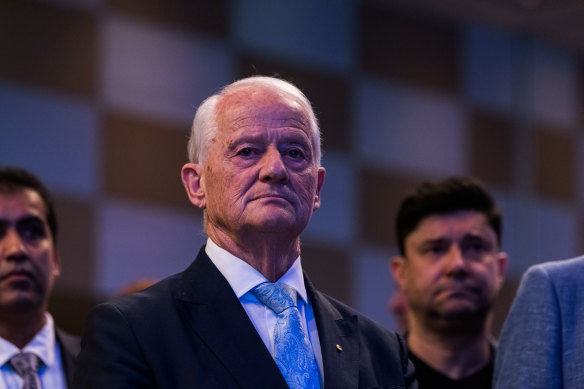 Former minister Philip Ruddock has revealed the Howard government was warned of the dire consequences of inaction on climate change, including bushfires.James Brickwood
The paper predicted climate change would place significant pressure on water resources in the cities and rural areas, with reduced rainfall and more severe droughts in south-west and south-eastern Australia.
“The Howard government, while not ratifying Kyoto, was very cognisant of the research that had been done in relation to climate change,” Ruddock said.
Related Article
“These documents indicate that there were others who had doubts about whether they were willing to commit to negotiations on Kyoto-style greenhouse gas emissions targets. Nevertheless, they were very persuasive in suggesting that we needed to be cognisant of the many human and natural systems failures that are likely to result if we don’t address climate change.”
Ruddock noted that cabinet papers made explicit reference to environmental risks that resonate strongly today, including bushfires – a threat that recent weeks’ fires across New South Wales have tragically underlined – and hinted there were lessons for the modern-day Liberal Party.
The submission, authored by then-foreign minister Alexander Downer and environment minister Ian Campbell, urged Cabinet to note that the climate was changing and “some observed changes are occurring more quickly than previously predicted”.
“During the 20th century the magnitude of observed average temperature increase in Australia was greater than observed globally,” the submission reads.
“The magnitude of climate change in Australia, combined with marginal rainfall in many of our key agricultural areas and a heavy reliance on irrigation, is likely to make Australia more vulnerable to climate change than most developed countries, including the United States and many European countries.”
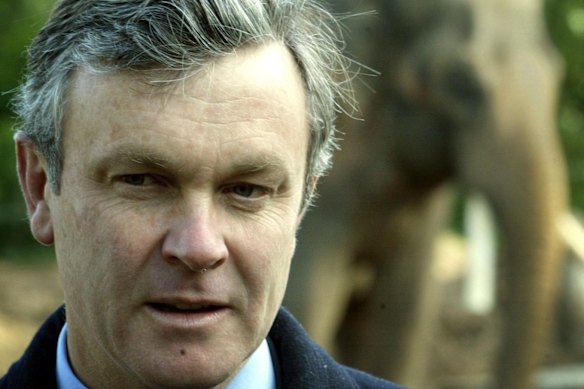 Climate change proved the elephant in the room for Howard’s environment minister Ian Campbell.John Woudstra
Australia signed the Kyoto Protocol in 1998 but ultimately chose not to ratify it under the coalition government led by John Howard, citing potential economic disadvantage compared with major emitters such as the United States and China.
The report said Australia was on track to meet its Kyoto protocol target of 108 per cent of 1990 by 2012, with projections that greenhouse gas emissions would be at 123 per cent of 1990 levels by 2020.
It urged cabinet to continue to work with the international community to develop a robust and comprehensive global response to climate change that was environmentally effective, economically efficient and did not impose an unfair burden on Australia.
Ruddock’s remarks suggest the cabinet’s decision not to ratify Kyoto was not due to ignorance of the science, but a considered political judgment about Australia’s negotiating position and obligations.
“I’ve always been of the view that the world is going to address it. But we need to be ensuring that Australia plays its part,” he said.
“If you look at the events that we’ve seen tragically in NSW over this last week, it’s made [clear], I think, the importance of reviewing these documents and ensuring that those who are considering these issues today are cognisant of the material that was available to the Howard government,” he said.
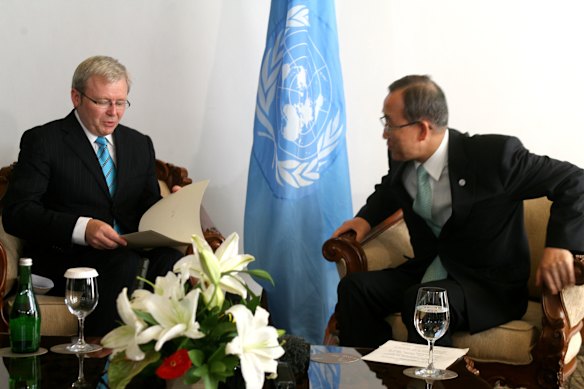 Then-prime minister Kevin Rudd hands over the signed Kyoto agreement to United Nations secretary-general as part of the 2007 UN Climate Change Conference in Bali.Glen McCurtayneSave
You have reached your maximum number of saved items.
Remove items from your saved list to add more.
 Rob Harris is the national correspondent for The Sydney Morning Herald and The Age based in Canberra.Connect via email.Most Viewed in PoliticsFrom our partners
AloJapan.com