
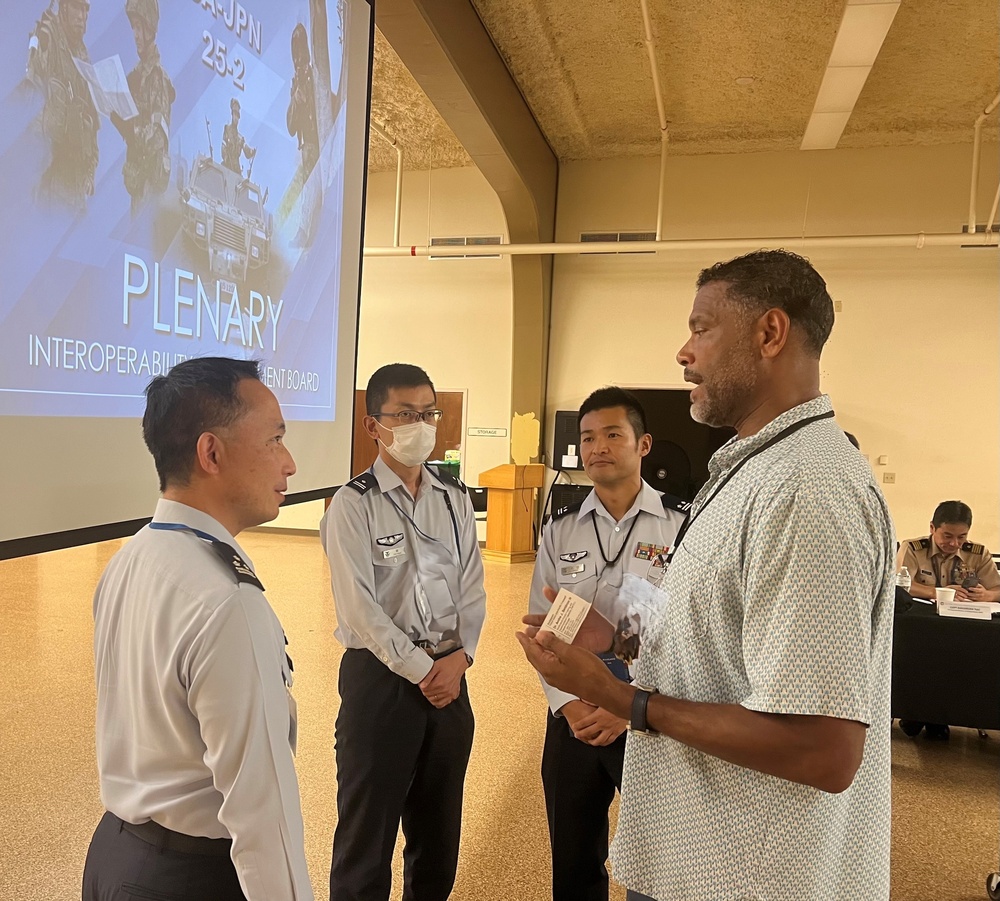
Where’s the Remote? Insights from U.S.-Japan Interoperability Management Board 25-2
Your browser does not support the audio element.
How many remote controls are in your home? Estimates for the average U.S. household range from two to five or more. Having so many remotes can cause clutter, confusion and frustration when you can’t find the one you need. Wouldn’t it be nice to have one universal remote to talk to every device seamlessly?
For USINDOPACOM’s J6, that answer is a resounding yes. From October 20-24, 2025, the United States and Japan convened in Hawaii for the 26th session of the Interoperability Management Board (IMB). This critical meeting brought together military leaders, technical experts, industry and policymakers to address the challenges of achieving seamless collaboration in Command, Control, Communications, and Computers (C4) systems. Analogous to creating a universal remote control, the IMB focused on creating compatible systems that allow both nations to bilaterally operate their defense systems in harmony.
A Shared Vision for Interoperability
The IMB, co-chaired by Col. Oliver Sagun, Chief, Partner Interoperability and Engagement, USINDOPACOM J69, and Mr. ARA Shimpei from Japan’s Ministry of Defense, has been a cornerstone of U.S.-Japan defense collaboration since its inception in the 1980s. Over the years, the IMB has evolved to address modern challenges, from cybersecurity to space-based communications.
According to Sagun, the IMB ensures effective military coordination between the U.S. and Japan by enhancing digital interoperability, setting communication standards and procedures and addressing cyber requirements.
“The ability to functionally share data, securely communicate, and work from a common operating picture that provides time sensitive information is key to operating together and making decisions in this AOR [area of operations],” said Sagun. “C4 is the nervous system for any force because it enhances situational awareness, improves decision-making, streamlines coordination, increasing speed of action, driving efficiency, and ensuring effective command and control, all while bolstering cybersecurity and interoperability.”
The IMB 25-2 focused on several critical areas to advance C4 interoperability, including cryptographic modernization, tactical data link enhancements, and space-based capabilities. Japan’s transition to a zero-trust security model and its integration with the U.S. Mission Partner Network (IMN) were highlighted as significant milestones that advance cybersecurity and support more secure, seamless communication between the U.S. and Japan.
PMTEC and C4 Interoperability
During the IMB’s closing plenary session, Dr. Andre Stridiron, Pacific Multi-Domain Training and Experimentation Capability (PMTEC) Program Manager, briefed participants on PMTEC’s mission to develop a modernized, distributed training capability. He underscored the importance of realistic, interconnected training environments for enhancing C4 interoperability, and explained how PMTEC integrates live, virtual, and constructive (LVC) simulations to create those scenarios for joint and coalition forces.
“We are talking about scale, scope and fidelity,” said Stridiron. “Providing the highest level of training to the warfighter, as well as supporting strategic and operational personnel across the joint force, with allies and partners, and across geography.”
He defined the terms, live, virtual and constructive, adding they are often used incorrectly. According to Stridiron:
Live training Involves real-world operations with actual personnel, equipment, and platforms. It provides hands-on experience in real environments, such as field exercises or live-fire drills.
Virtual training uses computer-based simulations to replicate real-world scenarios. The training audience interacts with simulated environments and systems, often through simulators or virtual reality tools. He gave the example of Japanese aviators being able to rehearse flying over Australia using simulators in Japan.
Constructive training involves computer-generated forces and scenarios that simulate operational environments. This enables large-scale complex training that is difficult or impossible to replicate in live environments.
PMTEC’s integration of LVC training facilitates controlled environments to test and refine communication protocols, allowing U.S, Allies and Partners to identify technical and operational gaps before they become critical issues in the real-world.
“Even the best universal remote is useless if you don’t know how to use it,” said Stridiron. “That’s why high fidelity, LVC training is essential.” He pointed to Keen Edge and Valiant Shield as examples of exercises where PMTEC raised the bar in terms of training value, and supported after-action review and analysis to improve future exercises. Stridiron emphasized PMTEC’s role in accelerating those insights, critical for maintaining a tactical advantage in the Indo-Pacific region.
The next IMB session, IMB 26-1, is scheduled for April 2026 in Japan. As the U.S. and Japan continue to build on the foundation laid by decades of collaboration, the IMB and PMTEC are critical enablers for a strong and effective U.S. Japan defense partnership.
About PMTEC: Established in 2022, the Pacific Multi-Domain Training and Experimentation Capability is a transformative enterprise funded and resourced by the United States Indo-Pacific Command to enhance joint, combined, and coalition warfighting readiness and lethality in the Indo-Pacific. PMTEC is a key component of the Pacific Deterrence Initiative, reinforcing the U.S. commitment to homeland defense and a free and open Indo-Pacific. PMTEC’s integration of advanced training technologies and its alignment with strategic priorities make it a cornerstone of U.S. efforts to maintain regional stability and counter adversarial aggression.
Date Taken:
12.18.2025
Date Posted:
12.29.2025 18:46
Story ID:
555030
Location:
KANE’OHE, HAWAII, US
Web Views:
0
Downloads:
0
PUBLIC DOMAIN

This work, Where’s the Remote? Insights from U.S.-Japan Interoperability Management Board 25-2, by Eleanor Prohaska, identified by DVIDS, must comply with the restrictions shown on https://www.dvidshub.net/about/copyright.
AloJapan.com