
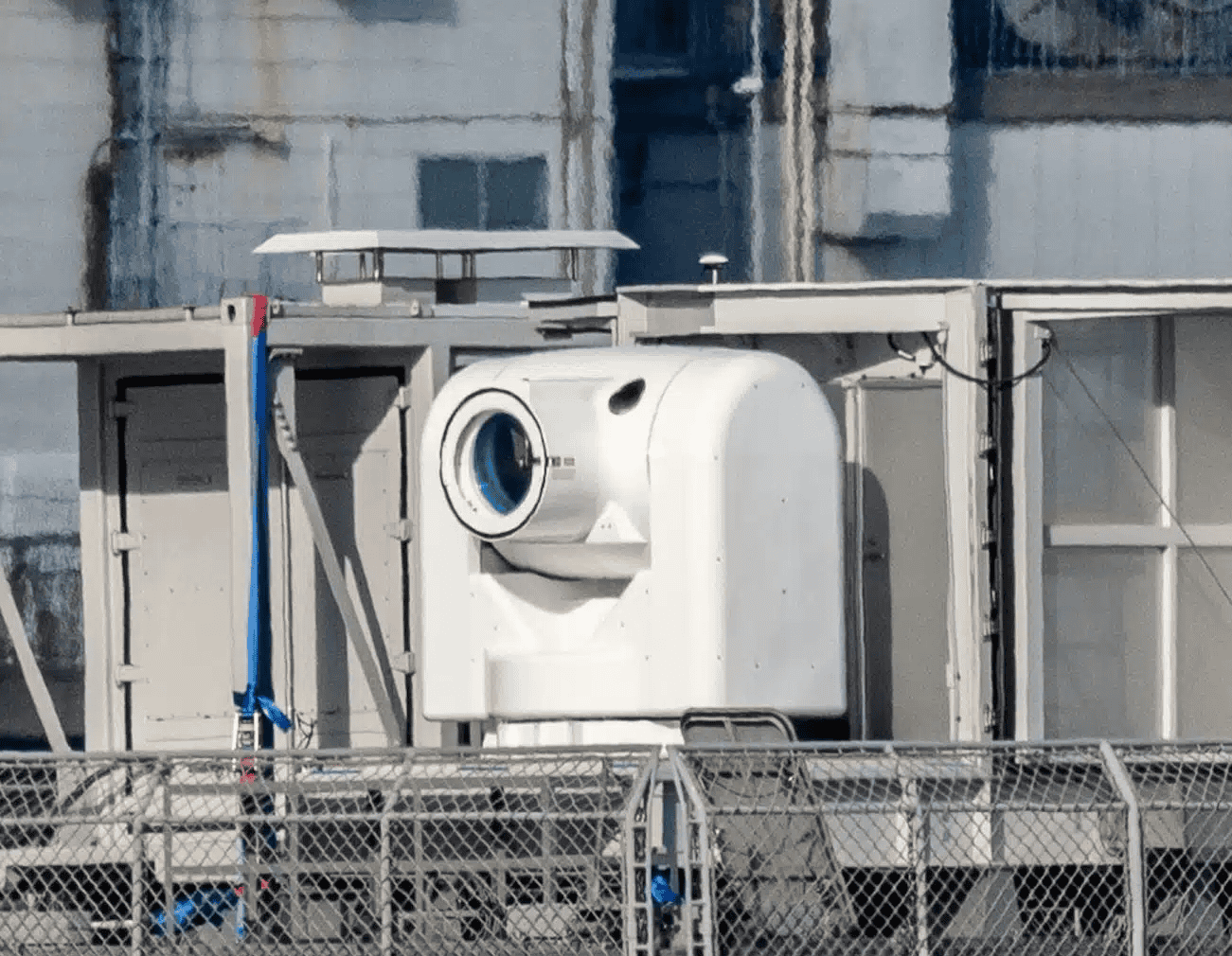
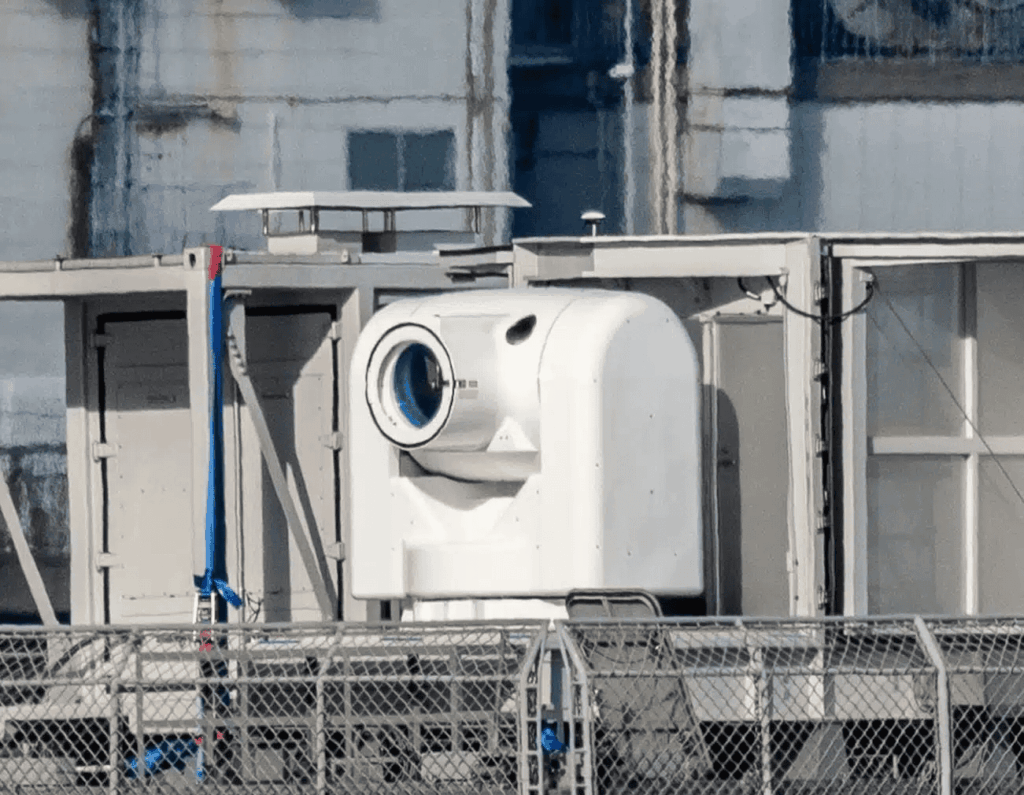
 The laser weapon system fitted aboard JS Asuka. Credit: ⚓︎アルザス⚓︎/X
If you look closely at the rear deck of the JS Asuka, you’ll spot something new. That innocent-looking dome looks like a GPS antenna, but it hides a high-energy laser designed to incinerate drones and mortar rounds before they can touch a ship.
Japan is officially gearing up to begin sea trials in 2026 for this “100-kilowatt-class” weapon system. It’s the latest move in a long-running program led by the Ministry of Defense’s Acquisition, Technology & Logistics Agency (ATLA), which confirmed the installation in a statement on Dec. 2, 2025.
The timing isn’t accidental. Officials say the laser already destroyed drones and live mortar rounds during ground tests earlier this year. Now, the tech has moved from the lab to the Asuka—a 6,200-ton vessel that serves as Japan’s floating laboratory for experimental gear.
Hiding in Plain Sight
Militaries around the world have been searching for cheaper ways to defend against the spread of small drones and other short-range airborne threats. A laser, if it works, could fire repeatedly without the logistics of hauling and loading interceptors. The UK recently tested its groundbreaking system, and now, Japan is coming in with its own.
The system’s first striking feature may be how ordinary it looks. Rather than a single turret with everything inside, ATLA’s high-output laser travels in two modules roughly the size of 12-meter long (40 feet) shipping containers.
Those modules hold the parts that make a shipboard laser possible: a fiber-laser array, beam-control optics, power systems, and cooling units. A laser doesn’t use bullets, it only needs energy and cooling.
A dome-shaped aiming unit mounts on deck and connects to fast steering mirrors, thermal imagers, and precision tracking sensors designed to keep the beam locked on a moving target despite ship motion.
ATLA notes that the 100-kilowatt output doesn’t come from brute force. Instead, the system fuses ten domestically produced 10-kilowatt fiber lasers (built by Kawasaki Heavy Industries) into a single, lethal beam.
The Infinite Ammo Cheat Code
Why go through the trouble? Lasers are impressive and all, but in the past couple of years, they’ve become an important focus of military research. The reason for that is drones. Drones have drastically changed the rules of military engagement: they’re cheap and usually come in a swarm. Militaries worldwide are scrambling for cheaper ways to stop them. Traditional defenses are expensive and firing a multi-million dollar missile to stop a $500 drone is a losing economic game.
A laser can be an equalizer.
“So long as sufficient electrical power is available, the system can continue engaging threats without running out of ammunition,” the agency said. Without missiles to restock, ATLA says the cost per shot is largely the cost of electricity, making lasers attractive against large numbers of inexpensive targets.
In parallel, Japan has built a heavy-truck demonstrator with a 10-kilowatt-class laser for stopping small drones. Mitsubishi Heavy Industries delivered it in October 2024 and displayed it at DSEI Japan in May 2025. Kawasaki Heavy Industries built the 100-kilowatt prototype, delivered in February 2023.
The Laser Tradeoffs
On paper, lasers are the perfect weapon. They engage at the speed of light and offer a “deep magazine.” This matters when a ship faces a swarm attack designed to drain its defenses.
But power is a massive bottleneck. High-energy lasers are inefficient, converting electricity to light at a rate of roughly 25-30%. That means a 100-kilowatt beam might demand a massive 300 kilowatts of electrical supply—a heavy load for most ships.
The Asuka trials will test whether the hardware can cope with ocean reality. The plan is to evaluate detection, tracking, and engagement from a moving platform, where moisture and spray can affect how a beam travels and how sensors see their targets. Japan expects to move from tracking and detection to attempts at intercepting live projectiles over water in 2026.
Officials have framed counter-drone and counter-mortar missions as the near-term focus, while missile defense would require higher power and deeper integration with combat systems.


AloJapan.com