
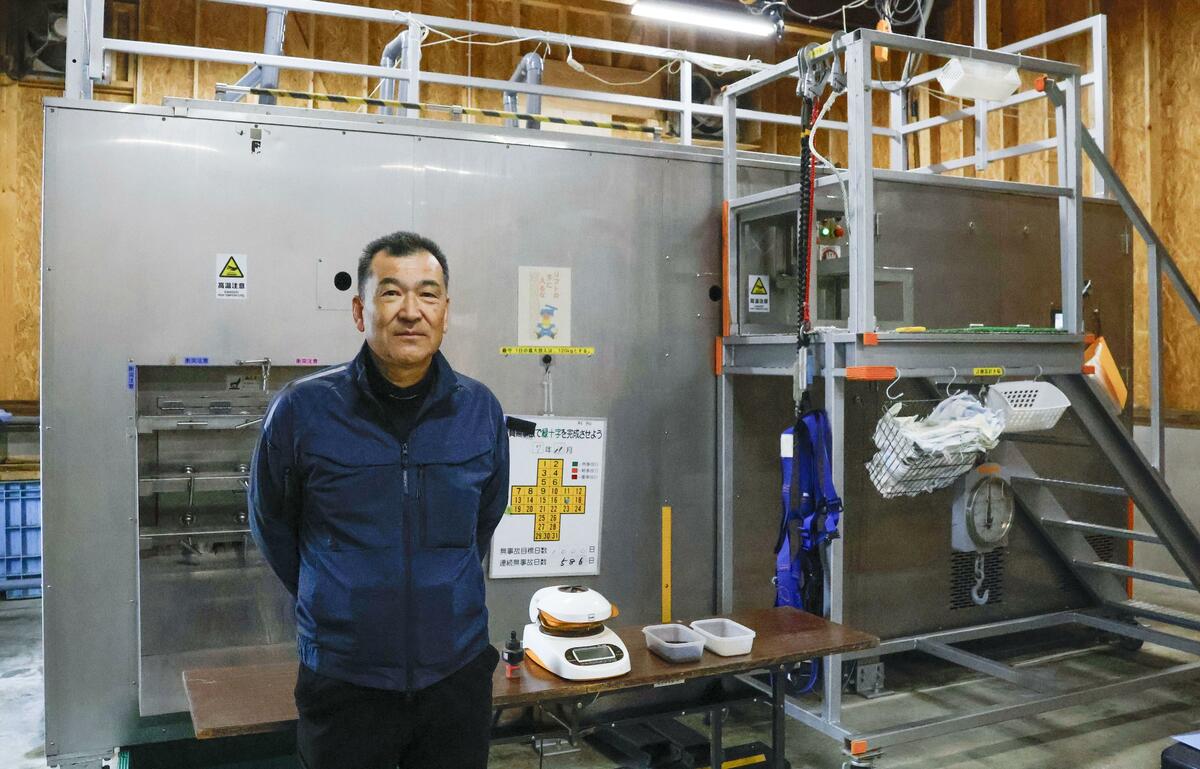
HAKODATE, Japan – A disposal unit that utilizes microorganisms to decompose animal carcasses is being used in a town in Hokkaido, northern Japan, to lighten the burden on hunters responding to a surge in bear attacks.
Brown bears in Hokkaido often weigh up to 200 kilograms and hunters had to resort to cutting carcasses into smaller chunks for disposal, as it is prohibited to leave killed animals where they are.
The town of Fukushima in Hokkaido installed the 100 million yen ($639,000) disposal unit on the premises of its waste facility in April 2024. The stainless steel unit, 5 meters wide and 2.4 meters high, can process a whole bear carcass using grinding blades and carbonized wood chips mixed with microorganisms and water.
Maintained at about 80 C, the process breaks down the organs and muscles in one day and the skin and bones in about a week, mainly into water and carbon dioxide. In the first eight months, a total of 88 bears killed in the area, including nearby towns, had been rendered.
Kazuya Ota, a 52-year-old hunter from the neighboring town of Matsumae, said that previously, in line with Hokkaido’s guidelines, he had used a small knife to cut up a bear carcass into 10-centimeter chunks, which were disposed of in 10 to 20 large garbage bags.
But with the surge of bear sightings in urban areas in recent years, there have been times when as many as three bears are killed in a day. This meant Ota had to work from early morning until late at night, dismembering the carcasses by himself and hauling about 30 bags to Fukushima’s waste disposal facility.
“In summer, I thought I was going to collapse from heat exhaustion,” Ota recalled.
Among others benefitting from the new unit, a 70-year-old hunter from the town said, “Disposal has become much easier, nothing could be more helpful.”
According to BOD Shokai Co., a trading firm based in Okayama Prefecture that sells the units, which were originally developed to dispose of the carcasses of invasive animals such as deer and wild boar, have been installed at 18 locations nationwide.
The unit installed in the Hokkaido town is an upgraded version featuring strengthened blades designed to handle bear bones, it said.
The carbonized chips can be reused as fertilizer, with a few exceptions depending on the type of animal processed.
The units have drawn interest from other local governments that are also grappling with bear attacks. Last month, a city council member from Akita visited the facility to observe its operations.
Masaki Takahara, BOD Shokai’s representative director, said, “This method, by emulating nature’s cycle and returning (the matter) to the soil without using fire, is good for the environment too.”
AloJapan.com