
When you play a game, there is often a lingering curiosity about what it would feel like to stand in the same setting as the characters you see on screen. Some game developers take this a step further, crafting worlds and characters so immersive that players feel as if they are part of the story themselves.
But what if you could actually step into the very landscapes you once only experienced through a screen?
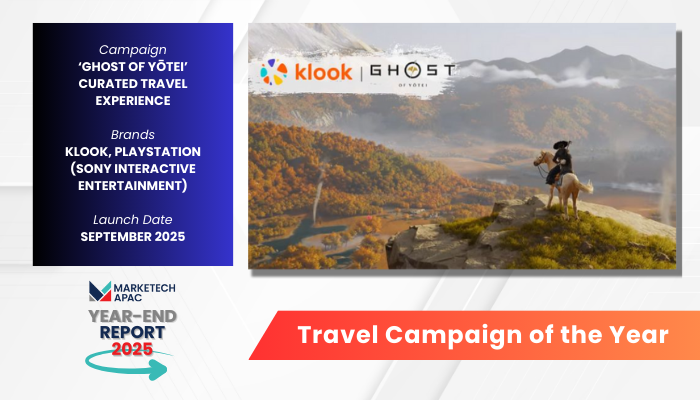
In 2025, Klook teamed up with PlayStation to invite explorers to experience the real-world landscapes that inspired the lore of Ghost of Yōtei. From Hokkaido’s misty valleys to its cultural heritage sites, the collaboration stood out for its immersive approach to travel storytelling — earning MARKETECH APAC’s Travel Campaign of the Year recognition.
MARKETECH APAC spoke with Marcus Yong, vice president of global marketing at Klook, and Jacqueline Chiu, senior director of Asia marketing at Sony Interactive Entertainment, to unpack the strategy, creative intent, and execution behind this bold partnership — and what it signals for the future of travel storytelling and gaming communities.
Gaming and travel fuse to spark real-world exploration
When examining what motivates people to travel, Klook has consistently looked beyond traditional triggers such as landmarks and seasonal deals. This time, the spark came from a cultural medium with deep emotional engagement — video games.
“Experiences are at the heart of what we do, so we pay close attention to how people are inspired to travel… video games are a natural extension of that,” said Marcus.
For Klook, gaming represents a frontier of cultural storytelling that can elevate travel inspiration beyond visuals and recommendations. Partnering with PlayStation on Ghost of Yōtei offered a way to connect narrative with place — turning the landscapes that inspired a fictional world into tangible cues for adventure in Hokkaido.
PlayStation’s view aligned closely with this ethos, particularly in terms of expanding appeal beyond its core gaming audience.
“The tour also helps us reach travellers who may not be traditional gamers, where they get to understand how real-life locations inspired our studio in making an open-world adventure game,” shared Jacqueline.
This dual aim — drawing in both gamers and general travellers — became a defining strength of the campaign.
Designing an experience for two audiences
Jacqueline shared that after the launch of PlayStation’s Ghost of Tsushima in 2020, there was strong interest in Tsushima Island from fans who wanted to visit the real-life locations that inspired the game. Building on this insight, the team anticipated that fans of Ghost of Yōtei would similarly want to explore the places that shaped its world.
At the same time, both Klook and PlayStation recognised that not all participants would be familiar with the game. Balancing the expectations of gaming fans with those of seasoned travellers required thoughtful curation, with Klook ensuring the itinerary could stand on its own beyond the game’s context.
“The destination always came first,” Marcus said. “Our goal was to create an experience that stands on its own as a compelling Hokkaido adventure for travellers, whether or not they’ve played Ghost of Yōtei.”
This philosophy shaped a tour that placed Hokkaido’s natural beauty, cultural nuances, and historical textures at the forefront, while still allowing game enthusiasts to step into scenes that inspired the game’s world.
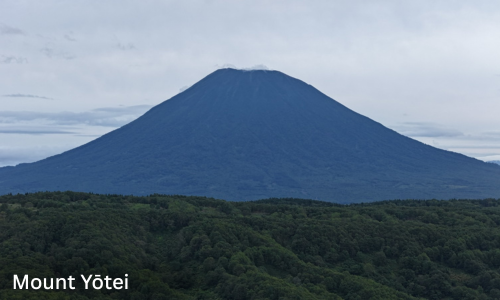
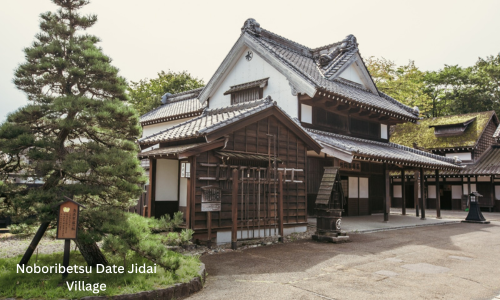
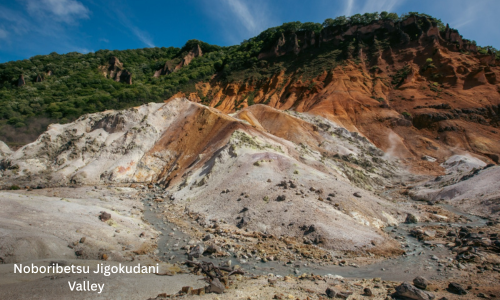
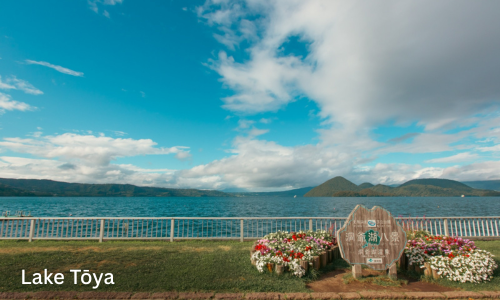
The itinerary includes witnessing the volcanic energy of Hell Valley, whose steaming vents and jagged cliffs echo the game’s misty fortresses. Travellers can also visit Lake Tōya, take in onsen culture, and reflect with Mount Yōtei in the distance. From Nakayama Pass and Lake Hill Farm, they experience sweeping views of Mount Yōtei—the mountain that gave the game its identity and anchors both the landscape and the story.
For Marcus, the goal was to create an experience that resonated with both audiences.
“It’s a true win-win, allowing us to extend the game’s universe while spotlighting what makes the destination authentic, while reinforcing our commitment to curating innovative experiences that go beyond the ordinary,” he added.
Creative problem-solving on the ground
As with any cross-industry collaboration, the campaign came with logistical and creative challenges — particularly in aligning fictional storytelling with real-world locations.
Marcus emphasised that a key consideration in designing the travel experience was showcasing the best of Hokkaido while also meeting the expectations of fans familiar with the Ghost of Yōtei world.
“We worked closely with Sony and local on-the-ground partners to ensure that the tour design was well-rounded, offering a glimpse into the game’s origins while spotlighting Hokkaido as a destination worth discovering more deeply,” he explained.
This emphasis on authenticity was shared by PlayStation, which worked closely with Klook and local groups throughout the process.
In a blog written by Nate Fox, co-creative director at Sucker Punch Productions, and published on PlayStation’s website, he detailed how the studio conducted two reference-gathering trips across different parts of Hokkaido to ensure the game’s world was grounded in real environments.
Fox described the experience as “fulfilling”, noting how the team spoke with locals and synthesised new ideas for the game.
“During development, the Sucker Punch team conducted in-depth visits to local sites in Hokkaido… we worked closely with Klook and local tourism groups to ensure the itinerary authentically reflects and respects the cultural background,” said Jacqueline.
This attention to detail helped ensure that the transition from game world to travel experience felt organic, respectful, and deeply rooted in place.
A hybrid storytelling approach
Rather than fitting neatly into a single category, the campaign blended elements of brand experience, product support, and cultural storytelling.
“We took a hybrid approach, anchored in bringing out the best of the travel and gaming worlds… showing the real-life world that inspired Ghost of Yōtei,” said Marcus.
He added, “It’s very much ingrained in our marketing and brand strategy, as we’re always focused on storytelling to drive travel inspiration and then bridging that into meaningful experiences.”
For PlayStation, the collaboration pushed gaming beyond the console and into lived experience.
“Strategic brand collaborations offer a new dimension to how consumers interact with and experience gaming… the tour allows players to better understand the natural landscape and cultural and historical inspirations behind the game,” said Jacqueline.
Together, this union of travel and gaming enabled both brands to reach new audiences with layered meaning — using narrative as a driver of inspiration rather than conventional promotion.
Looking ahead: culture, community, and travel inspiration
When asked whether “game-to-destination” collaborations like this were a one-off experiment, Marcus said Klook views them as part of a broader evolution in travel marketing—one shaped by cultural storytelling and fandom.
He noted that the partnership was about finding the right collaborator at the right moment, marking Klook’s first official partnership with Sony that connected online fandom with offline travel.
“With fandom, pop culture, and social media increasingly powering travel discovery, we’re open to creating new opportunities where culture and storytelling align,” he said. “It’s less about repeating a format but continuing to innovate in how travellers experience the destinations.”
Meanwhile, PlayStation sees such collaborations as part of a wider effort to connect communities and celebrate creativity.
“At Sony Interactive Entertainment, each new release from PlayStation Studios is an opportunity to celebrate creativity, connect cultures, and inspire global communities… we’re thrilled to have worked with Klook, while closely connecting the cultural and creative lens Ghost of Yōtei inspired,” Jacqueline said.
“For Sony Interactive Entertainment, the launch represented a coordinated Asian effort to highlight the intersection of entertainment and travel,” she concluded.
****
The Klook × PlayStation Ghost of Yōtei campaign demonstrates how immersive narrative can serve as more than a marketing angle — it can become the coordinate that guides real‑world exploration. By grounding digital imagination in cultural and geographical reality, the campaign redefined how travel inspiration can be shaped and shared in the age of experiential storytelling.
This recognition is based on Google Analytics results on the most-read stories of 2025, along with editorial validation on the significance of a leader’s contribution, campaign results, and overall impact.
AloJapan.com