

The Japanese Yen (JPY) scales higher against a broadly weaker US Dollar (USD) for the fourth straight day and touches a fresh weekly high during the Asian session on Wednesday. Minutes of the Bank of Japan’s (BoJ) October meeting showed that board members debated the need to continue raising interest rates. Apart from this, geopolitical uncertainties stemming from rising US-Venezuela tensions, the protracted Russia-Ukraine war, and the risk of a renewed Israel-Iran conflict contribute to safe-haven JPY’s outperformance.
Meanwhile, the BoJ’s hawkish outlook marks a significant divergence in comparison to bets for further policy easing by the US Federal Reserve (Fed). The latter drags the US Dollar (USD) to its lowest level since early October and also benefits the lower-yielding JPY. However, the upbeat market mood acts as a headwind for the JPY and assists the USD/JPY pair to find support ahead of mid-155.00s. The fundamental backdrop, however, favor of the JPY bulls and warrants caution before positioning for any meaningful USD/JPY recovery.
Japanese Yen retains bullish bias amid BoJ rate hike bets and flight to safetyMinutes of the Bank of Japan’s October meeting, released earlier this Wednesday, showed that board members agreed that the central bank will continue raising interest rates if economic price forecasts materialize. At the subsequent meeting in December, the central bank raised the policy rate to 0.75%, or a 30-year high, and left the door open to further tightening.Moreover, tensions linked to the United States’ actions against vessels carrying Venezuelan oil, along with Russia’s escalation of attacks on Ukraine and a potential new Israel-Iran war, underpin the safe-haven Japanese Yen for the third consecutive day. Apart from this, the prevalent US Dollar selling bias drags the USD/JPY pair to a fresh weekly low on Wednesday.The USD Index (DXY), which tracks the Greenback against a basket of currencies, has declined to a fresh low since early October amid rising bets for two more rate cuts by the Federal Reserve in 2026. Moreover, US President Donald Trump declared that the candidate for the role of the Fed Chair must commit to lowering rates even when the economy is performing well.This overshadows Tuesday’s upbeat US GDP growth figures, which showed that the economy expanded at a 4.3% annualized pace during the July–September period. The reading was stronger than consensus estimates and the 3.8% rise recorded in the previous quarter, though it does little to provide any respite to the USD bulls or help ease the prevalent selling bias.Separately, the US Census Bureau reported that Durable Goods Orders declined 2.2% in October, following the 0.7% increase recorded in the previous month and worse than the market expectation for a decrease of 1.5%. Furthermore, a sharp fall in consumer confidence in December suggested that households are becoming much more cautious about the future.Traders now look forward to Wednesday’s release of the US Initial Weekly Jobless Claims, which might influence the USD and provide some impetus to the USD/JPY pair later during the North American session. The focus, however, will remain glued to Friday’s release of the Tokyo CPI report, which could play a key role in driving the JPY demand in the near term.USD/JPY bearish technical setup backs the case for a further depreciation
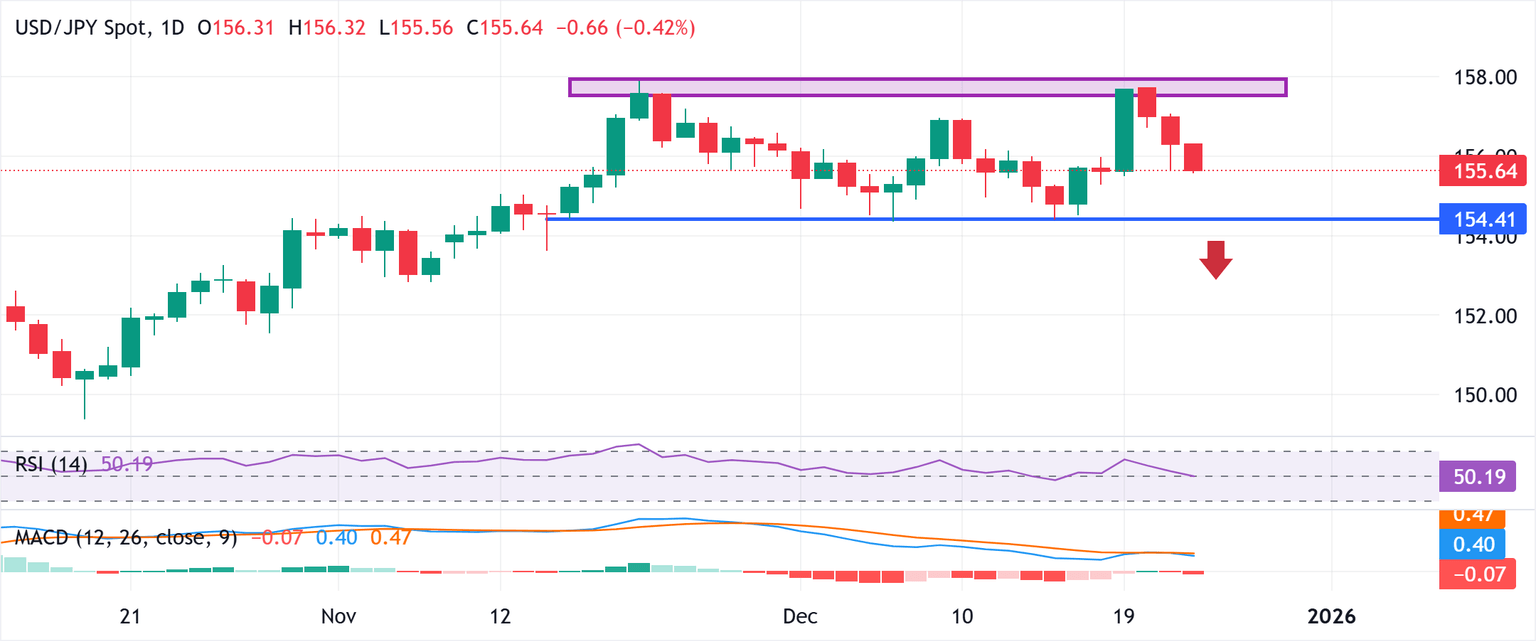
The USD/JPY pair has now reversed the post-BoJ strong move up back closer to the November swing high. Moreover, the weekly downtrend from the vicinity of the 158.00 mark constitutes the formation of a bearish double-top pattern and validates the negative outlook for spot prices.
Meanwhile, the Moving Average Convergence Divergence (MACD) line sits below the Signal line just under the zero mark, while a slightly deeper negative histogram hints at building bearish momentum. The RSI stands at 50 (neutral) after easing from recent highs, reinforcing a wait-and-see stance.
This, in turn, suggests that the USD/JPY pair’s downfall could stall near the 155.00 psychological mark. This is followed by the 154.55-154.50 horizontal zone, which should act as the neckline support of the bearish pattern. A convincing break below will be seen as a key trigger for bearish traders and pave the way for deeper losses.
(The technical analysis of this story was written with the help of an AI tool)
Bank of Japan FAQs
The Bank of Japan (BoJ) is the Japanese central bank, which sets monetary policy in the country. Its mandate is to issue banknotes and carry out currency and monetary control to ensure price stability, which means an inflation target of around 2%.
The Bank of Japan embarked in an ultra-loose monetary policy in 2013 in order to stimulate the economy and fuel inflation amid a low-inflationary environment. The bank’s policy is based on Quantitative and Qualitative Easing (QQE), or printing notes to buy assets such as government or corporate bonds to provide liquidity. In 2016, the bank doubled down on its strategy and further loosened policy by first introducing negative interest rates and then directly controlling the yield of its 10-year government bonds. In March 2024, the BoJ lifted interest rates, effectively retreating from the ultra-loose monetary policy stance.
The Bank’s massive stimulus caused the Yen to depreciate against its main currency peers. This process exacerbated in 2022 and 2023 due to an increasing policy divergence between the Bank of Japan and other main central banks, which opted to increase interest rates sharply to fight decades-high levels of inflation. The BoJ’s policy led to a widening differential with other currencies, dragging down the value of the Yen. This trend partly reversed in 2024, when the BoJ decided to abandon its ultra-loose policy stance.
A weaker Yen and the spike in global energy prices led to an increase in Japanese inflation, which exceeded the BoJ’s 2% target. The prospect of rising salaries in the country – a key element fuelling inflation – also contributed to the move.
AloJapan.com