
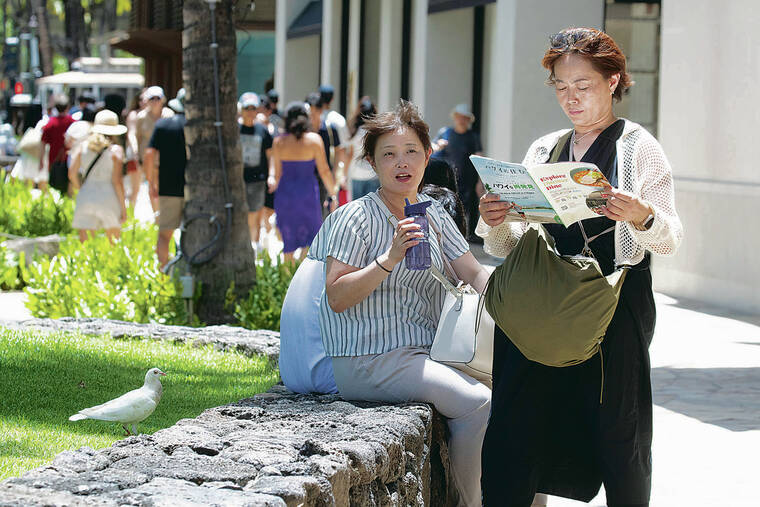
Hawaii tourism officials are raising alarms that a new federal proposal requiring millions of foreign visitors to disclose their social media handles could further depress international arrivals — and potentially undermine the benefits of a major national marketing reboot aimed at restoring global travel to the United States.
U.S. Customs and Border Protection published a notice Dec. 10 proposing new vetting rules for travelers from 42 visa waiver countries, including Japan, South Korea, Australia and most of Europe. If it moves forward as proposed, applicants for the Electronic System for Travel Authorization (ESTA) starting on Feb. 8 would have to list all social media accounts used in the past five years.
The changes, part of broader vetting measures under the Trump administration, also would require travelers to disclose email addresses used over the past decade and detailed family information. Public comment is open for 60 days.
The U.S. Travel Association warned the requirement could have a “chilling effect” on inbound travel. Travelers from a Visa Waiver Program (VWP) country who are traveling to the U.S. for business or pleasure trips under 90 days must get an approved ESTA before they travel, as airlines will deny boarding without it. An approved ESTA is generally valid for two years or until the traveler’s passport expires.
In Hawaii, where international markets remain slow to recover from the pandemic, the stakes are especially high. From January through October, 77% of arrivals came from domestic markets, while international visitors accounted for just 21.6% — contributing $3.8 billion compared to nearly $14 billion from U.S. travelers. Japan, once Hawaii’s top overseas market, sent just 601,777 visitors, still far below pre-pandemic levels. Canada and other international markets showed similar stagnation. While international visitors often spend more per trip, their diminished volume means they now contribute less than a quarter of total tourism dollars.
Industry leaders say the new rule risks compounding those challenges. “The fact that we don’t even know what the specific rules are makes it a concern,” said Keith Vieira, principal of KV &Associates, Hospitality Consulting. “It’s the narrative that always hurts us — the appearance of being unwelcoming.”
Vieira added that Hawaii’s hotel sector is already struggling with soft demand and discounted room rates during peak booking periods. “At this point we need visitors to create a base of business so that mom and pops can survive,” he said.
Jerry Gibson, president of the Hawai‘i Hotel Alliance, echoed those concerns, calling the proposal “definitely negative for tourism.”
“I’m all for safety and security, but I’m not for invasion of privacy,” Gibson said. “I don’t think from a tourism perspective that it will be acceptable for people.”
Gibson said the industry is monitoring the situation closely and expects national attention.
“If they are going to screen everyone like they are saying, that would almost be virtually impossible with the volume,” he said. “We’ll have to work as a group from Hawaii and with other major destinations around the U.S. that I’m sure are just as concerned as we are.”
Eric Takahata, managing director of Hawai‘i Tourism Japan, said the industry’s initial reaction has been muted but warned of serious consequences if the changes are enacted.
“It will definitely affect inbound numbers to Hawaii from Japan and from all international markets,” he said, noting the changes would undermine gains made in streamlining travel through programs like Global Entry and Mobile Passport.
He said a more onerous screening process also could result in higher prices to obtain an ESTA, which could dampen demand.
Takahata also cautioned that requiring celebrities and influencers to disclose years of social media history could deter them from visiting Hawaii, a key strategy in marketing promotion abroad.
“If you ask an American actor like Jason Momoa to hand over five years of social media history just to film in Hawai‘i, he’d probably say, ‘I’ll have to film somewhere else,’” Takahata said.
Proposal pushback
In a sharply worded statement, the U.S. Travel Association said it is “deeply concerned” by the proposal and questioned whether the policy would meaningfully improve national security.
The organization said travelers and security experts alike lack clarity about what information would be required and how it would be used. “One thing that isn’t in question: this policy could have a chilling effect on travel to the United States,” the group said.
Visa Waiver Program travelers, the association noted, “come here to do deals with American businesses, buy American products and experience the beauty of our great nation.” If the policy is implemented poorly, “millions of travelers could take their business and the billions of dollars they spend elsewhere, only making America weaker.”
The group also emphasized that the administration has taken several positive steps in its first 11 months — including modernizing TSA policies, adding CBP officers, reducing visa wait times and coordinating federal preparations for the 2026 FIFA World Cup — and said it hopes to continue working with the administration to “restore the United States as the world’s most visited destination.”
The social media requirement is part of a broader tightening of vetting measures under the Trump administration. Applicants for immigrant and nonimmigrant visas have been required to share social media information since 2019.
A January executive order noted that the U.S. must be “vigilant during the visa-issuance process to ensure that those aliens approved for admission into the United States do not intend to harm Americans or our national interests. More importantly, the United States must identify them before their admission or entry into the United States.”
The U.S. Department of State separately announced that, effective Dec. 15, all H 1B applicants and their dependents must set their social media profiles to “public” so officials can review posts.
The department said in a statement to mark the announcement, “The United States must be vigilant during the visa issuance process to ensure that those applying for admission into the United States do not intend to harm Americans and our national interests, and that all applicants credibly establish their eligibility for the visa sought, including that they intend to engage in activities consistent with the terms for their admission.”
Brand USA
This latest proposal comes as Congress moves to restore funding to Brand USA, the nation’s destination marketing agency, through the bipartisan VISIT USA Act. Tourism leaders say the timing is especially troubling, with the U.S. preparing to host global events including the 2026 FIFA World Cup, America 250, and the 2028 Summer Olympics.
Brand USA is funded without U.S. taxpayer dollars and is widely credited with driving millions of international visits annually before the pandemic. The VISIT USA Act aims to ensure the agency has the resources to promote the United States abroad and help attract an estimated 40 million visitors and more than $100 billion in economic impact tied to upcoming global events.
Geoff Freeman, president and CEO of the U.S. Travel Association, said in a statement, “We have a once-in-a-generation opportunity to welcome the world — through the World Cup, America 250 and the Olympics — but that success depends on Brand USA having the resources to do its job. Congress must act now to restore funding, attract international visitors and showcase the very best of America.”
Hawaii’s visitor industry, already struggling with soft demand and discounted hotel rates, fears the added barriers could blunt international recovery.
Takahata said that even if the new policies are eventually scaled back or withdrawn — as some of the Trump administration’s tariffs were — perception alone can shape reality. He noted that educational tourism from Japan already has declined as parents grow uneasy over stricter U.S. border enforcement, reports of deportations, including among green card holders, and widely publicized ICE raids.
“The chance is very low, but a Japanese parent thinks, ‘I’m a foreign person, and my kid’s school group could get investigated or raided,’” he said.
Reuters contributed to this story.
AloJapan.com