
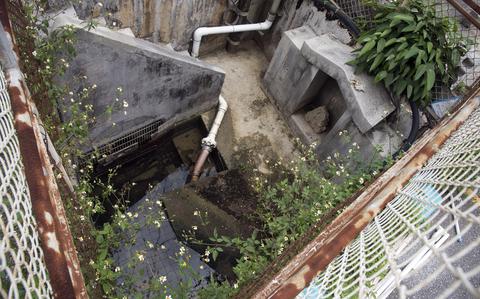

High PFAS contamination levels have been recorded at Ubugaa spring in Ginowan city, downstream from Marine Corps Air Station Futenma, Okinawa. (Keishi Koja/Stars and Stripes)
CAMP FOSTER, Okinawa — U.S. Forces Japan has denied Okinawa prefecture’s requests to test for so-called “forever chemicals” at three U.S. military bases, citing insufficient evidence that the facilities are sources of contamination.
USFJ denied access to Kadena Air Base, Marine Corps Air Station Futenma and Marine Corps Camp Hansen to collect water and soil samples for testing, according to a news release Friday from Japan’s Ministry of Defense. A request to USFJ to conduct an environmental survey of Futenma also was denied.
“PFAS in the environment is a shared concern associated not only with military operations but also civilian industrial activities throughout Japan including fire response, sewage treatment plants, solid waste landfills, and chemical plants regardless of nationality,” USFJ spokeswoman Marine Corps Staff Sgt. Savannah Mesimer said by email Monday.
The prefecture has sought base access four times since 2016, when elevated levels of PFAS — per- and polyfluoroalkyl substances — were first reported near the three bases, according to the release.
The prefecture’s Environmental Protection Division has made island-wide PFAS surveys since 2024 and biannual surveys since 2017.
Results from the most recent survey in May found levels of PFAS in water higher than Japan’s national standard of 50 parts per trillion at 22 spots near the two airfields and two sites near Hansen.
The division concluded that contamination near Kadena and Futenma is “highly likely to be sourced from both bases.”
USFJ may reconsider if the prefecture provides more evidence that U.S. military installations are contamination sources, according to the ministry.
That “represents a certain degree of progress,” because of ongoing coordination with the U.S., Defense Minister Shinjiro Koizumi said Friday at a news conference in Tokyo.
“We will continue to adhere to all relevant agreements, obligations, and procedures as good stewards of our installations and the environment through continued and close coordination with our Government of Japan counterparts as we work together towards sustainable solutions,” Mesimer said Monday.
PFAS components PFOS and PFOA were commonly used in aqueous film-forming foam, a fire suppressant used by both U.S. and Japanese forces. USFJ last year said it had incinerated its remaining stockpiles of the foam.
The prefecture asked to collect four water samples and one soil sample from Futenma, seven water samples and three soil samples from Kadena, and four water samples and four soil samples from Hansen.
Japan and the U.S. have no environmental standards for PFAS in soil, USFJ said in the ministry’s release.
A 2016 Marine Corps water quality survey found PFOS and PFOA at 7 parts per trillion at the inlet of Futenma’s drainage channel and 6 parts per trillion at the outlet, indicating no contamination, according to USFJ in the ministry release. It cited the same survey in its refusal to conduct an environmental survey.
The prefecture stopped using the Hija and Dakujaku rivers that flow through Kadena as drinking water sources and can collect water from the airfield’s drainage outlets without a permit, according to USFJ.
The command said the prefecture installed a water pipeline to supply neighboring Kin town, negating the need for sample collection on Hansen.
The prefecture has resumed water intake from the Hija river “when necessary to ensure sufficient water supply,” Okinawa Gov. Denny Tamaki said in a statement Friday from the Environmental Protection Division.
“We intend to present the scientific evidence we have accumulated to the U.S. military, seek their understanding for conducting on-site inspections at U.S. military bases, and make the inspections a reality,” he said.
AloJapan.com