
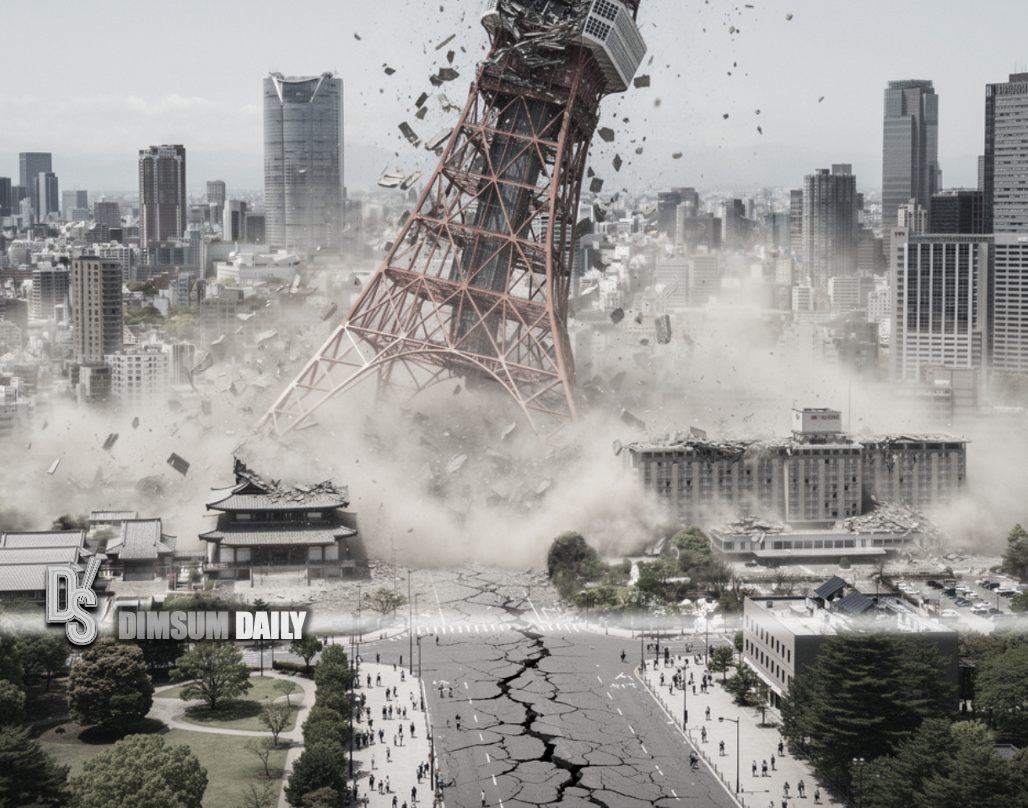
 AI-generated image for illustration purpose only.
20th December 2025 – (Tokyo) The Japanese government on Friday, 19th December, issued updated projections indicating that a magnitude 7.3 earthquake centred on the capital could, in a worst‑case scenario, result in around 18,000 deaths, the complete destruction of some 400,000 buildings and economic losses of approximately ¥83 trillion (about HK$4.1 trillion).
Citing the Japan Times and Kyodo, officials said there is a 70% probability of a major quake striking the Tokyo area within the next 30 years. A magnitude 7 event in southern Tokyo would be felt widely across neighbouring prefectures, with large‑scale casualties anticipated particularly in Tokyo, Saitama, Chiba and Kanagawa.
The government’s assessment, the first of its kind in 12 years, also warns that such a disaster would severely disrupt Japan’s core political, governmental and commercial functions. Compared with the 2013 projection, the latest forecast points to reduced fatalities, physical damage and financial losses, reflecting improved preparedness in the capital.
Given that most ministry buildings are concentrated in central Tokyo, government operations are expected to face temporary constraints, though the report judges the risk of collapse to be low due to interim seismic reinforcement measures already in place.
Fires are projected to account for the majority of deaths, about 12,000, with roughly 5,300 fatalities attributed to building collapse. The scenario modelled assumes a winter afternoon with strong winds of around 28.8 kilometres per hour, leading to the total loss of approximately 400,000 structures—about 110,000 from shaking and 270,000 from ensuing fires.
Around 8.4 million people are expected to be stranded by suspended public transport, with as many as 880,000 tourists and business travellers in the mix. Two weeks after the quake, shelters could be accommodating up to 4.8 million evacuees, including those who initially sheltered at home but later ran out of food and supplies. The government is seeking to raise public awareness to bolster preparedness.
Advances such as the installation of seismic circuit breakers—which automatically cut power when tremors are detected—and lifestyle changes that have reduced the use of open flames in homes and workplaces are expected to cut building destruction by roughly 30% compared with 2013 estimates. These factors have also lowered the projected death toll by more than 20%.
A 2015 basic emergency plan had aimed to halve anticipated losses relative to 2013 levels by fiscal 2024, a goal that has not been met. The new estimates were compiled by a special committee established in 2023 to update the risk assessment after more than a decade.
AloJapan.com