
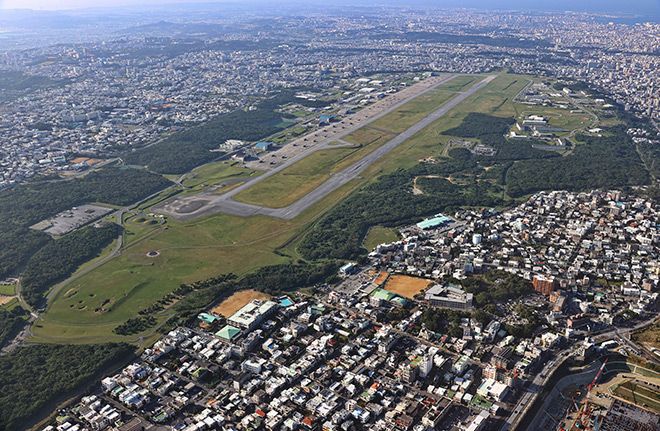
The United States for the first time explained its refusal to let Okinawa authorities investigate cancer-causing compounds believed to be leaking from U.S. military bases, blaming the prefecture for failing to provide “sufficient” information.
High concentrations of perfluoroalkyl and polyfluoroalkyl substances (PFAS) have been found in the vicinity of U.S. military bases in Okinawa.
The prefectural government has asked the U.S military for permission four times to investigate the matter: in 2016 and 2020 concerning PFAS around the Kadena Air Base, in 2019 regarding the Marine Corps Air Station Futenma, and in 2021 for Camp Hansen.
But the United States had simply rejected such requests without explaining why.
However, the Defense Ministry on Dec. 19 informed the prefectural government that Washington had given a response that explained why an investigation within the military bases was not approved in the past.
According to the ministry, the four requests from Okinawa were based on the 1972 agreement by the Japan-U.S. Joint Committee, which outlines procedures for an investigation when pollution is believed to originate from a U.S. military base.
In the latest response, the United States listed conditions needed for it to approve an investigation within a base.
One is the existence of environmental standards that both Japan and the United States can use to properly evaluate the results of a study of samples. Another condition is sample study data that clearly shows the U.S. base or the area where it was located is the pollutant source.
The U.S. response said approval could not be given in the past because Okinawa had not provided such information.
The prefectural government now plans to submit another request, including the scientific basis for the need to determine exactly what is causing the PFAS.
The U.S. document also said there is no need to take water samples from Kadena and Camp Hansen for an investigation because the Okinawa prefectural government had decided to stop using water sources near those two facilities as drinking water.
But the United States said it might allow the prefecture to take water samples from a drainage ditch at the Futenma base if Okinawa presents data proving that areas outside the base were not the source of the PFAS.
The Okinawa prefectural government in 2016 released the results of its study that found high concentrations of PFAS in rivers and water treatment plants near U.S. military bases.
Regarding Futenma, the prefectural government found that groundwater upstream from the base had lower concentrations of PFAS than groundwater downstream.
The prefecture’s panel of experts concluded that the Futenma base was the cause of the pollution.
Noting that fire extinguishing foam containing PFAS has been used at U.S. military bases, the prefectural government said there was a high probability that the bases were the sources of the pollution.
“The Okinawa public has major concerns about the safety of their drinking water,” Okinawa Governor Denny Tamaki said in a statement after the U.S. explanation. “We will present the scientific basis that we have accumulated until now to the U.S. military and carry out an investigation within the bases.”
AloJapan.com