
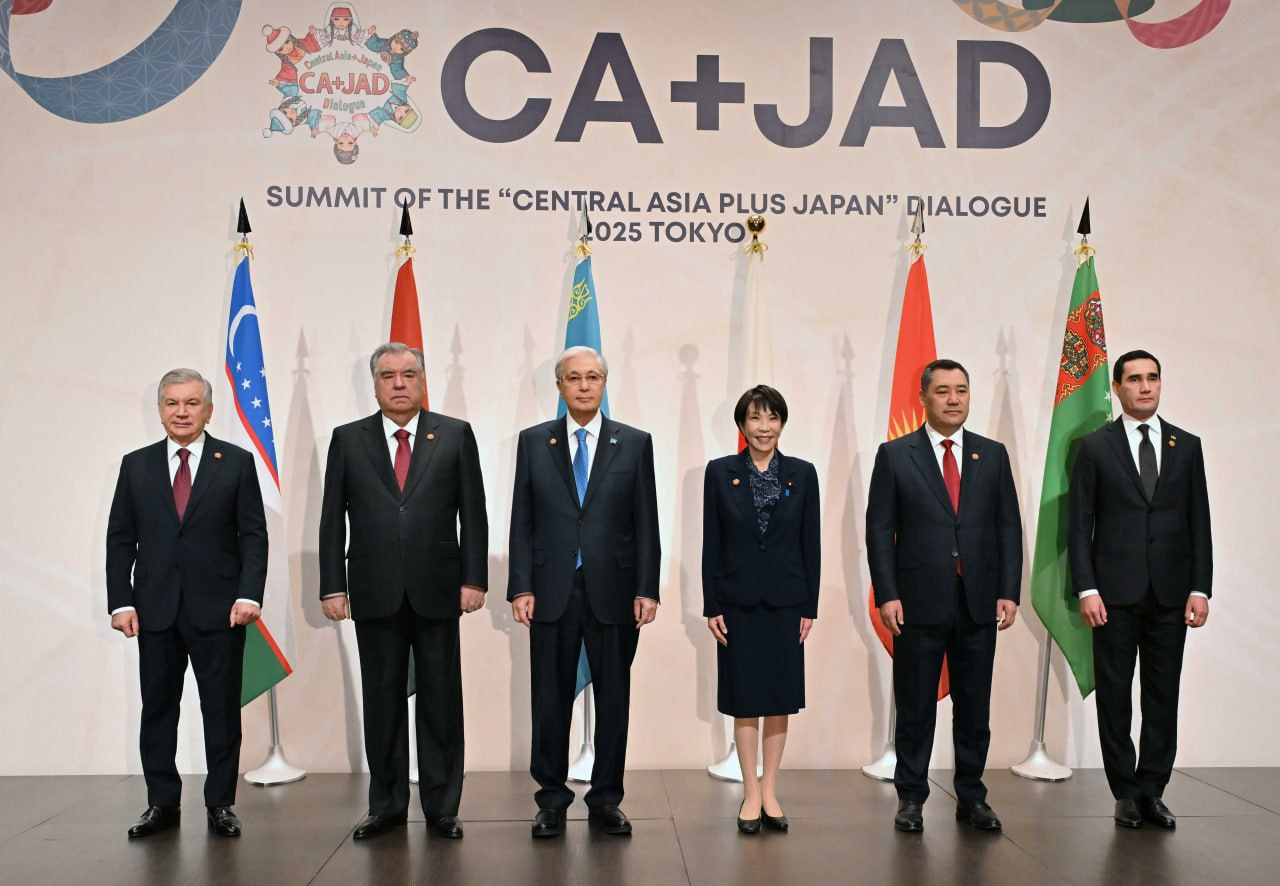
ALMATY – President Kassym-Jomart Tokayev outlined Kazakhstan’s strategic vision for expanding political, economic, and technological cooperation during the first Central Asia–Japan Summit in Tokyo on Dec. 20, where leaders adopted the Tokyo Declaration and agreed to elevate the format to a new level.
From L to R: Uzbek President Shavkat Mirziyoyev, Tajik President Emomali Rahmon, Kazakh President Kassym-Jomart Tokayev, Japanese Prime Minister Sanae Takaichi, President of the Kyrgyz Republic Sadyr Japarov and Turkmen President Serdar Berdimuhamedov at the first Central Asia–Japan Summit in Tokyo on Dec. 20. Photo credit: Akorda
Speaking alongside Prime Minister Sanae Takaichi and leaders of Central Asian states, Tokayev underscored that the new format strengthens the international agency of Central Asia and builds on two decades of cooperation, reported the Akorda press service.
Economic cooperation
Tokayev stressed that Japan’s longstanding role as a responsible and consistent partner makes it one of Kazakhstan’s key allies in Asia. He emphasized that trade and investment must remain the foundation of cooperation.
“Last year, mutual trade reached around $2 billion. Japan’s investment in Kazakhstan has already exceeded $8.5 billion,” Tokayev said, adding that the visit resulted in the signing of more than 60 bilateral documents worth over $3.7 billion, including major commercial agreements.
Kazakhstan, he said, is ready to ensure a favorable investment climate for Japanese companies across energy, manufacturing, transport, critical minerals, agriculture, and digital technology.
Transport and connectivity: Opportunities along the Trans-Caspian route
Tokayev highlighted Japan’s growing interest in regional logistics, particularly in light of Central Asia’s role as a bridge between East and West.
“We welcome the decision of the government of Japan to participate in improving customs procedures at the port of Aktau on the Caspian Sea. Japanese companies could play a greater role in developing rail, port, road, and logistics infrastructure along the Trans-Caspian International Transport Route,” he said.
Through Kazakhstan alone, he added, more than 80% of Europe–Asia land cargo already passes.
Energy, nuclear cooperation, and critical minerals
Tokayev outlined opportunities for deeper collaboration in energy, from traditional resources to new technologies, stressing that hydrocarbons will continue to play a vital role in the global economy during the transition period.
“Kazakhstan is interested in attracting Japanese competencies and innovations to projects on extraction and processing of traditional energy resources using green technologies,” he said.
He also pointed to Kazakhstan’s leading position in global uranium supply, emphasizing that the region holds significant reserves essential for the global energy transition, and Kazakhstan welcomes Japan’s participation in deeper processing.
“The combination of Kazakhstan’s resource potential and Japan’s advanced technologies in nuclear energy opens favorable opportunities for successful cooperation,” Tokayev said.
In this context, he praised the launch of the Next-Generation SmartMining Plus project aimed at digitalizing and improving sustainability in the mining sector.
Agriculture, water security, and sustainable development
Turning to agriculture, Tokayev emphasized the importance of introducing Japanese resource-saving technologies, drought-resistant crops, and smart farming practices. He proposed creating a Central Asia–Japan Research Platform on Sustainable Agriculture and holding the first expert meeting in Astana.
Addressing regional water challenges, Tokayev noted that water availability per capita in Central Asia has fallen nearly 30% over the past 20 years, while the Caspian Sea’s decline and the legacy of the Aral Sea disaster pose additional risks.
“The continued shallowing of the Caspian Sea is a cause for serious concern, while the environmental catastrophe of the Aral Sea stands as a tragic reminder of the consequences of mismanaging water resources,” he said.
AI and digital partnership: Kazakhstan supports Japan’s Tokyo Initiative
Tokayev highlighted digital transformation as a new frontier for cooperation as Kazakhstan has embarked on the path to becoming a digital state. According to him, two supercomputers were launched this year, and next year the Digital Qazaqstan strategy will begin.
“I want to emphasize separately the exceptional importance of cooperation in digital transformation and the development of artificial intelligence. Japanese innovations are widely known for their quality, reliability, and high level of technological advancement,” Tokayev said.
He welcomed Japan’s Tokyo Initiative on artificial intelligence and proposed placing the new CA–Japan AI cooperation platform at Astana Hub and the Alem.ai International AI Center.
Education, tourism, sports, and cultural ties
Tokayev emphasized that human capital remains “the main engine of development” and invited Japan to open university branches and educational centers in Kazakhstan.
He also encouraged expanding tourism flows and called for a unified Central Asian tourist route for Japanese travelers, along with easier visa procedures.
President Tokayev highlighted growing cultural ties, noting his recent meeting with the Japanese sumo wrestler of Kazakh origin Yersin Baltagul, and announcing that Kazakhstan will host the 2027 World Judo Championships.
The summit concluded with Kazakhstan assuming the chairmanship of the C5+Japan dialogue and announcing plans to host the next leaders’ meeting, underscoring Astana’s growing role in shaping regional cooperation.
AloJapan.com