
Image courtesy of U.S. Wheat Associates.
Wheat farmers in the United States and consumers in Japan share a
special relationship built on trust and mutual respect cultivated over
the past 70 years. As a result, Japan is one of the largest and loyal
markets for U.S. wheat, importing roughly half of its wheat needs from
the United States. Maintaining this market means keeping Japanese
government officials and millers informed about wheat availability and
quality, and having ongoing, curious conversations about concerns,
including the unintended presence of soybeans in wheat shipments to
Japan.
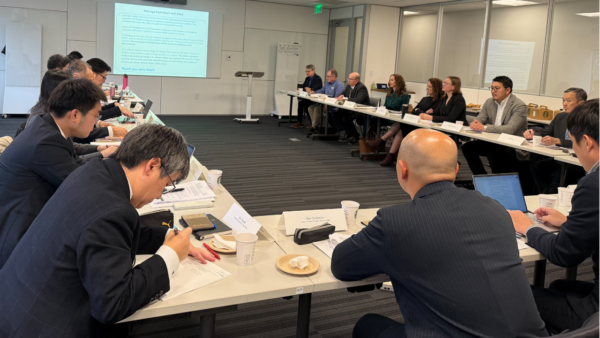
In mid-December, a high-level Japanese delegation from the Ministry
of Agriculture, Forestry, and Fisheries (MAFF), along with
representatives from the Japanese Flour Millers Association (JFMA),
traveled to the West Coast to discuss strengthening the supply chain and
continuing to deliver stable, high-quality wheat shipments.
Japanese government officials have expressed concerns about soybean
admixture in wheat shipments, referring to the unintentional presence of
small amounts of soybeans or soybean pieces in bulk shipments of wheat.
This foreign material (FM) is monitored according to strict quality
control standards, as regulated by USDA’s Federal Grain Inspection
Service (FGIS), and is an inadvertent result of farm equipment, storage
facilities or transportation units (such as trucks, railcars or shipping
holds) handling both bulk commodities.
Maintaining High Quality in Wheat Shipments
It is important to note that all U.S. wheat shipments to Japan meet
strict contract specifications, including testing by both FGIS and OMIC,
a Portland-based Japanese independent lab and grain inspection service.
While admixture can lower milling efficiency, soybean admixture is of
particular concern to the Japanese market, as soybeans are among the top
potential allergens that can cause severe reactions in Japanese
consumers, similar to peanut reactions.
“U.S. exporters and producers have long implemented initiatives to
reduce foreign grain admixture, and the overall admixture rate has
declined as a result,” said Steve Wirsching, vice president and director
of the USW West Coast Office in Portland, Oregon. “However, sporadic
admixture, particularly with soybeans, still occurs, and Japanese
milling companies continue to request improvements to minimize and
prevent admixtures as much as possible.”
The delegation met with staff from the wheat commission and producers
from Washington, Oregon, Idaho, Montana and North Dakota as well as
representatives from grain merchandising companies. Together, the group
explored strategies to reduce the presence of soybeans in wheat
shipments, including providing information to producers and country
elevators that handle both commodities.
“The longstanding relationship between the United States and Japan
depends on smooth wheat trade, cooperation, transparency and trust,”
said Brittany Hurst Marchant, executive director of the Idaho Wheat
Commission. “The Japanese delegation came prepared with charts and
graphs that provide a visual representation of soybean admixture in U.S.
wheat classes. The good faith the members of the delegation showed by
coming to us directly to find a solution, rather than shifting purchases
to competitor origins, demonstrated respect, loyalty, trust and a
genuine desire to keep trade and relationships strong between MAFF, JFMA
and U.S. wheat producers.”
Following the meeting, the delegation toured an export elevator
loading a combination cargo of wheat and corn bound for Japan, gaining
firsthand insight into how grain is handled and loaded to meet contract
specifications. The conversations will continue now that the team has
returned home, with both sides benefiting from in-person discussions and
firsthand site visits to grain-handling facilities.
“The Japanese delegation saw firsthand the resilience of the U.S.
grain supply chain and commitment to Japan’s high standards,” Wirsching
said. “In turn, our wheat producers were reminded of the importance of
engaging with customers to address concerns and their value in
consistently delivering high-quality wheat.”
Read more from U.S. Wheat Associates here.
AloJapan.com