

The World Athletics Championships Tokyo 25 earned platinum level recognition against the Athletics for a Better World (ABW) Standard, the tiered evaluation system implemented by World Athletics that measures an event’s achievements in sustainable delivery.
The recognition came after a comprehensive evaluation by a team of international sustainability experts of the local organising committee’s efforts to reduce the event’s environmental impacts and maximise their social and local economic benefits.
The WCH Tokyo 25 was only the third event to achieve the top level of the evaluation system since it was implemented in 2024, and the first edition of a World Athletics Championships to do so.
“From the outset, the local organising committee made reducing the environmental impact of these championships and maximising their social impact a top priority,” World Athletics President Sebastian Coe said. “They did so by having a strong vision and clear objective to create a sustainability template that all sporting events, not just athletics, can follow. The Tokyo team has set a high bar for future World Championships.”
The local organising committee of the WCH Tokyo 25 were the first outdoor World Athletics Championships host to fully adopt the ABW Standard and its 55 action areas. The WCH Tokyo 25 sustainability plan, created in alignment with the standard, charted a path towards platinum level certification, and with it, the creation of what organisers have dubbed ‘The Tokyo Model’, a new global benchmark for delivering an environmentally and socially responsible international sports event.
”We are deeply proud that the sustainability initiatives of the World Athletics Championships Tokyo 2025 have been highly recognised by World Athletics, achieving the highest platinum level under the Athletics for a Better World Standard,” said Mitsugi Ogata, President of the WCH Tokyo 25 local organising committee. “This achievement is the result of close collaboration among the Tokyo Metropolitan Government, the Japan Association of Athletics Federations, sponsors, and all those who contributed to delivering a sustainable event.”
A focus on renewable energy sources and biofuels
Biofuels powered 100% of the temporary generators used to provide power for broadcasters, a first for a World Athletics Championships. Additionally, all electricity purchased for the championships was either supplied from renewable energy sources or guaranteed through certified energy certificates.
All cars, compact shuttles and motorcycles from the official vehicle fleet provided by World Athletics Partner Honda were either electric, hybrid or fuel cell (green-powered hydrogen) powered, another first for a World Athletics Championships. Biofuels also powered the temporary power generators at the training venues and some of the transportation fleet used to transport athletes. That too was a first.
Almost all of the spectators used public transportation to reach the National Stadium, further reducing the event’s carbon footprint.
Innovation on show, sharing sustainability stories
Organisers used the event to showcase locally-developed sustainable innovation, initiatives that also contributed to the championships’ sustainability legacy.
The hub of that activity was the LOC tent in the Stadium park, which featured displays explaining and sharing the event’s sustainability programme. Nearly 20,000 spectators visited the tent over the course of the championships.
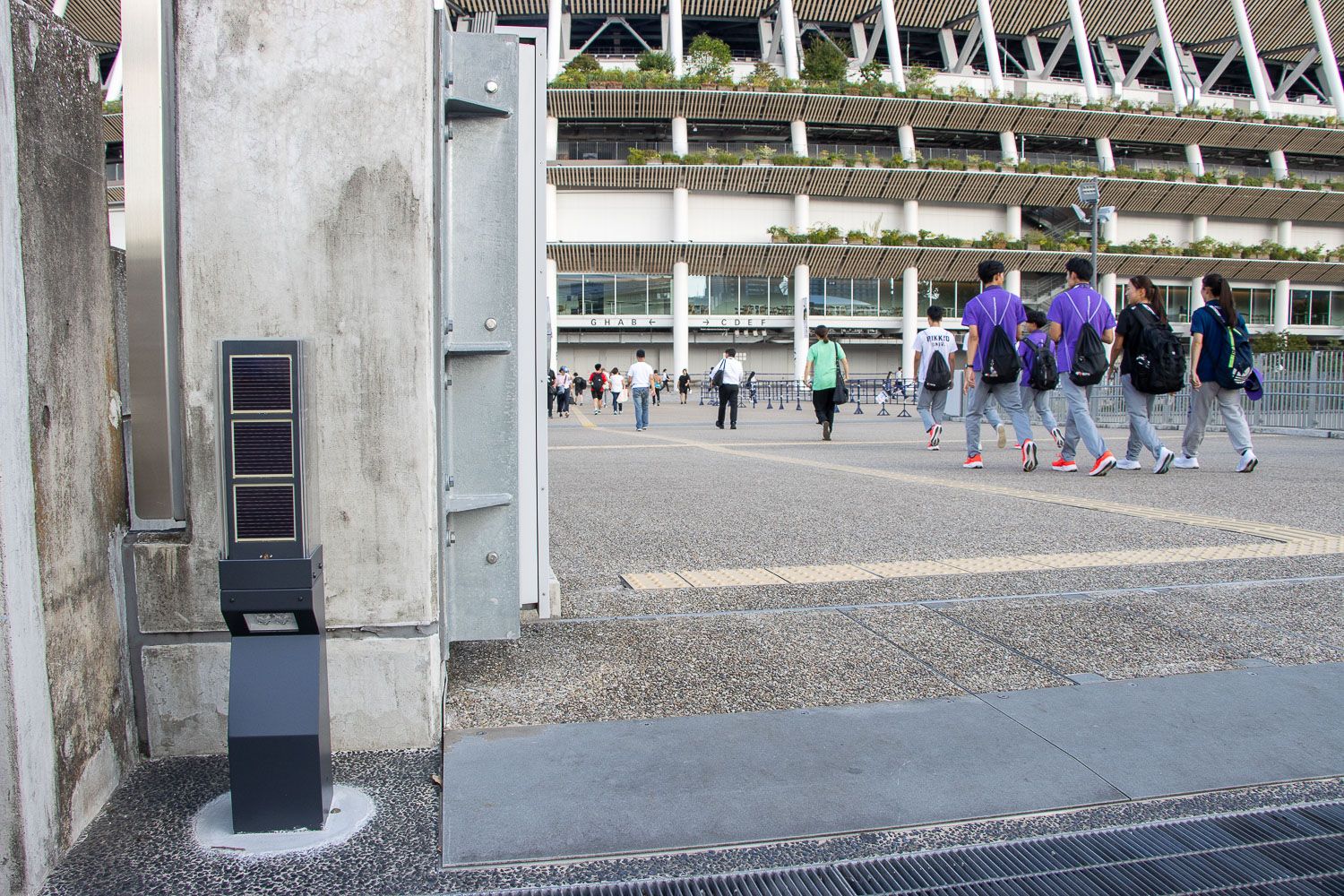
Solar cells at the National Stadium
The area was used to demonstrate practical applications of Next-Generation Solar Cells, a solar power technology developed in Japan. The cells are 20 times thinner than regular solar panels and can be plastered over stadiums, airports and office buildings, enabling mass adoption to solar power across large parts of the country. Lights, powered by the cells, were installed along the spectator route from the train station to the stadium and remained in place after the championships.
Another popular draw were the sustainability quizzes and giveaways hosted by athletes and athletics legends. More than 1000 spectators attended those seven activations.
Organisers communicated their sustainability initiatives widely through campaigns targeting specific themes and through a looped video shown on dozens of screens throughout the stadium.
Sustainable aviation fuel awareness and supply chain campaign
In alignment with its ‘Zero Emissions Tokyo by 2050’ targets, the Tokyo Metropolitan Government launched a used cooking oil collection project in 2023 that encourages businesses and communities to help build a supply chain for domestically produced Sustainable Aviation Fuel (SAF), a type of biofuel usually made from food and feed crops, waste oils and fats. When more widely implemented, use of SAF can ultimately reduce the carbon emissions of aviation fuel by up to 80% over its lifecycle.
The mascot RikuOne and Haruka Kitaguchi, the 2023 world javelin champion, helped promote the campaign.
Local sourcing and waste reduction
A dedicated sustainable procurement policy was developed, with World Athletics guidance, to inform all sourcing decisions, prioritising environmentally responsible products when available. Some highlights:
• 450,000 single-used plastic bottles, more than 10 tonnes, were recycled through a circular ‘Bottle to Bottle’ recycling system, developed in cooperation with event sponsor Otsuka Pharmaceuticals
• 81% of the products used at the event were sourced within 100km
• All catered meals at VIP areas and in the team hotels featured vegan and vegetarian options, focusing on locally and regionally-sourced food
• Food loss was reduced through the rigorous assessment and optimisation of the number of meals provided, as well as through measures such as the composting of discarded food materials
The policy also included reuse and repurposing initiatives that engaged with various community and regional groups.
Other initiatives included a plogging event organised by event sponsor Morinaga, several Kids Athletics activations in the build-up to the event, training and announcements related to sustainability for the LOC staff and volunteers and cultural sensitivity training for the event’s 3000 volunteers, and athletics participation programmes that reached thousands of local elementary school students.
A comprehensive sustainability report, providing insight and analysis of the LOC’s sustainability impact, will be published soon.
Ogata added: “The strong message of integrating sports and sustainability conveyed during this championship will remain a significant legacy of the event. Initiatives such as SAF (Sustainable Aviation Fuel), next-generation solar cells ‘Air Solar’, the use of biofuels and low-emission vehicles, as well as bottle-to-bottle recycling and plogging, are believed to serve as a model for future sporting events. Encouraged by this recognition, we are committed to carrying this legacy forward into the future.”
About the Athletics for a Better World Standard
In January 2024, sustainability reporting through the Athletics for a Better World Standard became a requirement for most global elite competitions managed or awarded by World Athletics. More than 100 events completed sustainability reporting in 2024 and nearly 100 have either started or completed their ABW Standard reporting in 2025. When fully adopted, the ABW standard will be the largest sustainability evaluation system in the sport industry.
A mandatory minimum achievement against the ABW Standard will be a contractual requirement for most World Athletics Series events from 2026.
AloJapan.com